
A Level 2 EV Chargers cuts overnight charging time from a full day to a few hours by delivering 240 volts instead of the 120 volts from a standard wall outlet. That jump in voltage, combined with higher amperage, is why most EV owners upgrade from the charging cable that came with their car to a dedicated home charging station. The right unit depends on the vehicle’s connector type, the home’s electrical panel capacity, and whether the charger needs to survive rain, snow, or direct sun.
Two connector standards matter here: J1772, used by nearly every non-Tesla EV and plug-in hybrid sold in North America, and NACS, the Tesla-style plug now adopted by a growing number of automakers. Amperage determines charging speed, but only up to the limit of the home’s circuit breaker and wiring. A charger rated for 48 amps is only as fast as the circuit feeding it, so matching the unit’s output to an electrician-verified circuit capacity matters more than chasing the highest number on the box.
Plug-in chargers that use a NEMA 14-50 outlet install faster and offer more flexibility, while hardwired units typically support higher amperage and are built for permanent, high-output installations. Cable length, WiFi-based app control, and weatherproof ratings (like IP66 or NEMA 4) round out the list of things worth comparing before buying. This roundup breaks down ten Level 2 chargers to help match the right one to a specific garage, driveway, or electrical setup.
Best for most non-Tesla EVs: EVIQO 40A NEMA 14-50 Charger
Best budget-friendly plug-in option: AIMILER 32A EV Charger
Best for permanent high-output installs: ChargePoint HomeFlex Hardwired 50A
Best plug-in charger for maximum amperage: Emporia 48A NEMA 14-50 Charger
Best hardwired charger for dedicated circuits: Emporia 48A Hardwired Charger
Best for Tesla and NACS-equipped EVs: EVIQO NACS 48A Hardwired Charger
Best for buyers who want an established charger brand: Autel 40A EV Charger
Best for dual-voltage travel flexibility: bokman 32A Level 1/Level 2 Charger
Best for large-battery EVs needing max speed: AIMILER 48A EV Charger
Best portable charger with extension reach: Lectron 40A Portable Charger
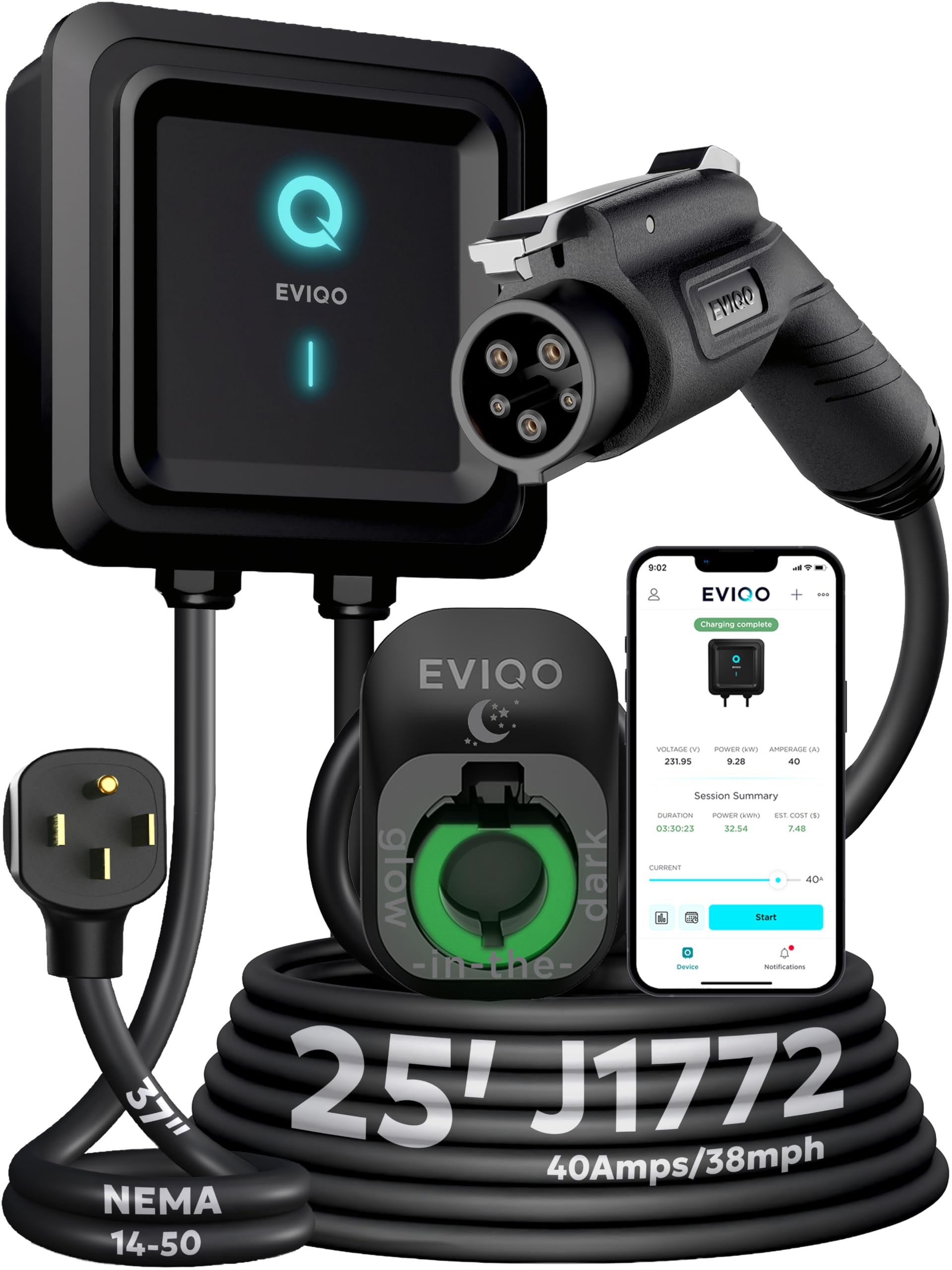
EVIQO 40A NEMA 14-50 Level 2 Charger

This charger suits any J1772-equipped EV owner who wants strong plug-in performance without hiring an electrician for hardwiring.
Pros
- Plugs into a NEMA 14-50 outlet for 40A output, no hardwiring required
- IP66/NEMA 4 weatherproof housing for indoor or outdoor mounting
- Glow-in-the-dark connector holster for nighttime visibility
Cons
- Requires a dedicated 50A circuit, which some garages may not have
- Not compatible with NACS vehicles without a separate adapter
- WiFi features depend on a 2.4GHz network, which some routers don’t broadcast by default
The 25-foot cable reaches across most garages and driveways, and the app lets owners schedule off-peak charging to lower electricity costs. Independent certification from UL, ETL, and Energy Star backs its safety claims. A side-mounted reset button also avoids the need to cut power at the breaker for routine troubleshooting.
AIMILER 32A Plug-In EV Charger
This charger works well for owners who want adjustable amperage and app control at a lower price point than premium brands.
Pros
- Adjustable output from 16A to 32A to match different circuit breaker sizes
- Built-in leakage protection means no separate GFCI breaker is needed
- Touchscreen display shows amperage, voltage, and charging speed in real time
Cons
- Maximum 32A output is lower than several competitors offering 40A or 48A
- Some owners report the breaker tripping after months of regular use
- WiFi setup requires a 2.4GHz connection, which trips up some first-time users
The 25-foot cable and dual charging modes (plug-and-charge or app-start) give it flexibility for different daily routines. Reviewers charging PHEVs and full EVs alike report consistent performance overnight. The NEMA 4-rated housing holds up outdoors, though direct sun and heavy rain exposure aren’t recommended.
ChargePoint HomeFlex Hardwired Charger
This charger fits households wanting a hardwired installation backed by a large public charging network and long-standing brand support.
Pros
- Adjustable output from 16A to 50A to match a range of circuit sizes
- Access to one of the largest public charging networks for trip planning
- Cold-resistant cable rated for outdoor installation
Cons
- Requires professional hardwiring, adding to upfront installation cost
- App-dependent features need stable WiFi to function fully
- Rated amperage tops out lower than some 48A hardwired competitors
Hardwiring means no outlet or plug to maintain, which suits owners planning a permanent charging setup. The companion app tracks energy use and connects with smart home systems. A 23-foot cable offers solid reach, though it falls a couple feet short of the 25-foot cables common elsewhere in this list.
Emporia 48A NEMA 14-50 Charger
This charger gives plug-in convenience along with the flexibility to convert to hardwired service later.
Pros
- Delivers up to 40A through a NEMA 14-50 plug, or converts to 48A hardwired
- Energy Star certified with broad compatibility across EV brands
- 25-foot cable offers strong reach for garages and driveways
Cons
- Reaching the full 48A rating requires professional hardwiring, not just the plug-in setup
- Needs a 2.4GHz WiFi connection for app features
- Bulkier unit dimensions than some plug-in-only competitors
Owners who might upgrade their electrical service later benefit from a charger that can switch configurations instead of buying new hardware. The J1772 connector covers nearly every EV and PHEV sold in North America. Real-time energy data through the app helps track charging costs over time.
Emporia 48A Hardwired Charger
This version suits owners who already know they want a permanent 48A hardwired setup without the NEMA 14-50 conversion option.
Pros
- Full 48A output through a dedicated hardwired connection
- UL listed and Energy Star certified for safety and efficiency
- 25-foot cable with wall mount and connector holster included
Cons
- Requires professional installation, adding labor cost
- No plug-in option, so it’s a poor fit for renters or those planning to move
- Needs a 2.4GHz WiFi network for app-based scheduling
This model works well for new construction or garage remodels where an electrician is already running dedicated circuits. Charging speed reaches up to 46 miles of range per hour on compatible vehicles. The company’s warranty includes direct customer support for installation questions.
EVIQO NACS 48A Hardwired Charger
This charger is built for Tesla owners and other NACS-equipped EV drivers who want a native plug without relying on an adapter.
Pros
- Built-in NACS connector with a Tesla charge-port release button
- Supports up to 50A with a DIP switch adjustment on a 70A circuit
- IP66/NEMA 4 weatherproof housing for outdoor mounting
Cons
- Requires professional hardwiring on a dedicated 60A (or 70A for 50A mode) circuit
- Non-Tesla J1772 vehicles need a separate NACS-to-J1772 adapter, sold separately
- Higher amperage draw means it needs more electrical panel capacity than 32A or 40A units
Reviewers charging Rivian, Kia, and Cadillac EVs through adapters report reliable results alongside native Tesla charging. The 25-foot cable and glow-in-the-dark holster carry over from EVIQO’s J1772 model. A side reset button and OTA updates simplify long-term maintenance.
Autel 40A NEMA 14-50 Charger
This charger appeals to buyers who want a plug-in unit from a manufacturer with a long history in automotive electronics.
Pros
- Five-minute plug-in setup with a NEMA 14-50 outlet
- RFID start/stop access adds a layer of security against unauthorized use
- NEMA 4X weatherproof rating for outdoor durability
Cons
- Some owners report slow customer service response for troubleshooting
- Amperage tops out at 40A, lower than 48A hardwired competitors
- App interface is functional but not as polished as some rivals
Adjustable output from 16A to 40A lets owners match the charger to their circuit breaker size. The portable design means it can move with the owner to a new home. Scheduled charging through the app helps take advantage of off-peak electricity rates.
bokman Dual-Voltage EV Charger
This charger fits buyers who want both Level 1 and Level 2 charging in one unit without relying on a smartphone app.
Pros
- Includes a NEMA 5-15 adapter for standard 120V outlet charging
- Physical buttons and an LED screen work reliably in cold or wet conditions
- Delay timer (1-12 hours) supports off-peak charging without WiFi
Cons
- Shorter 20-foot cable compared to the 25-foot cables common elsewhere
- No app connectivity for remote monitoring or scheduling
- Maximum 32A output is lower than several hardwired competitors
The IP65 rating and wide temperature tolerance (-22°F to 130°F) suit owners in extreme climates. Tactile buttons stay responsive with gloves on, a practical detail for winter charging. This model works well as a backup or travel charger alongside a primary home unit.
AIMILER 48A EV Charger
This charger suits owners with larger-battery EVs who need the fastest realistic home charging speed available without commercial equipment.
Pros
- Delivers up to 48A output for up to 46 miles of range per hour
- Adjustable amperage from 24A to 48A to match different circuit sizes
- 25-foot cable with a sturdy connector rated for over 10,000 charge cycles
Cons
- Requires a 60A circuit breaker for full 48A output, a significant electrical upgrade for some homes
- NEMA 4 weatherproofing isn’t rated for direct sun or heavy rain exposure
- J1772 connector needs a separate adapter for Tesla and other NACS vehicles
Reviewers charging trucks and SUVs with larger battery packs report consistent, fast overnight charging. The touchscreen display and app both allow amperage adjustments, giving flexibility depending on available circuit capacity. Installation typically requires an electrician familiar with 6-AWG wiring for the full-rated output.
Lectron 40A Portable Charger
This charger works best for owners who want a compact, travel-friendly Level 2 charger for use at multiple locations.
Pros
- Compact and portable design suited to travel or multi-property use
- FCC and ETL certified with IP65 dust and water resistance
- NEMA 14-50 plug delivers a full 9.6kW charging rate at 40A
Cons
- 16-foot cable is notably shorter than the 25-foot standard seen elsewhere
- Two-year warranty is shorter than the three-year terms common in this category
- No native Tesla compatibility without a separate adapter
The shorter cable trades some reach for a more compact, easier-to-store package. It works well for owners who charge at a second home or a relative’s garage during visits. Overvoltage, overcurrent, and short-circuit protections match the safety features found in higher-priced competitors.
Level 2 EV Chargers Buying Guide
Match the Charger to the Vehicle’s Connector
J1772 is the standard connector for nearly all non-Tesla EVs and plug-in hybrids sold in the US. NACS, the Tesla-style connector, now appears on some non-Tesla EVs as automakers adopt the standard. Confirm the vehicle’s port type before buying, since an adapter adds cost and a small amount of charging inefficiency.
Understand Amperage and Circuit Requirements
The charger’s amperage rating only matters if the home’s electrical circuit can support it. A 48A charger needs a 60A dedicated circuit; a 40A charger needs a 50A circuit. Check the home’s electrical panel capacity, and consult a licensed electrician before assuming a higher-amperage charger will work.
| Charger Amperage | Typical Circuit Needed | Approx. Miles of Range per Hour* |
|---|---|---|
| 16A-24A | 20A-30A | 10-20 |
| 32A | 40A | 20-25 |
| 40A | 50A | 25-35 |
| 48A | 60A | 35-46 |
*Actual range added per hour varies by vehicle battery size and onboard charger capacity.
Plug-In vs. Hardwired Installation
A NEMA 14-50 plug-in charger installs into an existing outlet in minutes and can move with the owner if they relocate. A hardwired charger connects directly to the electrical panel, supports higher amperage in some models, and suits owners who won’t move the unit again. Renters and apartment dwellers typically benefit more from plug-in units.
Cable Length and Placement
A 25-foot cable reaches most garage and driveway configurations, while 16- to 20-foot cables suit tighter spaces or a charger mounted close to the parking spot. Measure the distance from the planned mounting location to the vehicle’s charging port before choosing a shorter cable.
Weather Resistance for Outdoor Installs
Outdoor chargers need a rating like IP65, IP66, or NEMA 4 to handle rain, snow, and temperature swings. IP66 and NEMA 4 offer stronger protection against water intrusion than IP65. Chargers mounted under an eave or overhang last longer regardless of rating, since direct sun and standing water still stress the housing over time.
Smart Features and App Control
App-connected chargers allow charging schedules, energy tracking, and remote start or stop, but they require a 2.4GHz WiFi connection since most units don’t support 5GHz networks. Charging schedules help shift energy use to off-peak hours, which lowers the electric bill in areas with time-of-use rates. Models with physical buttons and an LED screen work as reliable backups when WiFi drops or during a router outage.