
A dead battery on a passenger car is an inconvenience. A dead battery on a service truck, a diesel pickup, or a piece of fleet equipment is a lost workday. Best Heavy Duty Jump Starters exist to close that gap fast, delivering enough peak amperage to turn over large engines without waiting on roadside assistance or another vehicle for a jump.
These units fall into two broad camps: compact lithium power banks that handle most consumer trucks and SUVs, and larger lead-acid or industrial lithium boxes built for diesel engines, 24-volt systems, and repeated daily use. The right choice depends less on the biggest peak-amp number on the box and more on matching the starter’s output, voltage support, and battery type to the engines it needs to start. Weight and portability also matter, since a 40-pound unit that lives in a service van works differently than a 3-pound pack meant for a glovebox.
Buyers should pay attention to peak amps versus real cranking amps, 12V-only versus 12/24V support, battery chemistry (lithium versus AGM lead-acid), and any extras like air compressors or AC inverters that add utility but also weight. The five jump starters below cover different jobs, from daily passenger car use to full commercial fleet recovery.
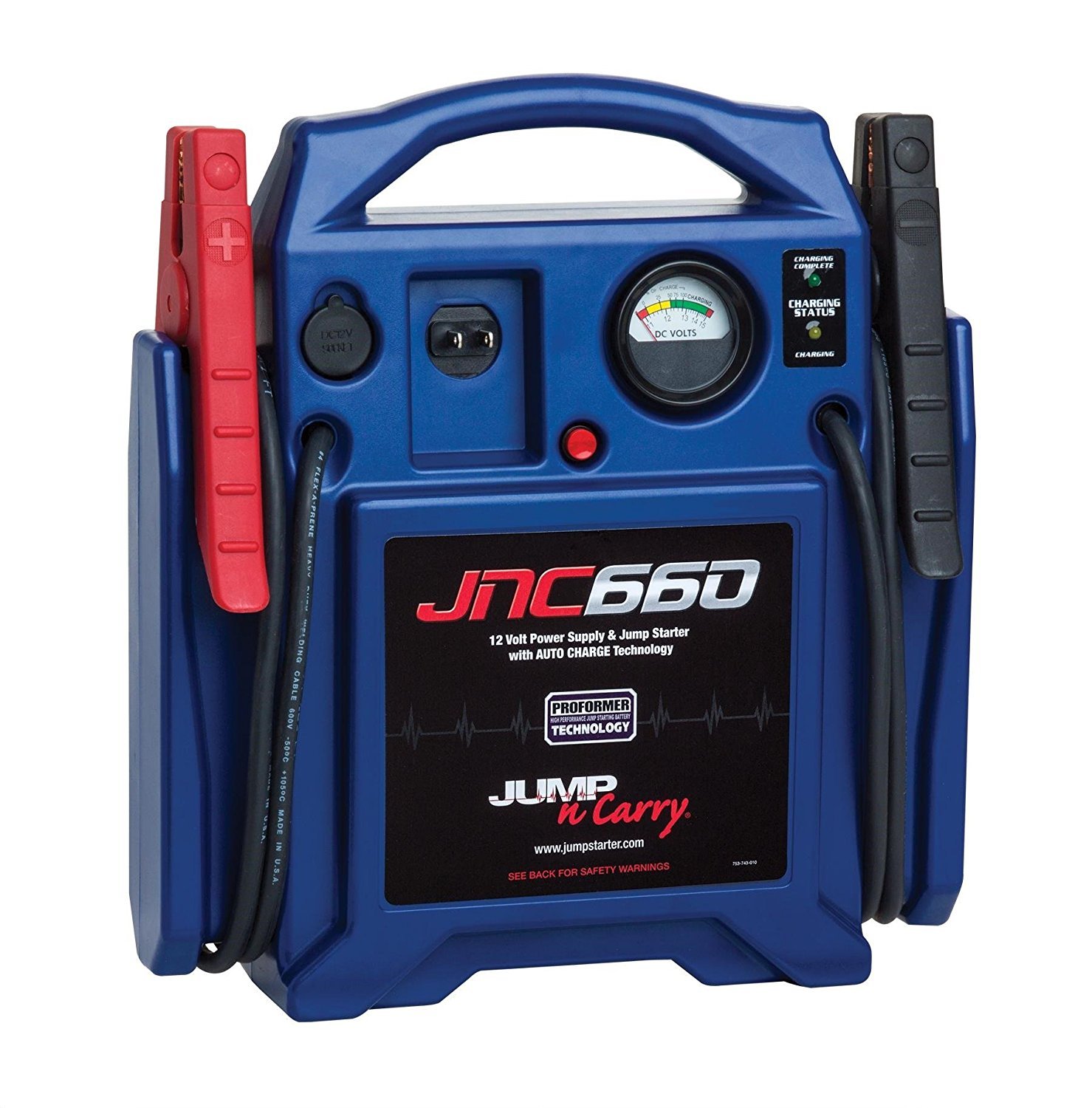
Best for AGM lead-acid reliability: Clore Automotive Jump-N-Carry JNC660
Best for compact lithium portability: WOLFBOX 4000A Jump Starter MV24
Best for maximum engine size and commercial fleets: NOCO Boost Max GB250
Best for integrated air inflation: DEWALT DXAEPS14
Best for 12/24V fleet and industrial equipment: Clore Automotive Jump-N-Carry JNC1224
Clore Automotive Jump-N-Carry JNC660

This is a solid pick for drivers and shops who want a proven, no-frills jump starter built on a large AGM battery instead of lithium cells.
Pros
- Large 22Ah AGM battery designed specifically for jump starting
- Thick 46-inch #2 AWG cables handle high current with less voltage drop
- Long track record with strong buyer satisfaction
Cons
- Heavier than lithium alternatives at 18 pounds
- No USB charging or app features
- 12V only, no support for 24V systems
The JNC660 skips modern extras and focuses on core jump-starting performance. Its onboard voltmeter shows battery charge status at a glance, and the AGM battery type tolerates repeated deep discharges better than many lithium packs designed for occasional use. It suits shops, fleets, and drivers who want a dependable unit that stays ready in a truck bed or garage without worrying about frequent recharging cycles.
WOLFBOX 4000A Jump Starter MV24
This lithium jump starter fits drivers who want strong peak output in a pack small enough to store in a glovebox or backpack.
Pros
- Weighs about 3 pounds, far lighter than lead-acid units
- 65W USB-C fast charging recharges the unit in roughly 1.3 hours
- Doubles as a power bank and flashlight with SOS mode
Cons
- Rated for engines up to 10 liters, smaller than industrial units
- 12V only, no 24V mode for commercial trucks
- Lower total battery capacity than larger lead-acid boxes
The MV24 trades raw capacity for convenience. Its lithium cell delivers 4000 peak amps in a housing that fits in a door pocket, and the LCD display gives a clear read on charge level and connection status. It works well for passenger cars, pickups, and boats, though drivers running larger diesel equipment should look at a unit rated for bigger engines.
NOCO Boost Max GB250
This is the strongest option here for anyone starting large diesel engines, including semi trucks and heavy equipment, on a regular basis.
Pros
- Rated for gas and diesel engines up to 16 liters
- Reviewers report success jumping semi trucks and tractors at very low voltage
- UltraSafe spark-proof and reverse-polarity protection for safer connections
Cons
- Significantly more expensive than consumer-grade jump starters
- At nearly 15 pounds and a larger footprint, less pocketable than compact packs
- A few buyers report inconsistent results on the largest engines
Mechanics and fleet operators describe the GB250 jumping trucks and tractors even when batteries read near zero volts. Its lithium pack recharges in about 4 hours with the included 56W adapter, and the built-in power bank and 600-lumen flashlight add roadside utility. It is priced and built for commercial use, not occasional passenger-car jumps.
DEWALT DXAEPS14
This pick suits drivers who want one device that jumps a battery, airs up a tire, and powers small electronics.
Pros
- Built-in 120 PSI digital air compressor with auto shutoff
- 500W AC inverter powers small electronics directly
- LCD display shows battery, voltage, and pressure readings clearly
Cons
- Air compressor works slowly on larger tires
- Rated for 4, 6, and 8-cylinder engines, not heavy diesel equipment
- A few buyers report reliability issues after light use
The DXAEPS14 packs a jump starter, air inflator, inverter, and USB charging into one 17-pound unit. Reviewers say the jump function starts most car and truck engines reliably, though the compressor takes longer on bigger tires. It works well as an all-in-one emergency kit for a trunk or truck bed rather than a dedicated heavy-duty starter for large diesel engines.
Clore Automotive Jump-N-Carry JNC1224
This unit is built for fleets and shops that service both 12V and 24V equipment from a single jump starter.
Pros
- Switches between 3400 peak amps at 12V and 1700 peak amps at 24V
- Built-in automatic charger allows continuous plug-in maintenance
- Industrial-grade clamps built for repeated daily use
Cons
- Weighs 40 pounds, making it a two-hand lift
- Costs more than single-voltage jump starters
- Overkill for drivers who only need occasional passenger-car jumps
The JNC1224 stands apart by supporting 24V systems found in larger commercial trucks and equipment alongside standard 12V vehicles. Its automatic charger stays connected to wall power without risk of overcharging, so it stays ready between uses. The tradeoff is bulk and weight, which makes sense for a service bay or fleet vehicle but less sense for a car owner who jumps a battery once or twice a year.
Best Heavy Duty Jump Starters Buying Guide
Peak Amps Versus Real Starting Power
Peak amp ratings show the maximum burst a jump starter can deliver for a fraction of a second, not what it sustains during a full crank. A rating of 2,000 peak amps does not mean the unit pushes that current the entire time it takes to start an engine.
Cranking amps and cold cranking amps (CCA) ratings on the vehicle’s own battery give a better sense of what’s needed. Matching a jump starter’s peak amp rating to at least the vehicle battery’s CCA rating, with some buffer for cold weather, gives a more realistic performance expectation than the peak number alone.
Battery Chemistry: Lithium Versus Lead-Acid
| Feature | Lithium | AGM Lead-Acid |
|---|---|---|
| Weight | 2 to 5 pounds typical | 15 to 40 pounds typical |
| Recharge time | 1 to 4 hours | 4 to 24 hours |
| Storage without charging | Loses charge slowly | Loses charge faster, needs maintenance |
| Best use case | Occasional use, portability | Daily professional use, extreme cold |
Lithium packs suit drivers who want a small, light unit for occasional emergencies. Lead-acid units hold up better under daily professional use and tend to perform more consistently in very cold temperatures.
Voltage Support: 12V Versus 12/24V
Most passenger cars, pickups, and SUVs run on 12V electrical systems. Larger commercial trucks, buses, and heavy equipment often use 24V systems built from two 12V batteries in series.
A jump starter built only for 12V cannot safely start a 24V vehicle. Fleet operators and drivers who service mixed equipment need a unit with a dedicated 24V mode, not just a 12V unit used twice.
Engine Size Ratings
Manufacturers list a maximum engine displacement, in liters, that a jump starter can reliably start. This number reflects the compression and current draw of larger engines, especially diesels, which need more sustained current than a small gas engine.
A unit rated for a 6-liter engine may struggle with a 10-liter diesel, even if the peak amp number looks similar on paper. Checking the engine size rating against the largest vehicle a buyer plans to start matters more than comparing peak amps between models.
Extra Features Worth Considering
- Air compressors add tire-inflation ability but increase weight and bulk.
- AC inverters let the unit power small appliances or tools directly.
- USB ports charge phones and small electronics during a roadside wait.
- LED flashlights with SOS or strobe modes add visibility during nighttime repairs.
Weight and Portability
A unit that lives in a service van can weigh more without causing problems. A jump starter meant for a glovebox or backpack benefits from a lighter lithium build, even if it sacrifices some raw capacity compared to a larger lead-acid box.