
A dead battery rarely picks a convenient moment. It happens in cold parking lots, on rural roads, or right before a work shift, and the fix used to mean flagging down a stranger with cables. Best Portable Car Battery Jump Starters changed that by putting a rechargeable power source in the trunk or glovebox, ready to bring a car back to life without help from anyone else.
Lithium jump starters have mostly replaced the old lead-acid boxes, though both styles still have a place. Compact lithium units pack real starting power into something the size of a paperback book, while larger lead-acid and hybrid models trade portability for extra durability and higher sustained output. Some newer options add tire inflators, LCD screens, and fast-charging ports, turning a single-purpose tool into a small emergency kit.
Choosing the right one means looking past the peak-amp number on the box. Engine size compatibility, cable quality, weight, recharge time, and safety protections matter more for real-world reliability than any marketing figure. A 4000A rating means little if the clamps are flimsy or the unit can’t handle a truck-sized diesel engine. The picks below cover a range of vehicles, budgets, and use cases, from daily commuter cars to trucks, fleets, and off-road rigs.
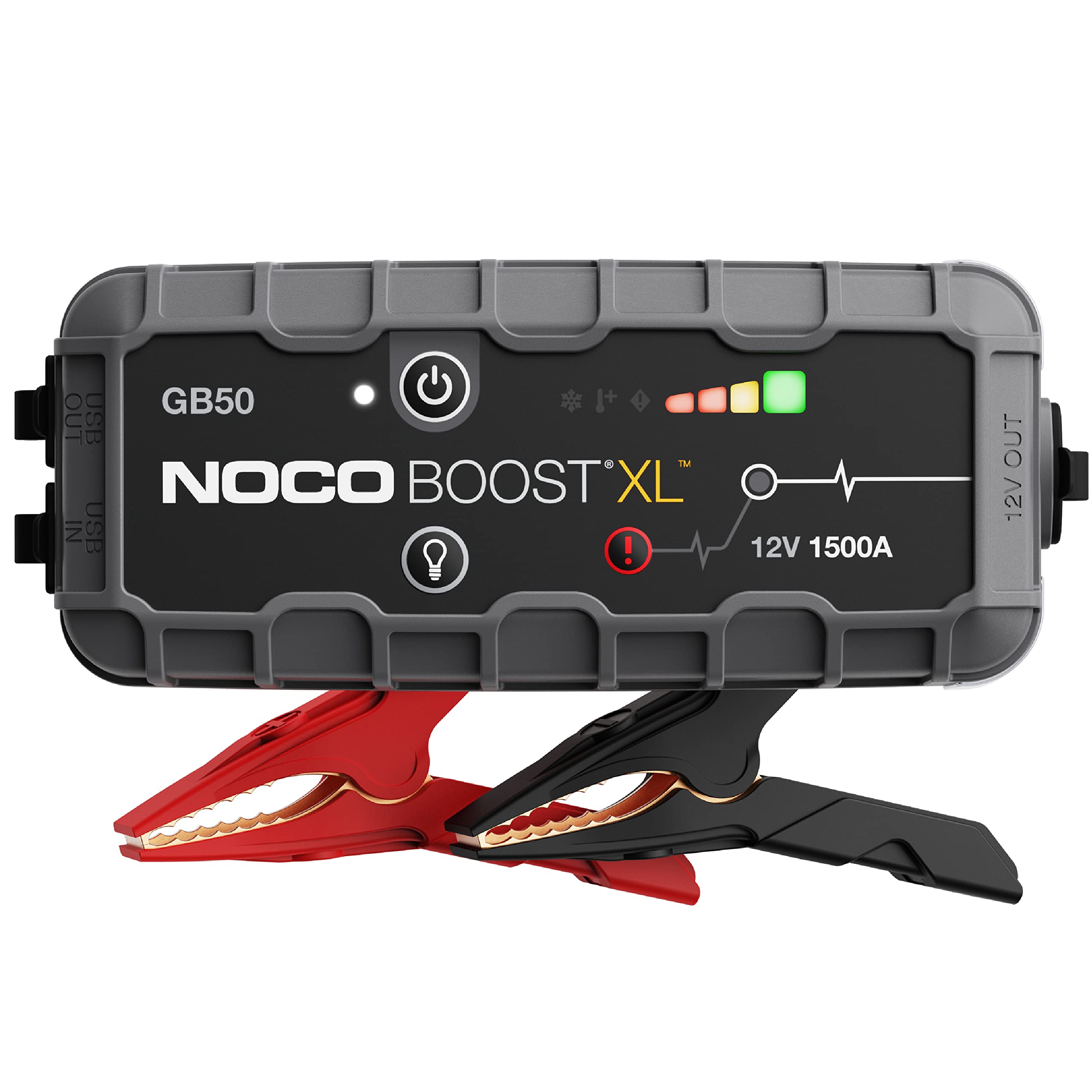
Best for compact glovebox storage: NOCO Boost GB50
Best for heavy-duty fleet and shop use: Clore Automotive Jump-N-Carry JNC660
Best for large trucks and diesel engines: Hulkman Alpha85
Best for lightweight everyday carry: S ZEVZO ET03
Best for fast recharging on the go: WOLFBOX MV24
Best for roadside tire emergencies: Joltekon 4500A with Air Compressor
Best for budget-conscious drivers: GOOLOO GP4000
Best for all-in-one emergency kits: Joltekon 6000A with Air Compressor
Best Portable Car Battery Jump Starters
NOCO Boost GB50

The NOCO Boost GB50 suits drivers who want a small, trustworthy jump starter that lives in the glovebox without taking up space.
Pros
- Compact 2.7-pound build fits almost anywhere
- Spark-proof clamps with reverse polarity protection
- Doubles as a phone charger and flashlight
Cons
- 1500A peak rating trails larger units
- Limited to smaller gas and diesel engines
- No LCD screen for battery status
Rated for engines up to 7.0L gas and 4.5L diesel, the GB50 covers most sedans, SUVs, and light trucks without issue. It won’t be the right pick for larger diesel pickups or commercial vehicles. The IP65-rated housing shrugs off rain and dust, and the built-in flashlight with SOS mode adds real value during roadside breakdowns. For everyday drivers, this is an easy one to trust.
Clore Automotive Jump-N-Carry JNC660
The JNC660 is built for shops, fleets, and drivers who want a jump starter that can handle repeated daily use without wearing out.
Pros
- Heavy-duty 22Ah lead-acid battery holds up to frequent use
- Thick 46-inch cables reach awkward battery placements
- Built-in voltmeter shows charge status at a glance
Cons
- Weighs 18 pounds, far heavier than lithium options
- No USB charging or power bank function
- Bulkier size makes storage harder in smaller cars
This is not a glovebox item. It’s a shop or truck-bed tool, the kind mechanics and fleet managers keep charged and ready for repeated jump starts across a workday. The lead-acid battery inside doesn’t match lithium units for weight, but it holds up to heavy cycling better over time. Drivers who jump-start vehicles often, rather than occasionally, get more mileage out of this design.
Hulkman Alpha85
The Hulkman Alpha85 works best for owners of larger trucks and diesel vehicles who need a jump starter with real reserve power.
Pros
- Rated for engines up to 8.5L gas and 6.0L diesel
- 3.3-inch smart display simplifies operation
- Fast 65W charging gets it to 80% in about an hour
Cons
- Heavier and larger than compact lithium models
- Higher price point than basic jump starters
- Extra features add complexity for occasional users
At 4.5 pounds, the Alpha85 sits between compact boosters and full-size units. The screen walks users through connection steps, which helps anyone unfamiliar with jump-starting a car. Its DC and USB-C outputs also power small air pumps or fridges, making it useful for road trips beyond emergency starts. Diesel truck owners in particular get real benefit from its higher engine-size ceiling.
S ZEVZO ET03
The S ZEVZO ET03 fits drivers who want a slim, lightweight jump starter that still claims a high peak-amp rating.
Pros
- Weighs just 1.4 pounds, one of the lightest on this list
- LCD screen displays battery status clearly
- Force-start function helps with fully drained batteries
Cons
- Claimed 4000A peak amp figure deserves skepticism relative to its size
- Only two USB output ports, no USB-C fast charging
- Slim clamps may feel less rugged for heavy-duty jobs
Peak-amp numbers on ultra-light jump starters like this one often outpace what the internal battery can sustain in practice. That said, the ET03’s 74Wh capacity and dual USB ports make it a solid everyday carry option for smaller vehicles. Its slim, rectangular shape slides easily into a door pocket or bag, which matters more than the headline number for most daily drivers.
WOLFBOX MV24
The WOLFBOX MV24 stands out for drivers who want quick recharging alongside solid jump-starting power.
Pros
- 65W USB-C charging refills the unit in about 1.3 hours
- LCD display shows clear status information
- One-touch boost mode helps with low-voltage batteries
Cons
- IP64 rating is lower than some competitors’ IP65
- Compatible vehicle list on the spec sheet is limited to passenger cars
- Advertised 10L diesel rating should be treated cautiously at this size and weight
Recharge speed is the MV24’s strongest asset. Many jump starters take several hours to refill, but this one gets back to a useful charge level fast enough to use again the same day. The claimed 10L diesel compatibility is optimistic for a 3-pound device, so buyers with large diesel trucks should look at heavier-duty options instead.
Joltekon 4500A with Air Compressor
This Joltekon model earns its spot for drivers who want a jump starter and tire inflator combined into one roadside kit.
Pros
- Built-in 150PSI air compressor with auto-shutoff
- Smart display shows both jump starter and inflator status
- Bright 500-lumen light includes SOS and strobe modes
Cons
- Adding a compressor increases size and weight versus jump-only units
- 150PSI rating applies to the compressor, not the jump starter’s output
- More moving parts means more that can eventually wear out
Combining a jump starter with a tire inflator solves two common roadside problems with one device. The auto-shutoff feature on the compressor prevents overinflation, a nice touch for drivers unfamiliar with checking PSI manually. This is a heavier, bulkier tool than a standalone booster, but for road-trippers who want fewer separate gadgets, that trade-off makes sense.
GOOLOO GP4000
The GOOLOO GP4000 offers a reliable, no-frills jump starter for drivers who want dependable performance without paying for extra features.
Pros
- Wide vehicle compatibility, including ATVs and snowmobiles
- Metal clamps built for repeated use
- Performs in cold weather down to -4°F
Cons
- No LCD screen for battery status
- Larger and heavier than some ultra-compact competitors
- 4000A peak rating should be read as a ceiling, not a guarantee, for every listed engine size
Owners who have used the GP4000 for years report consistent results across seasons, including cold winter mornings when batteries struggle most. The metal clamp construction feels sturdier than the plastic-heavy clamps on some rivals. It skips a digital display, so users rely on light indicators instead, which works fine but offers less detail than screen-equipped models.
Joltekon 6000A with Air Compressor
This higher-capacity Joltekon model suits drivers who want the most complete emergency kit on this list, tire inflation included.
Pros
- 45L/min compressor inflates tires quickly with 5 nozzle options
- High claimed efficiency rating for its charging circuitry
- Detachable air hose reaches tricky valve stems
Cons
- 6000A peak rating is a marketing figure that exceeds what most car batteries need
- Larger footprint than jump-only alternatives
- Premium features come with a higher price than basic units
The inflator here is the real standout, with a detachable hose and multiple nozzle types that handle bikes, balls, and mattresses alongside car tires. The 6000A peak-amp claim sounds impressive, but no passenger vehicle battery requires that much current; it reflects the unit’s ceiling, not typical use. Buyers should choose this for the combined toolset, not the amperage number on the box.
Buying Guide
Peak Amps Are Not the Whole Story
Peak amperage numbers get bigger every year, but a battery only needs enough current to turn over the engine. Most passenger cars require 400 to 600 amps; trucks and diesels need more.
A jump starter rated at 4000A or 6000A is not four to six times more effective than a 1000A model for a compact sedan. These figures often describe a brief burst the unit can theoretically produce, not sustained real-world output. Engine size compatibility listed by the manufacturer is a more reliable guide than the peak-amp figure alone.
Match the Jump Starter to the Engine
| Vehicle Type | Typical Need | Look For |
|---|---|---|
| Compact car, sedan | Light duty | 1000-1500A, small/compact unit |
| SUV, minivan | Moderate duty | 1500-2000A |
| Pickup truck, gas | Moderate-high duty | 2000-3000A |
| Diesel truck, large SUV | High duty | 3000A+, diesel-rated clamps |
Portability vs. Durability
Lithium units under 3 pounds fit in a glovebox or backpack easily. Lead-acid boosters weigh more but tend to handle repeated daily use in shops or fleets better over years of service.
Consider how often the jump starter will be used and where it needs to live. A device that never leaves a car trunk can afford to be heavier if it lasts longer.
Safety Features Worth Checking
- Reverse polarity protection: prevents damage if clamps are connected backward
- Spark-proof clamps: reduce risk of sparks near a battery
- Reverse-hookup alerts: audio or light warnings for incorrect connections
Extra Features That Add Value
Some jump starters double as power banks, flashlights, or tire inflators. These extras help in different situations:
- A power bank function charges phones during long waits for roadside help
- An LED flashlight with SOS mode improves visibility at night
- A built-in air compressor handles low tires without a separate tool
Recharge Time and Storage
Jump starters lose charge slowly over months in storage. Look for a unit with a stated standby time of a year or longer, and recharge every few months regardless of use.
Fast-charging models refill in one to two hours, while basic models can take four to five hours. Drivers who use their jump starter often should weigh recharge speed alongside starting power when deciding.