
A dead Car Battery Portable Jumper rarely picks a convenient moment. It happens in a parking garage before a meeting, at a trailhead miles from cell service, or in a driveway on a cold morning when the engine won’t turn over. A portable jump starter solves that problem without needing a second car, a set of cables, and a stranger willing to help. These compact battery packs use lithium or AGM cells to deliver a jolt of power straight to a dead battery, getting an engine running again in seconds.
The technology behind these devices has improved considerably. Older jump starters relied on heavy lead-acid batteries and offered little protection against incorrect hookups. Current models use lithium-ion cells, weigh a fraction as much, and include safety features like reverse polarity protection and spark-proof clamps that prevent damage from a wrong connection. Many now double as phone chargers and flashlights, which adds real value for roadside emergencies at night.
Choosing the right one comes down to matching the unit to the vehicle and the situation. Peak amperage numbers get most of the attention, but engine size, cable quality, safety certifications, and extra features like air compressors or LCD displays often matter more for real-world reliability. A compact sedan owner needs something very different from a diesel truck owner or someone who tows a boat. The list below breaks down ten portable jump starters, covering everyday commuter cars, larger diesel engines, motorcycles, and roadside kits that combine jump-starting with tire inflation.
Best for compact everyday cars: NOCO Boost GB50
Best for heavy-duty and commercial use: Clore Automotive Jump-N-Carry JNC660
Best for small cars and motorcycles: NOCO Boost GB20
Best for fast device charging on the go: WOLFBOX MegaVolt24
Best for large diesel trucks: OXILAM 6000A Jump Starter
Best for lightweight portability: S ZEVZO ET03
Best budget-friendly option: AstroAI S8
Best for roadside tire emergencies: WOLFBOX MV24A with Air Compressor
Best all-in-one roadside kit: Joltekon 6000A with 150PSI Compressor
Best for RVs and larger vehicles: Powrun P-ONE
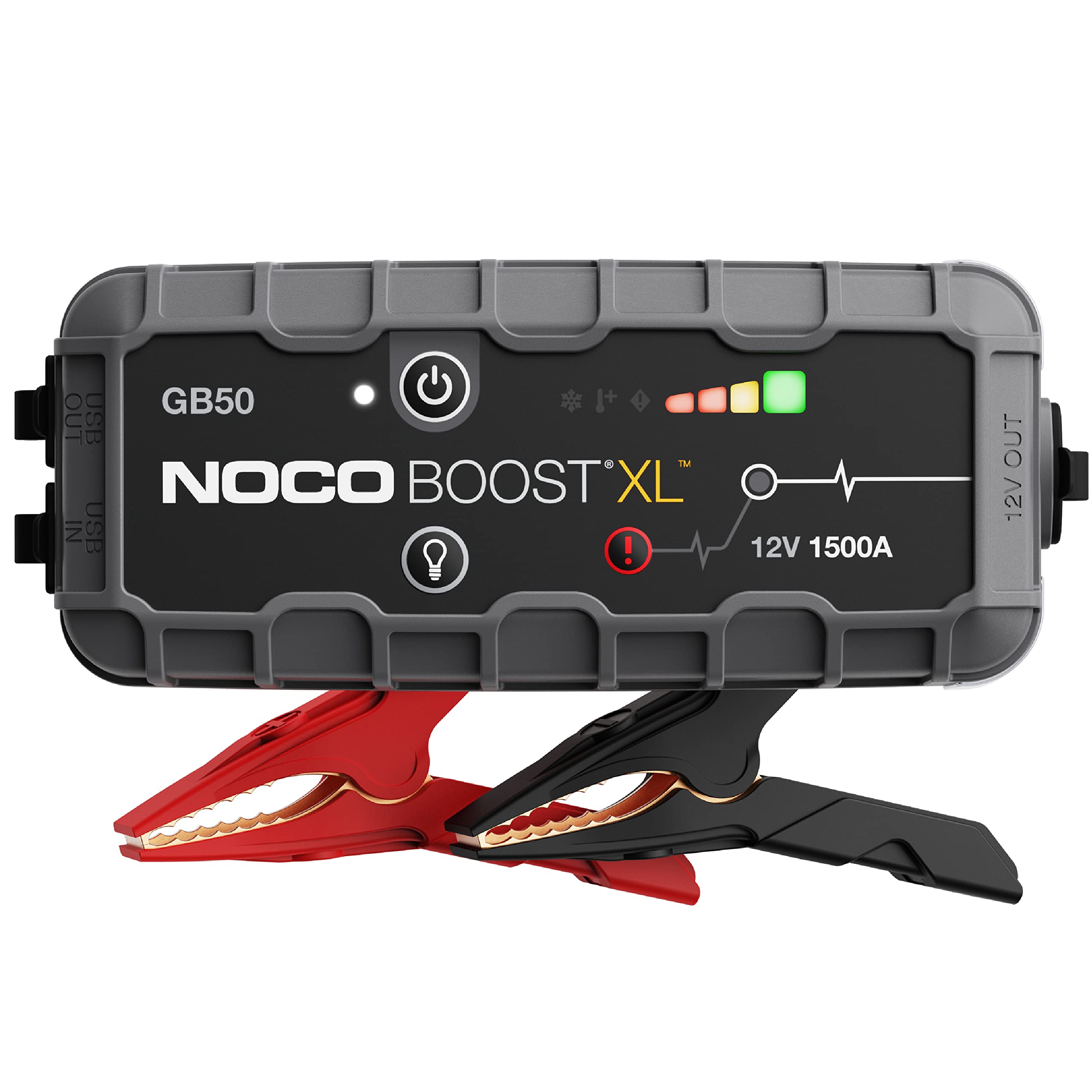
NOCO Boost GB50 1500A UltraSafe Jump Starter

The GB50 suits drivers who want a dependable, glovebox-friendly jump starter that can still handle larger gas and diesel engines.
Pros
- Rated for gas engines up to 7.0L and diesel up to 4.5L
- Spark-proof clamps with reverse polarity protection
- Rugged IP65 housing rated for water and dust resistance
Cons
- No LCD screen for battery status
- Higher price point than basic lithium units
- Cables are shorter than heavy-duty clamp-style starters
At 2.7 pounds, the GB50 fits easily into a trunk or glovebox while still delivering up to 1500 peak amps, enough for SUVs, vans, and light trucks. The UltraSafe technology removes the guesswork from clamp placement, an important detail for drivers who aren’t comfortable with electrical work. Its 200-lumen flashlight with SOS mode adds real value during nighttime breakdowns, and the USB-C power bank function means a dead phone doesn’t have to become a second problem during a roadside wait.
Clore Automotive Jump-N-Carry JNC660
This is the right choice for shops, fleets, or anyone who needs a jump starter that can be used dozens of times a week without recharging concerns.
Pros
- 22Ah AGM battery built for repeated heavy use
- 1700 peak amps with thick 2 AWG cables
- Built-in voltmeter shows charge status at a glance
Cons
- Weighs 18 pounds, far heavier than lithium models
- Bulky dimensions make trunk storage harder
- No USB charging or flashlight features
The JNC660 trades portability for durability and raw power. Its lead-acid AGM battery holds up to frequent use better than lithium packs designed for occasional emergencies, which is why it shows up often in repair shops and commercial fleets. The DC outlet lets it power 12V accessories beyond just jump-starting, and the voltmeter takes the guesswork out of knowing when to recharge. Drivers who want a lightweight glovebox option should look elsewhere, but anyone who jumps vehicles regularly will appreciate its staying power.
NOCO Boost GB20 500A UltraSafe Jump Starter
The GB20 works best for small sedans, motorcycles, and ATVs where a compact size matters more than diesel truck capability.
Pros
- Compact 2.4 lb design fits in a small bag or under a seat
- Same spark-proof, reverse-polarity protection as larger NOCO models
- Recharges in about 3 hours
Cons
- Limited to 4.0L gas engines only, no diesel rating
- Lower peak amperage than most competitors on this list
- Flashlight is dimmer at 100 lumens
Owners of compact cars, motorcycles, and small ATVs often don’t need 4000 peak amps sitting in their trunk. The GB20 scales the same safety technology found in NOCO’s larger units down to a smaller, lighter package. Reviewers frequently mention using it for boats, lawn tractors, and vehicles that sit unused for weeks at a time. It’s not built for diesel trucks or larger SUVs, but for its intended use case, it performs reliably and charges back up quickly between uses.
WOLFBOX MegaVolt24 4000A Jump Starter
This model suits drivers who want fast charging for both the jump starter itself and their devices, alongside a clear LCD readout.
Pros
- 65W USB-C fast charging recharges the unit in about 1.3 hours
- LCD display shows battery status and charge level clearly
- Rated for 10L gas and 10L diesel engines
Cons
- IP64 rating is lower than some fully waterproof competitors
- No air compressor, unlike the WOLFBOX MV24A variant
- Larger dimensions than ultra-compact NOCO models
The MegaVolt24 stands out for charging speed. A 65W PD charger brings it back to full power in under two hours, which matters for drivers who forget to recharge between trips. The LCD screen removes ambiguity about remaining charge, a feature missing from simpler indicator-light designs. Its 88.8Wh battery capacity supports both large gas and diesel engines, making it a reasonable fit for trucks as well as everyday cars.
OXILAM 6000A Jump Starter
Owners of large diesel trucks, RVs, or commercial vehicles get the most from this jump starter’s high peak-current rating and diesel capacity.
Pros
- Rated for all gas engines and diesel engines up to 12L
- 10 built-in safety protections against short circuits and overheating
- Bright 800-lumen flashlight with three light modes
Cons
- Peak-amp claims are hard to independently verify against smaller units
- Bulkier than compact commuter-focused jump starters
- Type-C input charging speed varies by charger used
Diesel engines need more cranking power than gas engines of similar size, and the OXILAM’s 12L diesel rating puts it near the top of this list for heavy-duty use. Its LED display gives a clear read on remaining charge, useful for anyone who relies on it across multiple vehicles. Reviewers note it holds up well for vans and trucks that smaller units struggle to start. Buyers should treat peak-amp figures as one data point among several rather than the deciding factor.
S ZEVZO ET03 Car Jump Starter
This jump starter fits drivers who want strong diesel capability in a package light enough to toss in a backpack or glovebox.
Pros
- Weighs just 1.4 pounds despite 8.0L gas / 7.0L diesel rating
- Force-start function assists with fully drained 0V batteries
- 500-lumen flashlight with stable, strobe, and SOS modes
Cons
- Smaller cable length than heavy-duty clamp models
- Two-year warranty is shorter than some competitors’ coverage
- LCD screen is basic compared to premium displays
The ET03 packs a surprising amount of capability into a slim, lightweight housing. Its force-start feature is designed specifically for batteries that have dropped to zero volts, a scenario where some jump starters refuse to engage at all. Ten safety protections, including short-circuit and reverse polarity detection, back up its everyday use. For drivers who want diesel-truck capability without carrying something bulky, this is one of the lighter options available.
AstroAI S8 Car Battery Jump Starter
This is a solid pick for drivers who want basic jump-starting coverage for everyday cars without paying for extra features.
Pros
- Smart boost mode auto-detects low voltage batteries
- Compact at under one pound
- Eight built-in safety protections
Cons
- Rated only up to 6.0L gas and 3.0L diesel
- Lower average rating than other models on this list
- Metal clamps are smaller than heavy-duty alternatives
The S8’s boost mode automatically senses when a battery has dropped below 9 volts and unlocks a dedicated button to push through the start. That’s a helpful safeguard for batteries that have sat dead for a while. Its size and weight make it easy to keep in a glovebox permanently. It’s better suited to sedans, small SUVs, and smaller diesel engines than to full-size trucks or vans.
WOLFBOX MV24A with Air Compressor
Drivers who want jump-starting and tire inflation in a single tool will get the most value from this combination unit.
Pros
- Built-in 160PSI air compressor inflates a truck tire in about 2.5 minutes
- 4000A peak current for 10L gas or diesel engines
- 65W fast charging with USB-C and USB-A output
Cons
- Heavier at 5.3 pounds due to the added compressor
- Charging adapter sold separately
- Larger footprint than jump-starter-only models
Combining a tire inflator with a jump starter cuts down on the number of tools a driver needs to keep in the trunk. The 45-liter-per-minute compressor handles everything from bike tires to full-size truck tires in a few minutes. Its 400-lumen flashlight and multiple safety protections round out a kit built for roadside self-sufficiency. The added weight and bulk are the tradeoff for that versatility.
Joltekon 6000A with 150PSI Air Compressor
This all-in-one kit is built for drivers who prioritize complete roadside preparedness over a minimalist glovebox footprint.
Pros
- Auto-shutoff tire inflator with pressure memory and five nozzle types
- Rated for all gas engines and diesel up to 10L
- V0 fire-retardant materials with 10 safety protections
Cons
- Newer product with a smaller review history than established brands
- 37Wh capacity is modest compared to some jump-only competitors
- Detachable air hose adds another part to keep track of
The auto-shutoff inflator sets this apart from compressors that require manual monitoring. Its pressure memory function stops inflation at the target PSI automatically, useful for drivers who don’t want to check a gauge repeatedly. The jump-starting side handles diesel engines up to 10L, covering most trucks and vans. Between the compressor, flashlight, and charging ports, it functions as a fairly complete emergency kit in one unit.
Powrun P-ONE Jump Starter
The P-ONE is a practical choice for RV owners and drivers of larger vehicles who need diesel capability without an air compressor attached.
Pros
- Rated for 8.0L gas and 6.5L diesel engines
- LCD screen shows battery status clearly
- IP65 waterproof and dustproof housing
Cons
- No air compressor or tire inflation feature
- Boost button required for very low voltage starts
- Cables shorter than dedicated heavy-duty starters
At 1.5 pounds, the P-ONE punches above its weight for diesel and larger gas engines. The dedicated boost button engages when battery voltage drops below the normal threshold, giving it a fighting chance with batteries that have sat dead for days. Its EVA storage case keeps cables and cords organized, a small but useful detail for glovebox storage. Drivers who also want tire inflation should consider one of the compressor-equipped options instead.
Car Battery Portable Jumper Buying Guide
Match Peak Amps to Engine Size, Not Just the Biggest Number
Peak amperage gets marketed heavily, but it tells only part of the story. A jump starter’s amp rating needs to match the engine’s cold cranking amp (CCA) requirement, which varies by engine size and fuel type.
Diesel engines generally require more cranking power than gas engines of similar displacement because of higher compression ratios. A jump starter rated for a 4.0L gas engine won’t necessarily handle a 3.0L diesel, even though the numbers look similar on paper.
| Vehicle Type | Typical Engine Size | Suggested Peak Amp Range |
|---|---|---|
| Motorcycle, ATV | Under 1.0L | 300-500A |
| Compact car, sedan | 1.5L-2.5L gas | 500-1000A |
| SUV, minivan | 2.5L-4.0L gas | 1000-2000A |
| Full-size truck | 4.0L-7.0L gas | 1500-4000A |
| Diesel truck, RV | 3.0L-10L+ diesel | 3000-6000A |
Battery Type and Capacity
Lithium-ion batteries dominate the portable jump starter market because they’re lighter and hold a charge longer in storage than older lead-acid or AGM designs. AGM batteries, still found in some heavy-duty units, tend to handle repeated daily use better in shop or fleet settings.
Battery capacity, measured in watt-hours (Wh) or milliamp-hours (mAh), affects how many jump starts a full charge provides and how much power remains for charging phones or running a flashlight. A higher capacity number generally means more total starts before a recharge is needed.
Safety Features Worth Checking
Reverse polarity protection and spark-proof clamps prevent damage or injury from an incorrect connection. These features matter most for drivers who aren’t experienced with jumper cables.
Look for these common protections:
- Reverse polarity protection
- Short-circuit protection
- Overcurrent and overvoltage protection
- Overcharge protection
- Temperature/overheat protection
Portability and Storage
Weight and size determine whether a jump starter lives in a glovebox, a trunk, or a garage shelf. Compact lithium units under three pounds fit almost anywhere, while heavy-duty AGM units can weigh 15 pounds or more.
Consider where the device will be stored and how often it needs to be carried. A commuter who wants glovebox storage needs a different size than a shop that keeps one unit near a workbench.
Added Features: Compressors, Displays, and Lights
Some jump starters include a built-in air compressor for tire inflation, which adds bulk and weight but removes the need for a separate tool. An LCD display showing battery percentage gives a clearer read than a simple indicator light.
Integrated LED flashlights with SOS or strobe modes add real value for nighttime roadside situations. USB-C and USB-A charging ports let the same device serve as a backup power bank for phones and tablets during longer waits for help.