
A dead battery rarely happens at a convenient time, and waiting for roadside assistance can turn a five-minute fix into an hour-long delay. A lithium ion portable jump starter solves that problem by putting enough power to restart an engine into a device that fits in a glovebox or center console. Unlike old lead-acid booster packs, lithium models are lighter, hold a charge longer while sitting unused, and often double as phone chargers or flashlights.
These devices vary more than their similar-looking spec sheets suggest. Peak amperage gets most of the marketing attention, but battery capacity (measured in watt-hours or milliamp-hours), engine size ratings for gas and diesel, and the number of safety protections built into the clamps matter just as much for real-world reliability. A unit rated for a small sedan will struggle with a diesel truck, while an oversized model built for heavy equipment may be more bulk than a commuter needs to carry around.
The right jump starter matches the vehicle it needs to serve, not just the biggest amperage number on the box. Compact 1500A units suit sedans and motorcycles, while 4000A to 6000A models cover trucks, RVs, and diesel engines up to 12 liters. Some models add air compressors or fast-charging power banks, which can justify extra size and cost for drivers who want one device to handle multiple emergencies.
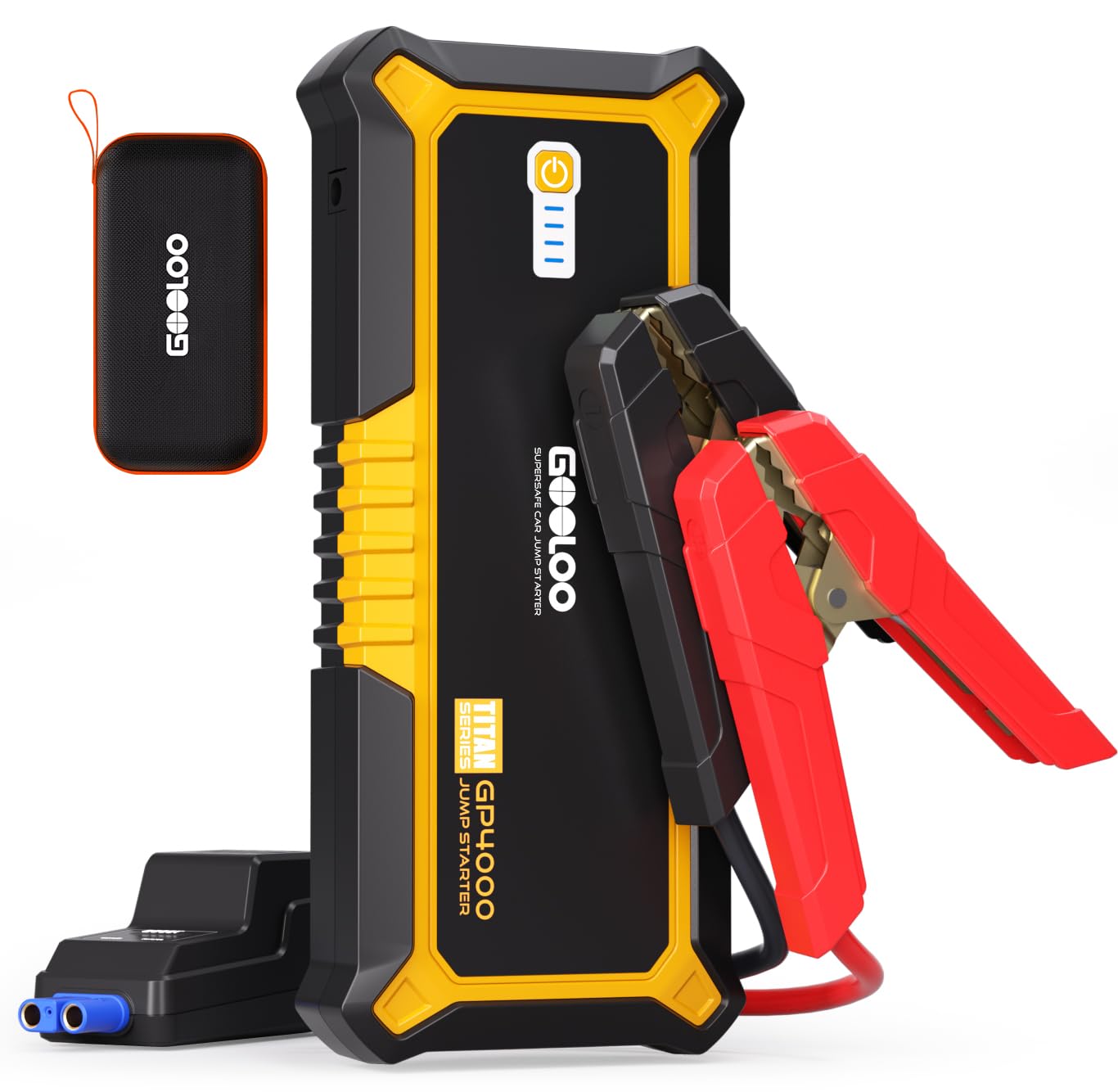
Best for large diesel trucks and RVs: GOOLOO GP4000 Jump Starter
Best for compact everyday carry: NOCO Boost GB20
Best LCD display and dead-battery recovery: S ZEVZO ET03
Best fast-charging power bank combo: WOLFBOX MV24
Best peak amperage for heavy diesel equipment: OXILAM 6000A Jump Starter
Best all-in-one with tire inflator: WOLFBOX MV24A Air
Best budget pick for small cars: AstroAI S8
Best ultra-lightweight option: TREKURE Jump Starter
GOOLOO GP4000 Jump Starter

This unit suits drivers who need reliable starts for larger engines, including diesel trucks and RVs, without stepping up to a bulkier commercial-grade booster.
Pros
- Rated for gas engines and diesel engines up to 10.0L
- Delivers roughly 60 jump starts per full charge
- USB-C, USB-A, and fast-charging ports for phones and tablets
Cons
- Heavier than compact starters at nearly 4 pounds
- No LCD screen for detailed battery status
- Wall charger sold separately
The GP4000 pairs a 24,000mAh lithium battery with 4000 peak amps, giving it enough reserve to start large diesel engines multiple times before needing a recharge. Its all-metal clamps and ten built-in protections address common failure points like reverse polarity and sparking. A built-in flashlight adds visibility during nighttime breakdowns, and the rugged rubberized corners hold up to drops in a truck bed or trunk. Owners who use it seasonally note it holds a charge well between uses, which matters for a device meant to sit unused for months at a time.
NOCO Boost GB20
The GB20 fits drivers who want a small, trustworthy jump starter for daily commuter cars rather than large trucks or diesel engines.
Pros
- Compact 2.4-pound design fits easily in a glovebox
- UltraSafe spark-proof clamps prevent incorrect connections
- IP65-rated housing resists water and dust
Cons
- Limited to gas engines up to 4.0L
- Lower peak amperage than larger competitors
- Smaller battery capacity means fewer jump starts per charge
NOCO built its reputation on straightforward, foolproof design, and the GB20 reflects that. The spark-proof clamps only activate when connected correctly, which reduces the risk of user error during a stressful roadside moment. Its integrated 100-lumen flashlight includes SOS and strobe modes for visibility. While its 500-amp rating and 4.0L engine limit make it less suited to trucks or diesel vehicles, it performs well for sedans, motorcycles, and small SUVs where portability matters more than raw output.
S ZEVZO ET03
This model works well for drivers who want a clear battery readout and confidence starting vehicles with a fully dead battery.
Pros
- LCD display shows real-time battery status
- Force-start function designed for 0V dead batteries
- Rated for gas engines up to 8.0L and diesel up to 7.0L
Cons
- Reports of inconsistent USB-C charging connections in some units
- Cables described as a bit stiff by some owners
- Slim design trades some grip comfort for portability
The ET03 stands out for its LCD screen, which removes the guesswork common in single-LED indicator units. Its force-start feature in the clamps is built specifically to handle batteries that have dropped to 0 volts, a scenario where cheaper jump starters often fail. A 500-lumen flashlight with three modes adds emergency utility. Some buyers have reported early charging port issues, though replacements resolved the problem in most of those cases.
WOLFBOX MV24
Drivers who also want a fast phone and laptop charger built into their jump starter should look at the MV24.
Pros
- 65W USB-C fast charging recharges the unit in about 1.3 hours
- LCD display for clear status readouts
- Rated for both 10L gas and 10L diesel engines
Cons
- Lower rated battery capacity (6000mAh) despite 88.8Wh spec listed
- Charging adapter not included
- No published customer review data available yet
The MV24 targets drivers who use power banks daily and want that same fast-charging convenience in their emergency jump starter. Its 65W Type-C port charges phones, tablets, and even laptops, while a QC3.0 USB-A port covers older devices. The one-touch boost mode handles low-voltage starts, and the LED flashlight includes SOS and strobe settings. Its IP64 rating and wide operating temperature range make it a reasonable option for drivers in variable climates.
OXILAM 6000A Jump Starter
This is the highest-output model in the lineup, built for owners of large diesel engines and heavy-duty vehicles.
Pros
- 6000A peak output, the highest in this roundup
- Rated for diesel engines up to 12.0L
- Long 48-month manufacturer warranty
Cons
- Larger footprint than compact starters
- Higher peak amperage may be more than smaller vehicles need
- USB-C input details less documented than competitors
OXILAM’s 6000A rating and 12.0L diesel compatibility put it ahead of most competitors on paper, making it a fit for heavy trucks, large RVs, and commercial vehicles. It includes ten safety protections and an LED display for battery status. The extended 48-month warranty signals confidence in long-term durability. Drivers with smaller sedans or motorcycles will find this more capacity than they need, but fleet operators and truck owners get a meaningful buffer against larger engine draws.
WOLFBOX MV24A Air
Drivers who want to handle both dead batteries and low tires with a single device will get the most value from this model.
Pros
- Built-in 160 PSI air compressor inflates truck tires in under 3 minutes
- 4000A output covers 10L gas and 10L diesel engines
- 65W fast charging with USB-C and USB-A ports
Cons
- Heaviest option in this roundup at 5.3 pounds
- Charging adapter not included
- Larger size may not fit smaller glove compartments
The MV24A Air combines a jump starter with a genuinely useful air compressor, cutting down on the number of separate tools a driver needs to carry. Its compressor handles sedan tires in under a minute and truck tires in about two and a half minutes. The tradeoff is size and weight, since the added compressor hardware makes this the bulkiest unit here. For road-trippers and truck owners who want one emergency kit instead of two separate devices, that tradeoff is easy to justify.
AstroAI S8
This is a solid budget-friendly pick for drivers with small to midsize cars who do not need diesel compatibility.
Pros
- Lightweight at under 1 pound
- Smart boost mode simplifies low-voltage starts
- Compact enough for a glovebox or small bag
Cons
- Limited to 6.0L gas or 3.0L diesel engines
- Lower peak amperage (1500A) than most other picks
- Smaller battery capacity limits number of jump starts per charge
The S8 keeps things simple with an automatic boost mode that detects low voltage and unlocks a start button once conditions are safe. Its eight built-in protections cover the most common failure risks, including reverse polarity and overcurrent. At under a pound, it is one of the easiest units here to keep in a glovebox without noticing the extra weight. Its lower amperage and engine size limits make it best suited to compact cars, motorcycles, and small SUVs rather than trucks or diesel engines.
TREKURE Jump Starter
This model appeals to drivers who want strong engine coverage in one of the lightest packages available.
Pros
- Weighs just 0.8 pounds, among the lightest in this category
- Rated for gas engines up to 8.0L and diesel up to 6.5L
- Dual-angle lighting with four modes including SOS
Cons
- No LCD display for battery status
- Fewer verified customer reviews than more established brands
- Cables reported as slightly less rugged than heavier-duty models
TREKURE built the ET-style unit around portability without sacrificing much engine coverage, fitting 8.0L gas and 6.5L diesel ratings into a body that weighs less than a pound. Its four-battery-pack design also functions as a power bank for phones and tablets. The dual-angle flashlight is a practical touch for checking under a hood or signaling other drivers during a roadside stop. Buyers should weigh its lighter cable construction against heavier units built for repeated heavy-duty use.
Lithium Ion Portable Jump Starter Buying Guide
Match Amperage and Engine Size to the Vehicle
Peak amperage numbers look impressive on packaging, but the more useful spec is the engine size rating in liters for both gas and diesel. A small sedan or motorcycle rarely needs more than 1500 peak amps, while trucks, vans, and diesel engines often require 4000 amps or more to turn over reliably.
| Vehicle Type | Recommended Peak Amps | Typical Engine Rating |
|---|---|---|
| Motorcycle, ATV, small car | 1000-1500A | Up to 4.0L gas |
| Midsize car, SUV | 1500-3000A | Up to 6.0L gas |
| Truck, van, RV | 4000A+ | Up to 10.0L gas / diesel |
| Heavy diesel, commercial | 5000-6000A | 10-12L diesel |
Buying more amperage than a vehicle needs adds cost and bulk without added benefit. Buying too little risks a failed start on a larger engine.
Battery Capacity and Number of Jumps
Battery capacity, listed in milliamp-hours (mAh) or watt-hours (Wh), determines how many jump starts a device delivers per charge. Higher capacity also means the unit works better as a backup phone charger. Look for a stated number of jump starts per charge, since that figure translates raw capacity into a real-world benefit.
Safety Protections and Cable Quality
Reverse polarity protection, short-circuit protection, and spark-proof clamps prevent damage to both the jump starter and the vehicle’s electrical system. Devices with eight to ten distinct protections cover the most common misuse scenarios. Metal clamps with solid, heavy-gauge cables hold up better over years of use than thinner, lighter-duty versions.
Portability Versus Added Features
Smaller, lighter units fit easily in a glovebox and suit drivers who want a simple emergency tool. Larger units that add air compressors, bigger LCD screens, or higher-wattage fast charging trade some portability for added function. Consider how often the extra features would actually get used before paying for the bulk.
Charging Ports and Speed
USB-C fast charging has become standard on newer models, cutting recharge time to a few hours instead of overnight. A unit that charges quickly is more likely to be ready the next time it is needed. Devices with both USB-A and USB-C output offer more flexibility for charging multiple device types at once.