
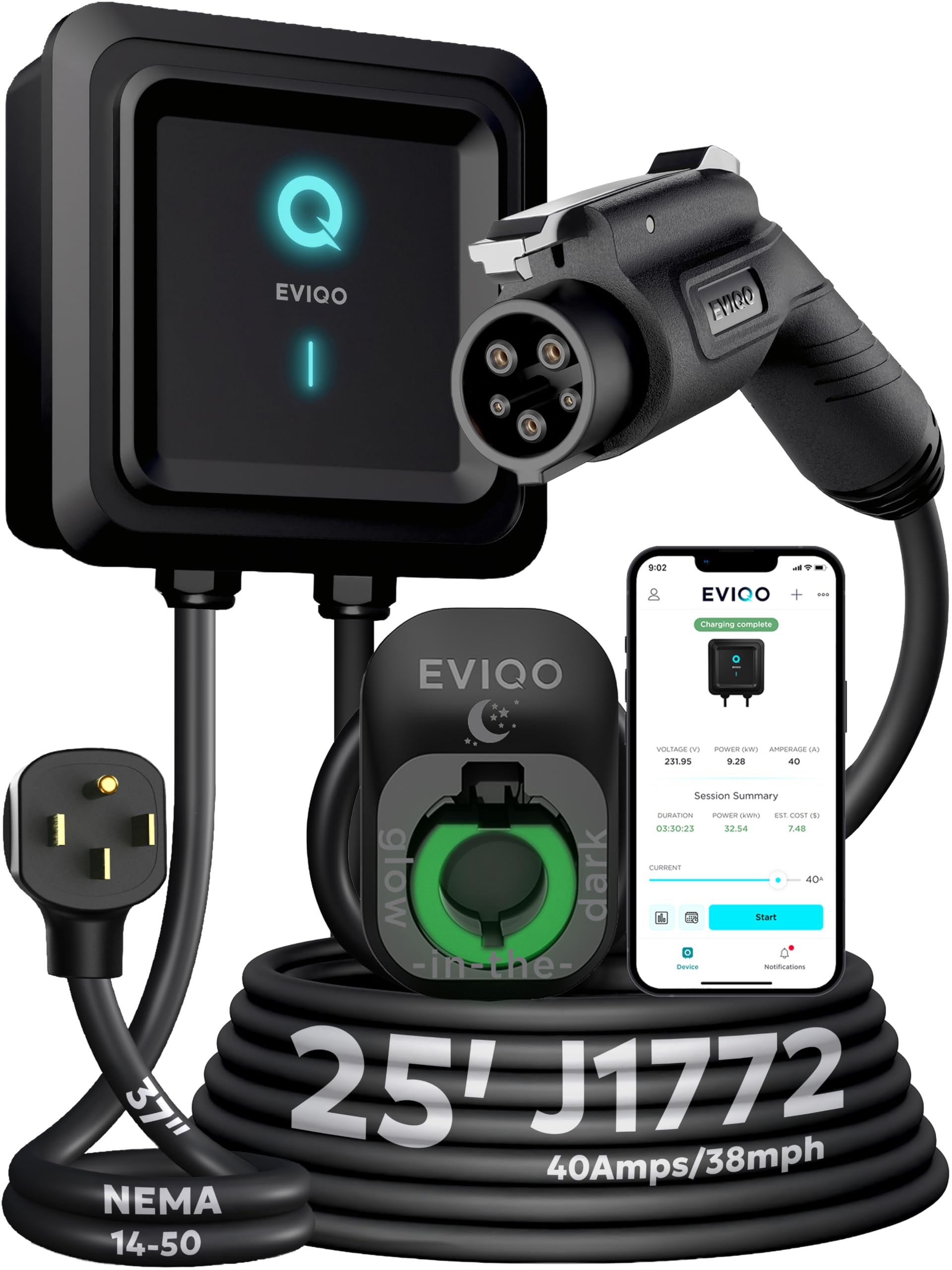
A EV Car Charger at home comes down to one piece of equipment: the Level 2 charger, also called an EVSE (electric vehicle supply equipment). Unlike the slow 120-volt trickle charger that comes in the trunk, a 240-volt Level 2 unit can refill a battery overnight instead of over several days. That difference is what makes home charging practical for daily driving.
Picking the right one means looking past the amperage number on the box. Connector type matters first: J1772 covers nearly every non-Tesla EV and plug-in hybrid, while NACS is built for Tesla and newer vehicles adopting that standard. Installation style matters too. Plug-in units connect to an outlet like a NEMA 14-50, which is easier to move or replace later, while hardwired units connect directly to the electrical panel and often support higher amperage. The charger’s maximum output only matters if a home’s circuit and the vehicle’s onboard charger can actually use it, so matching amperage to real capacity matters more than chasing the highest number.
Cable length, weatherproofing, and app reliability also shape daily use more than most buyers expect. A charger mounted outdoors needs a solid IP66 or NEMA 4 rating, and anyone parking a driveway’s length from the panel needs at least 25 feet of cable. The following picks cover a range of budgets, installation types, and vehicle compatibility needs.
Best smart charger: EVIQO Level 2 EV Charger J1772 40A
Best overall performance: EMPORIA Level 2 EV Charger w/ J1772
Best no-frills outdoor unit: Grizzl-E Classic Level 2 Charger
Best network-backed charger: ChargePoint HomeFlex
Best Tesla/NACS hardwired option: EMPORIA Level 2 EV Charger w/NACS
Best for cold-climate installs: Autel MaxiCharger AC Home
Best portable backup charger: EVDANCE Level 1&2 Portable Charger
Best value plug-in charger: AIMILER Level 2 32A Charger
Best Tesla wall connector alternative: EVIQO NACS 48A Hardwired Charger
Best adjustable portable Level 2: EVDANCE 40Amp Portable Charger
EVIQO Level 2 EV Charger J1772 40A

Buy this charger for a plug-in setup that pairs strong app control with weatherproof durability.
Pros
- Plugs into a NEMA 14-50 outlet, no electrician rewiring needed if the outlet exists
- IP66/NEMA 4 sealed housing suits outdoor or garage mounting
- Reinforced WiFi antenna helps keep connections stable in basements or detached garages
Cons
- Requires an existing or newly installed 50A circuit
- 40A ceiling won’t help vehicles limited to lower onboard charging rates
- App scheduling depends on a steady 2.4GHz WiFi connection
This charger delivers up to 40 amps through a standard J1772 connector, working with nearly every non-Tesla EV on the road (Tesla owners can use the adapter that ships with their car). The 25-foot cable reaches across most garages or driveways without an extension. Its glow-in-the-dark holster is a small but genuinely useful touch for late-night plug-ins. The side reset button also means fewer trips to the breaker box if the unit ever needs a restart. EV Car Charger
EMPORIA Level 2 EV Charger w/ J1772
Buy this charger for flexibility between plug-in convenience now and hardwired speed later.
Pros
- Ships preconfigured for a NEMA 14-50 plug, with the option to hardwire for higher output
- Reaches up to 48A when hardwired, among the higher outputs in this lineup
- Backed by Energy Star certification and broad EV compatibility
Cons
- Full 48A speed requires professional hardwiring, adding install cost
- NEMA 14-50 plug configuration caps out at 40A
- Charging speed still depends on the vehicle’s onboard charger limit
The Emporia charger’s dual installation path sets it apart. Buyers can start with the simpler NEMA 14-50 plug setup and upgrade to hardwired 48A service without buying a new unit. Its J1772 connector works with essentially all EVs sold in North America, including Tesla models through an adapter. The companion app tracks energy use and lets owners schedule off-peak charging, which can meaningfully lower electricity costs over time.
Grizzl-E Classic Level 2 Charger
Buy this charger for a rugged, no-app-required unit built to survive years outdoors.
Pros
- Solid metal enclosure with an IP67 water resistance rating
- Adjustable output (16A to 40A) matches different circuit breaker sizes
- Built-in GFCI and multiple electrical safety protections
Cons
- No WiFi app or smartphone scheduling
- Heavier metal housing needs a stud or solid mount point
- Manual amperage adjustment happens inside the unit, not remotely
Owners who want a dependable charger without WiFi dependency tend to favor the Grizzl-E Classic. Its all-metal case runs cooler under sustained load and holds up to outdoor exposure better than plastic-shelled alternatives. The tradeoff is simplicity: there’s no app for remote monitoring or scheduled charging, so anyone wanting smart features or usage tracking should look elsewhere. For a straightforward, heavy-duty charger, it delivers reliably.
ChargePoint HomeFlex
Buy this charger for access to ChargePoint’s public network alongside dependable home charging.
Pros
- Adjustable output from 16A to 50A fits a range of circuit sizes
- App connects home charging data with ChargePoint’s public station network
- Cold-resistant cable suits harsh outdoor climates
Cons
- Hardwired install requires a licensed electrician
- App-dependent features need a stable WiFi connection to work fully
- Slightly lower average customer rating than several other picks here
ChargePoint built its reputation on public charging infrastructure, and the HomeFlex brings that same brand ecosystem home. The J1772 connector fits all non-Tesla EVs, and the adjustable amperage (16A-50A) lets one unit serve multiple circuit configurations if a household upgrades its panel later. Hardwiring means no outlet to install, but also means the amperage setting is fixed unless reconfigured during setup. Support access around the clock is a meaningful plus for less confident DIYers.
EMPORIA Level 2 EV Charger w/NACS
Buy this charger for Tesla owners who want a native NACS plug instead of a J1772 adapter.
Pros
- NACS connector works directly with Tesla vehicles, no adapter needed
- Can remotely open a Tesla’s charge port door, like the factory charger
- Hardwired 48A output supports faster overnight charging
Cons
- Limited to NACS-compatible vehicles without an adapter
- Requires professional hardwired installation
- Smaller review base than some competitors, though ratings run high
This is the Tesla-specific version of Emporia’s charger, built around the NACS connector rather than J1772. It replicates a feature Tesla owners expect from the factory Wall Connector: pressing a button to pop open the charge port. Hardwired installation at 48A means faster charging than most plug-in units can offer, provided the electrical panel supports a 60-amp circuit. Non-Tesla owners with NACS-equipped vehicles get the same benefit.
Autel MaxiCharger AC Home
Buy this charger for extreme weather resilience and dual WiFi/Bluetooth connectivity.
Pros
- Rated to operate down to -40°C, useful for cold-climate regions
- NEMA Type 4 housing resists snow, rain, and dust
- Bluetooth pairing offers a backup when WiFi setup struggles
Cons
- Hardwired-only installation
- App history includes mixed feedback on connectivity reliability
- 50A output needs a properly sized circuit and panel capacity
Autel built its reputation on automotive diagnostic tools, and the MaxiCharger reflects that engineering background. It’s designed for punishing climates, with a cold-rated cable and enclosure that holds up in snow and freezing temperatures. The Bluetooth and Ethernet connectivity options give it more setup paths than WiFi-only competitors. Buyers should confirm their electrician can support the 50A hardwired circuit before choosing this model over a plug-in alternative.
EVDANCE Level 1&2 Portable Charger
Buy this charger as a backup or travel unit that works with common household outlets.
Pros
- Works with both 120V and 240V outlets using included adapters
- Compact and bag-friendly for travel or backup charging
- LED display shows charging status and errors clearly
Cons
- Maxes out at 16A, far below true Level 2 speeds
- Not compatible with 14-50, 14-30, or 6-50 outlets without a separate adapter
- Only a 1-year warranty, shorter than most hardwired competitors
This isn’t a primary home charging solution for most EV owners, and it isn’t meant to be. It’s built for flexibility: plug it into a standard NEMA 5-15 wall outlet for slow overnight trickle charging, or a NEMA 6-20 outlet for a modest speed boost. That makes it useful as a travel charger, apartment backup, or emergency option when a primary EVSE is unavailable. Owners depending on daily fast charging need a higher-amperage unit instead.
AIMILER Level 2 32A Charger
Buy this charger for budget-friendly Level 2 speeds without giving up smart features.
Pros
- Plug-and-charge or app-controlled modes, whichever fits the routine
- Adjustable amperage (16A-32A) matches multiple breaker sizes
- Built-in leakage protection removes the need for a separate GFCI breaker in most setups
Cons
- Tops out at 32A, lower than several chargers in this list
- Touchscreen controls require the charging gun to be unplugged first
- Not compatible with several newer NACS-only vehicles without an adapter
AIMILER’s charger competes well on price while still including a WiFi app, adjustable current settings, and a bright touchscreen display. The 25-foot cable and NEMA 14-50 plug make setup simple for anyone with the right outlet already installed. Its built-in anti-leakage detection is a helpful safety feature that removes a step some other plug-in chargers still require. Buyers wanting more than 32A of charging speed should look toward the EMPORIA or Autel units instead.
EVIQO NACS 48A Hardwired Charger
Buy this charger for a Tesla-style hardwired setup with faster charging headroom than most NACS options.
Pros
- Hardwired 48A standard, expandable to 50A via DIP switch on a larger circuit
- NACS plug pops open a Tesla’s charge port with one button
- Same reinforced WiFi antenna and weatherproof housing as EVIQO’s J1772 model
Cons
- Requires a 60A (or 70A for 50A mode) dedicated circuit, a bigger electrical ask than most 40A chargers
- Non-Tesla J1772 vehicles need a separate adapter
- Professional installation adds cost beyond the unit price
This is EVIQO’s Tesla-focused counterpart to its J1772 charger, swapping the plug-in NEMA 14-50 design for a hardwired NACS connector. The higher amperage ceiling (48A, expandable to 50A) means faster overnight charging, but it also means a bigger circuit requirement. Anyone considering this unit should confirm their panel has room for a 60-amp or larger dedicated circuit before buying. The same weatherproof housing and reset button carry over from EVIQO’s other charger.
EVDANCE 40Amp Portable Charger
Buy this charger for true Level 2 speed in a plug-in, semi-portable package.
Pros
- Adjustable current from 10A to 40A across six preset levels
- 2.4-inch display shows live voltage, power, and charging time
- Delay-start timer helps shift charging to off-peak electricity hours
Cons
- No WiFi app, so scheduling relies on the onboard delay timer only
- NEMA 14-50 plug still requires that outlet to be present
- Newer product with a smaller review history than established competitors
This charger splits the difference between a fixed wall unit and a fully portable one. It delivers genuine Level 2 speeds up to 40A through a NEMA 14-50 plug, with a carry bag and cable holder for anyone who wants to move it between locations. The built-in display and delay-start timer offer real functionality without needing a smartphone app. Buyers who want remote app control or usage history tracking will find this unit more limited than its WiFi-enabled competitors.
Buying Guide
Match the Connector to the Vehicle
Every charger needs the right plug type for the car it’s charging. J1772 is the standard connector for nearly all non-Tesla EVs and plug-in hybrids sold in North America. NACS (North American Charging Standard) is Tesla’s connector, now being adopted by other automakers as well. Tesla owners can use a J1772 charger with the adapter that ships with the car, but buying a NACS-specific charger skips that extra step and often adds features like remote charge-port release.
Understand Plug-In vs. Hardwired Installation
| Installation Type | How It Works | Best For |
|---|---|---|
| Plug-in (NEMA 14-50) | Connects to a 240V outlet on a dedicated circuit | Renters, easy replacement, DIY-friendly setups |
| Hardwired | Wired directly into the electrical panel by an electrician | Higher amperage, permanent installs, outdoor mounting |
Plug-in chargers are easier to install, move, or replace, since the charger simply unplugs from the wall. Hardwired chargers often support higher amperage and skip the outlet altogether, but any change to the unit requires an electrician.
Amperage and Charging Speed
A charger’s maximum amperage doesn’t guarantee that speed in practice. Three factors determine real-world charging rate.
- Circuit breaker size: A 40A charger needs a 50A dedicated circuit; a 48A charger needs a 60A circuit.
- Home electrical panel capacity: Older panels may not have room for a new high-amperage circuit without an upgrade.
- Vehicle’s onboard charger limit: Many EVs cap charging speed well below 40A or 48A, regardless of what the EVSE can deliver.
Buying a 48A charger for a car that only accepts 32A wastes money on unused capacity.
Cable Length and Mounting Location
Measure the distance from the planned mounting spot to the vehicle’s charging port before buying. Most home chargers include a 24- to 25-foot cable, enough for most garages and driveways, but corner parking spots or long driveways may need extra reach or a different mounting position.
Weather Resistance for Outdoor Installs
Any charger mounted outside or in an unheated garage needs a rating like IP66 or NEMA 4, which indicates resistance to rain, snow, and dust. Skipping this spec on an outdoor install risks corrosion and electrical faults over time.
Smart Features and WiFi Reliability
App-connected chargers offer scheduling, energy tracking, and remote start/stop, but only work as well as the home’s WiFi signal. Nearly all smart EVSEs require a 2.4GHz network specifically; 5GHz-only routers won’t connect. Garages and basements with weak WiFi coverage may need a range extender for reliable app performance.
Certifications to Confirm Before Buying
Look for UL or ETL listing, which confirms the charger passed independent safety testing. Energy Star certification indicates efficient energy use. These certifications matter more for hardwired units, where a faulty charger poses a bigger electrical risk than a plug-in model that can simply be unplugged.