
Best EV Chargers for Home an electric car at home starts with electricity, not gadgets. Level 1 charging through a regular wall outlet adds only a few miles of range per hour, which works for short commutes but leaves most drivers waiting days to top off a depleted battery. A Level 2 charger changes that math by using a 240-volt circuit, the kind that normally powers a dryer or range, to add 20 to 45 miles of range per hour depending on the vehicle and the charger’s amperage.
Home chargers fall into two installation types: plug-in units that connect to a NEMA 14-50 outlet, and hardwired units that a licensed electrician wires directly into the electrical panel. Plug-in chargers are easier to install, move, or replace, while hardwired units can deliver higher amperage and often qualify for a longer warranty period since a professional handles the connection. Connector type matters too: J1772 works with nearly every non-Tesla EV, while NACS is built for Tesla and the growing number of automakers adopting Tesla’s plug standard.
Before buying, check three things: the vehicle’s maximum onboard charging rate, the home’s available circuit capacity, and whether a garage or driveway needs weatherproofing. A 48-amp charger is only as fast as the weaker of the car’s charging limit or the circuit’s breaker rating, so buying more amperage than the vehicle or panel supports doesn’t add charging speed. These factors decide which of the chargers below actually fits a specific home and car.
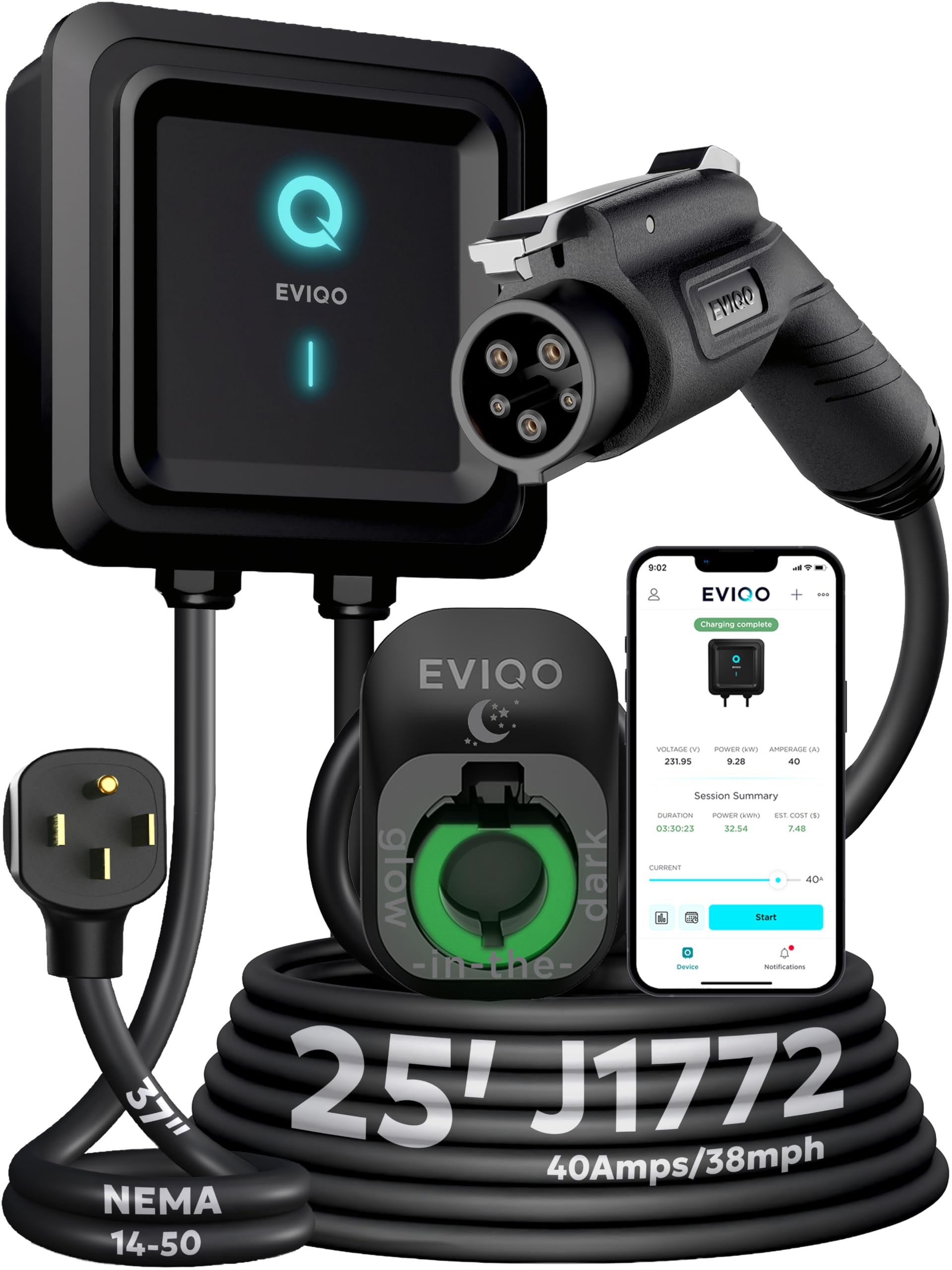
Best plug-in charger for most homes: EVIQO Level 2 EV Charger J1772 40A
Best for maximum charging speed with flexible install: EMPORIA Level 2 EV Charger 48 Amp
Best for drivers who want a large charging network: ChargePoint HomeFlex
Best from an established EV brand: Autel 40A Level 2 EV Charger
Best budget-friendly plug-in option: AIMILER Level 2 EV Charger 32A
Best for homes with limited panel capacity: EMPORIA Pro with PowerSmart
Best for Tesla and NACS-equipped vehicles: EVIQO NACS 48A Hardwired Charger
Best value for high-amperage charging: NexCyber 48A Level 2 EV Charger
EVIQO Level 2 EV Charger J1772 40A

This charger suits homeowners who already have or plan to install a NEMA 14-50 outlet and want a no-fuss plug-in unit with strong weatherproofing.
Pros
- Plugs into a standard NEMA 14-50 outlet, no electrician needed for the charger itself
- IP66/NEMA 4 sealed housing handles outdoor mounting in rain or snow
- Glow-in-the-dark holster makes nighttime plug-in easier
Cons
- Capped at 40A, slower than 48A hardwired options
- Requires an existing 50A dedicated circuit
- App depends on 2.4GHz WiFi, older routers may need adjustment
The 25-foot cable reaches across most garages or driveways without an extension. Its app lets owners schedule off-peak charging and adjust amperage from 6A to 40A, which helps on shared circuits. A side reset button avoids breaker trips turning into a troubleshooting chore.
EMPORIA Level 2 EV Charger 48 Amp
This unit works for drivers who want the option to start with a NEMA 14-50 plug and later convert to hardwired for full 48A output.
Pros
- Dual installation modes: plug-in at 40A or hardwired at 48A
- Meets multiple UL safety standards plus Energy Star certification
- Strong reputation among owners for straightforward setup
Cons
- Reaching 48A requires professional hardwiring, adding cost
- Some owners note the mounting screws take extra time during install
- WiFi setup can be finicky on first connection
Reviewers who hardwired the unit report reliable, fast charging and an app that’s noticeably better than earlier Emporia models. Compatibility spans nearly every J1772 vehicle sold in North America, and Tesla drivers can use it with the vehicle’s included adapter.
ChargePoint HomeFlex
This charger fits drivers who value access to a large public charging network alongside their home setup.
Pros
- Adjustable output from 16A to 50A to match different circuit sizes
- Backed by one of the largest public charging networks in North America
- Cold-resistant cable stays flexible in winter conditions
Cons
- Some owners report app connectivity issues after firmware updates
- Cannot manage two chargers under one account easily
- Requires professional hardwire installation
Owners consistently praise the 2.5-hour charge times on properly sized circuits and a cable long enough for most garage layouts. The brand’s network access is a genuine advantage for drivers who also charge away from home.
Autel 40A Level 2 EV Charger
This charger appeals to buyers who want a plug-in unit from a company with a long track record in automotive electronics.
Pros
- Installs in about 5 minutes with a NEMA 14-50 outlet
- NEMA 4X rating adds extra protection against dust and moisture
- RFID access adds a layer of security against unauthorized use
Cons
- Fewer customer reviews than some competitors
- Fixed 40A ceiling, no hardwire upgrade path
- App-dependent scheduling requires stable WiFi
Autel built this unit for portability, so it travels well if the owner moves or wants to relocate the charger within the garage. The adjustable 16A to 40A range lets it share a panel with other appliances without tripping breakers.
AIMILER Level 2 EV Charger 32A
This charger works well for owners on a tighter budget who don’t need the top charging speeds.
Pros
- Adjustable from 16A to 32A to match 20A, 30A, or 40A circuits
- Built-in leakage protection removes the need for a separate GFCI breaker
- Touchscreen controls work without the app if WiFi drops
Cons
- 32A ceiling means slower charging than 40A or 48A models
- Physical adapter needed for 120V outlets, sold separately
- Plastic carry bag feels less durable than the unit itself
Owners across a range of vehicles, from Tesla Model 3s to plug-in hybrids, report consistent performance and an app that clearly shows real-time charging cost. The 25-foot cable and NEMA 4 water resistance make it a solid fit for uncovered driveways.
EMPORIA Pro with PowerSmart
This charger targets homeowners whose electrical panel can’t easily support a full 48A circuit without an upgrade.
Pros
- PowerSmart load-balancing lets it work with limited panel capacity
- Includes an Emporia Vue home energy monitor for whole-house insight
- Supports both plug-in and hardwired installation
Cons
- Fewer total reviews since it’s a newer release
- Full feature set requires setting up the included energy monitor
- Premium positioning means a higher cost than the standard Emporia charger
Owners who paired this with an electrician report an easy install and appreciate not needing a panel upgrade. The included energy monitor is a genuine bonus for anyone curious about whole-home electricity use, though some skip it entirely and still get full charging performance.
EVIQO NACS 48A Hardwired Charger
This charger is built specifically for Tesla owners and other NACS-equipped vehicles that want to skip the J1772 adapter entirely.
Pros
- Native NACS plug opens the Tesla charge port automatically
- DIP switch setting unlocks 50A on a 70A circuit for faster charging
- Steel-shielded, IP66-rated housing for outdoor mounting
Cons
- Requires a 60A dedicated circuit and professional hardwire install
- J1772 vehicles need a separate NACS-to-J1772 adapter
- Higher upfront electrical work than plug-in alternatives
Owners of Rivians, Kias, and Teslas report smooth installs and reliable daily charging. The 25-foot cable and app-based scheduling match the rest of the EVIQO lineup, with the added benefit of skipping adapter clutter for Tesla drivers.
NexCyber 48A Level 2 EV Charger
This charger offers 48A output at a competitive price for buyers comfortable with a lesser-known brand.
Pros
- Reaches 48A hardwired, matching pricier competitors’ top speed
- Touchscreen works in plug-and-play mode without the app
- ETL and Energy Star certified for safety compliance
Cons
- NEMA Type 3 rating offers less weather protection than NEMA 4 units
- Limited review history compared to established brands
- 8AWG cable minimum requirement adds installation planning
The touchscreen display shows amperage, charging speed, and delay timers without needing a phone nearby. Buyers who want 48A speeds without paying for a bigger name brand will find this one competitively equipped, though its lighter weatherproofing rating makes it better suited to garages than fully exposed driveways.
Best EV Chargers for Home Buying Guide
Match the Charger to the Vehicle’s Onboard Limit
Every EV has a maximum charging rate built into its onboard charger, regardless of how much amperage the home charger supplies. A car limited to 32A won’t charge faster on a 48A charger. Check the vehicle’s manual or manufacturer specs before assuming a higher-amperage unit will speed things up.
Understand the Circuit Requirement
| Amperage | Typical Circuit Needed | Approx. Range Added Per Hour |
|---|---|---|
| 32A | 40A dedicated circuit | 20-25 miles |
| 40A | 50A dedicated circuit | 25-30 miles |
| 48A | 60A dedicated circuit | 30-45 miles |
A licensed electrician can confirm whether the home’s panel has room for a new dedicated circuit at the amperage a buyer wants.
Plug-In vs. Hardwired
Plug-in chargers connect to a NEMA 14-50 outlet, making them easier to install, replace, or take along during a move. Hardwired chargers connect directly to the panel, which usually supports higher amperage and skips the outlet as a potential failure point. Renters and buyers without dedicated outlets often start with plug-in units, while owners planning to stay put for years lean toward hardwiring.
Connector Type: J1772 vs. NACS
J1772 connectors work with nearly every EV and plug-in hybrid other than Tesla. NACS connectors are built for Tesla and the newer wave of automakers adopting the same standard. Tesla owners can use either type with the right adapter, so the choice comes down to which vehicle plugs in without extra hardware.
WiFi, Apps, and Load Management
Smart features let owners schedule charging during off-peak utility hours and track energy costs over time. Some chargers, like those with load-balancing technology, adjust output automatically to avoid overloading a home’s electrical panel. A stable 2.4GHz WiFi connection is required for most app features, and outages or router issues can disrupt remote control, though charging itself typically continues locally.
Weatherproofing and Indoor/Outdoor Ratings
IP66 and NEMA 4 ratings indicate strong resistance to rain, snow, and dust, making a charger suitable for uncovered outdoor mounting. Lower ratings, like NEMA 3, still handle light exposure but fit better under a carport or garage overhang. Buyers installing near a driveway with no cover should prioritize the higher-rated units.
Certifications to Look For
UL, ETL, and Energy Star certifications confirm a charger has passed independent safety and efficiency testing. These aren’t optional extras. A charger without recognized certification carries real electrical risk, especially at higher amperages connected directly to a home’s panel.