
Charging an Electric Vehicle Chargers at home comes down to one choice: how fast do you need power, and what does your electrical panel allow? A basic wall outlet can trickle-charge overnight, but most owners want a Level 2 charging station that cuts charging time to a few hours. Picking the right one means understanding amperage, connector type, and installation method before adding anything to a cart.
Level 2 chargers run on 240-volt power and typically add between 10 and 45 miles of range per hour, depending on amperage and the vehicle’s onboard charger. Some models plug into an existing outlet like a NEMA 14-50, while others require hardwiring by a licensed electrician into a dedicated circuit. Connector type matters too: J1772 works with nearly every non-Tesla EV, while NACS is built for Tesla and newer vehicles adopting that standard.
The most important factors are matching amperage to available circuit capacity and confirming connector compatibility with a specific vehicle before buying. Weatherproofing ratings, cable length, and app-based scheduling add convenience, but they only matter once the basics of power and plug type are sorted out. The lineup below covers hardwired stations, plug-in units, and portable Level 1/Level 2 chargers to fit different garages, budgets, and installation setups.
Best for no-hardwiring installs: EVIQO 40A Plug-In Charger
Best for public charging network access: ChargePoint HomeFlex
Best for high-amperage hardwired charging: EMPORIA 48A Charger
Best for tech-forward smart features: Autel MaxiCharger AC Home
Best for maximum charging speed: EVIQO 48A Hardwired Charger
Best for Tesla and NACS vehicles: IYILO NACS Charger
Best for flexible plug-and-play charging: AIMILER 32A Charger
Best for renters and apartment dwellers: EVDANCE Portable Charger
Best for budget-friendly backup charging: VEVOR Portable Charger
Best for road trips and travel: bokman Portable Charger
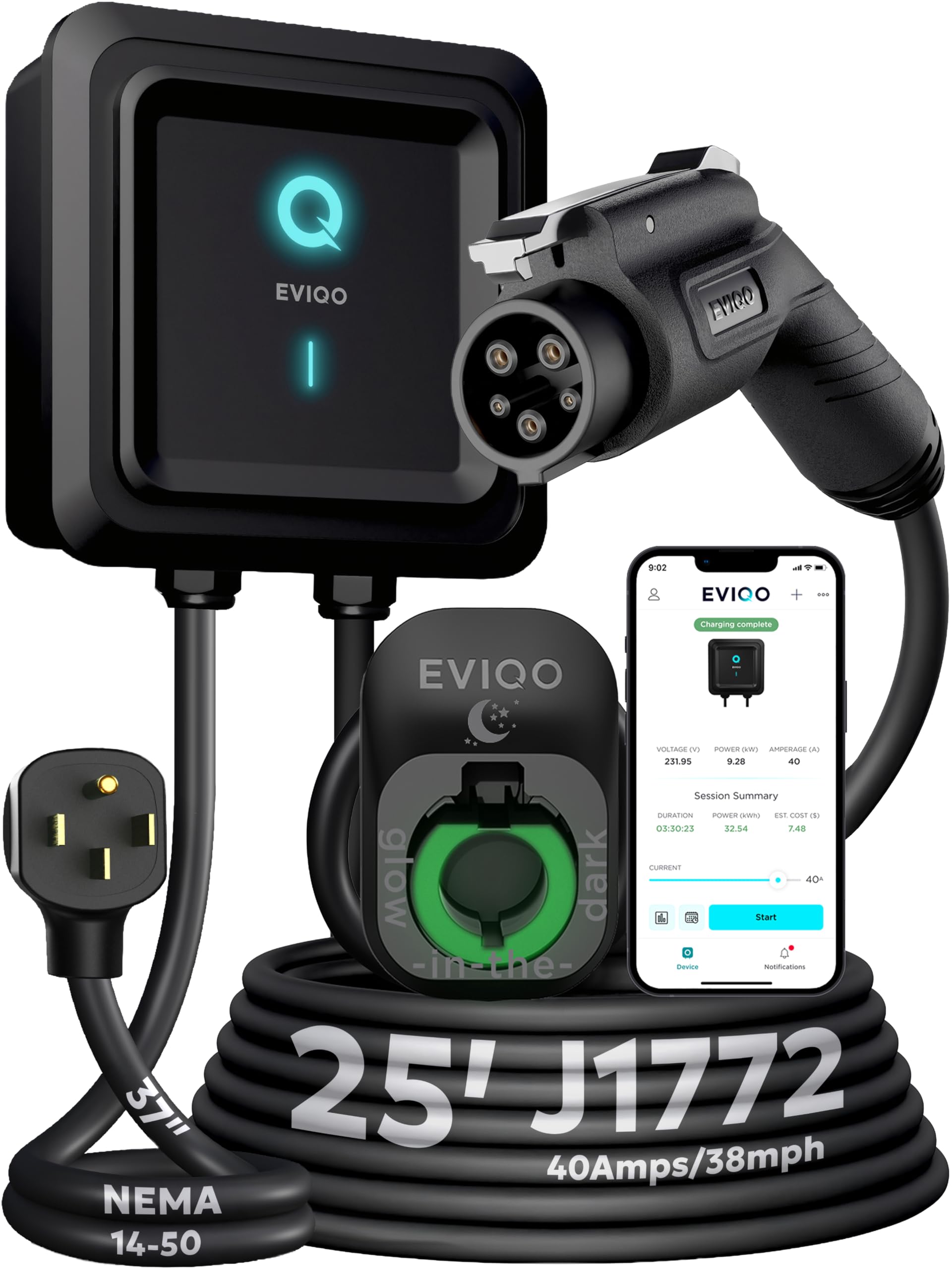
EVIQO 40A Plug-In Charger

This charger suits owners who already have a NEMA 14-50 outlet and want Level 2 speed without hiring an electrician for hardwiring.
Pros
- Plugs into an existing NEMA 14-50 outlet, no hardwiring needed
- Weatherproof IP66 / NEMA 4 housing for indoor or outdoor use
- Glow-in-the-dark holster and side reset button add convenience
Cons
- Requires a dedicated 50A circuit, which some garages lack
- Not compatible with dryer-style outlets, despite similar prongs
- 2.4GHz-only WiFi limits router options
Delivering up to 40A, this station charges most EVs overnight through a standard J1772 connector. The 25-foot cable reaches across most garages and driveways. The companion app allows remote start/stop and scheduled off-peak charging, which can lower electricity costs over time.
ChargePoint HomeFlex
This hardwired station fits owners who want a widely recognized brand backed by a large public charging network.
Pros
- Adjustable amperage from 16A to 50A fits multiple circuit sizes
- Access to ChargePoint’s extensive North American charging network
- UL-certified and rated for indoor or outdoor installation
Cons
- Requires professional hardwiring, adding to installation cost
- Slightly shorter 23-foot cable than some competitors
- Some app features need active WiFi to function fully
With output up to 45 miles of range per hour, this station handles daily charging for most EV models through its J1772 connector. Tesla drivers need a separate adapter. The mobile app manages scheduling and links to smart home devices, useful for owners who want deeper integration.
EMPORIA 48A Charger
This charger works well for owners who want near-maximum residential charging speed and are already planning a hardwired install.
Pros
- 48A output adds up to 46 miles of range per hour
- Energy Star certified and meets multiple UL safety standards
- Includes wall mount, holster, and hardware for a clean setup
Cons
- Hardwired installation requires a licensed electrician
- No Tesla-specific NACS version under this listing
- Higher amperage demands a larger dedicated circuit
Built for homes with sufficient electrical capacity, this station connects to any J1772-equipped EV. The 25-foot cable and 2.4GHz WiFi app support scheduled charging based on utility rates. Support comes from a US-based team, a point some owners value during installation questions.
Autel MaxiCharger AC Home
This station appeals to owners who want both Bluetooth and WiFi control along with strong weather resistance.
Pros
- NEMA Type 4 housing withstands snow, rain, and hail
- Bluetooth plus WiFi plus Ethernet options for connectivity
- Eligible for some federal rebate programs
Cons
- Best Sellers Rank suggests less market share than top competitors
- Hardwired install only, no plug-in version listed
- App-based scheduling requires initial setup time
Rated at up to 50A, this charger adds close to 37 miles of range per hour. Its durable 25-foot cable stays flexible even in cold temperatures, a detail that matters for owners in northern climates. Over-the-air updates keep the firmware current without manual intervention.
EVIQO 48A Hardwired Charger
This hardwired version of the EVIQO charger suits owners with a 60A circuit who want the highest charging speed the brand offers.
Pros
- Adjustable up to 50A when paired with a 70A circuit via DIP switches
- Same weatherproof IP66 / NEMA 4 housing as the plug-in model
- Side reset button simplifies troubleshooting
Cons
- Requires professional hardwiring and a larger circuit than the plug-in version
- DIP switch adjustment adds a technical step for top speed
- Needs 2.4GHz WiFi, same limitation as other EVIQO models
Standard output reaches 48A for close to 50 miles of range per hour. The 25-foot cable and glow-in-the-dark holster carry over from the plug-in model. This version fits owners set on a permanent hardwired install rather than an outlet-based setup.
IYILO NACS Charger
This charger is built specifically for Tesla and other NACS-equipped vehicles, skipping the J1772 connector entirely.
Pros
- Native NACS connector works directly with Tesla and NACS EVs
- Built-in temperature sensor reduces power automatically if overheating occurs
- Supports power sharing between two chargers on one circuit
Cons
- J1772 vehicles need a separate adapter, not included
- Newer product with a smaller review history than established brands
- Requires hardwiring and a 60A dedicated circuit
At 48A, this station adds up to 46 miles of range per hour for NACS vehicles. Dynamic load balancing works when paired with an optional energy meter, a useful feature for homes without room to upgrade their electrical panel. Utility program participation in several states may also qualify buyers for local incentives.
AIMILER 32A Charger
This plug-in charger suits owners who want adjustable amperage and the flexibility to move the unit between locations.
Pros
- Adjustable from 16A to 32A to match different circuit breakers
- Plug-and-charge mode works without needing the app
- Built-in leakage protection removes the need for a separate GFCI breaker
Cons
- Maximum 32A is lower than several hardwired competitors
- Touch buttons require pulling the charging gun out first to respond
- Not compatible with several newer Tesla and NACS-adapter vehicles
Plugging into a NEMA 14-50 outlet, this charger reaches up to 7.68 kWh at full amperage. The 25-foot cable and included carrying bag make it easy to relocate between a garage and a second property. App-based scheduling adds off-peak charging control for owners who want it.
EVDANCE Portable Charger
This charger fits renters or apartment dwellers who need flexibility between a standard outlet and a 240V connection.
Pros
- Works with both NEMA 5-15 (120V) and NEMA 6-20 (240V) outlets
- Compact and portable with an included carrying bag
- LED display shows charging status and error codes clearly
Cons
- Maximum 16A output is slower than dedicated Level 2 stations
- Shorter 1-year warranty compared to most competitors’ 3-year coverage
- Not compatible with several outlet types, including 14-50 and 14-30
At 120V, this charger adds roughly 2 to 5 miles of range per hour. Switching to a 240V NEMA 6-20 outlet raises that to about 10 to 12 miles per hour. It works well as a backup or travel unit rather than a primary daily charger for high-mileage drivers.
VEVOR Portable Charger
This budget-friendly charger works for owners who need occasional backup charging rather than a full-time home solution.
Pros
- Includes NEMA 5-15 adapter for standard household outlets
- IP66 waterproof control box handles outdoor use
- Compact carrying bag makes it easy to transport
Cons
- Newer listing means limited long-term reliability data
- 16A maximum output charges slower than most Level 2 stations
- Fewer smart features compared to WiFi-enabled competitors
Built around a 25-foot cable, this unit plugs into a NEMA 6-20 outlet for 240V charging or a standard outlet with the included adapter. Surge, overheating, and overcurrent protections come standard. It suits shared driveways or households with more than one EV rotating through a single charger.
bokman Portable Charger
This charger is built for travel, with tactile buttons and a delay timer that work without needing a smartphone app.
Pros
- Physical buttons work reliably in cold or wet conditions
- Delay timer allows 1 to 12 hour off-peak scheduling without an app
- IP65-rated housing withstands a wide temperature range
Cons
- 20-foot cable is shorter than most other portable chargers listed
- Maximum 16A output limits charging speed compared to hardwired stations
- No WiFi connectivity for remote monitoring
Adjustable from 6A to 16A, this charger matches output to whatever circuit is available at a campsite, rental, or relative’s home. The LED display shows live voltage and current without needing an app. Its lack of WiFi is a tradeoff some owners prefer, since physical controls stay usable even without a signal.
Electric Vehicle Chargers Buying Guide
Match Amperage to Your Electrical Circuit
Every charger’s amperage rating only matters if a home’s electrical panel supports it. A 40A charger needs a dedicated 50A circuit; a 48A charger needs a 60A circuit. Check with a licensed electrician before assuming a panel has enough capacity.
Understand Plug-In vs. Hardwired Installation
Plug-in chargers connect to an existing outlet, usually a NEMA 14-50, and can be installed without an electrician if that outlet already exists. Hardwired units connect directly to the electrical panel and require professional installation, but they often support slightly higher amperage and eliminate plug wear over time.
| Installation Type | Pros | Cons |
|---|---|---|
| Plug-in (NEMA 14-50) | No electrician needed if outlet exists; portable | Requires correct outlet already installed |
| Hardwired | Often supports higher amperage; permanent, tidy setup | Requires licensed electrician |
| Portable (120V/240V) | Flexible, travel-friendly | Slower charging speeds |
Confirm Connector Compatibility
J1772 connectors work with nearly all non-Tesla EVs and plug-in hybrids sold in North America. NACS connectors are built for Tesla and newer vehicles adopting that standard. Tesla owners using a J1772 charger need the adapter that comes with their vehicle; owners of J1772 vehicles buying a NACS charger need a separate adapter, often sold separately.
Consider Charging Speed Needs
Higher amperage charges faster, but most drivers do not need the maximum available speed. A vehicle driven 40 miles a day charges fully overnight even on a 24A charger. Higher amperage matters more for drivers who need a full charge in a short window, such as those sharing one charger between two EVs.
Look for Relevant Safety Certifications
UL, ETL, and Energy Star certifications confirm a charger has been independently tested for electrical safety and efficiency. NEMA 4 or IP66 ratings indicate weatherproofing suitable for outdoor installation. These certifications matter most for permanent, hardwired units exposed to the elements.
Decide If Smart Features Are Worth It
WiFi-enabled apps allow remote start/stop, scheduled off-peak charging, and energy tracking. These features help lower electricity costs but require a stable 2.4GHz WiFi connection. Chargers with physical buttons and no app dependency work more reliably in areas with weak WiFi signal or for owners who prefer simple controls.