
Electric Car Chargers at home comes down to one main choice: a Level 1 trickle charger that plugs into a regular outlet, or a Level 2 charger that runs on 240 volts and cuts charging time from days to hours. Most EV and plug-in hybrid owners upgrade to Level 2 once they realize how slow a standard wall outlet really is, especially for longer commutes or larger battery packs. A dedicated home charger also gives more control over charging speed, scheduling, and monitoring than what comes bundled with most vehicles.
Home chargers split into two installation types: hardwired units wired directly into the electrical panel, and plug-in units that connect to an existing outlet, most often a NEMA 14-50. Hardwired chargers tend to support higher amperage and skip the outlet altogether, while plug-in models are easier to install or move if a reader changes homes or garages. Connector type matters too. J1772 is the standard for nearly every non-Tesla EV and plug-in hybrid, while NACS is Tesla’s connector, now adopted by more automakers.
Choosing the right charger means matching amperage, connector type, and installation method to the electrical panel, vehicle, and daily driving habits, not just picking the highest number on the box. A 32A charger works fine for shorter commutes, while 40A to 48A units suit larger batteries or households charging multiple EVs. The lineup below breaks down hardwired and plug-in chargers, J1772 and NACS connectors, and portable versus fixed installs to help match the right unit to the right setup.
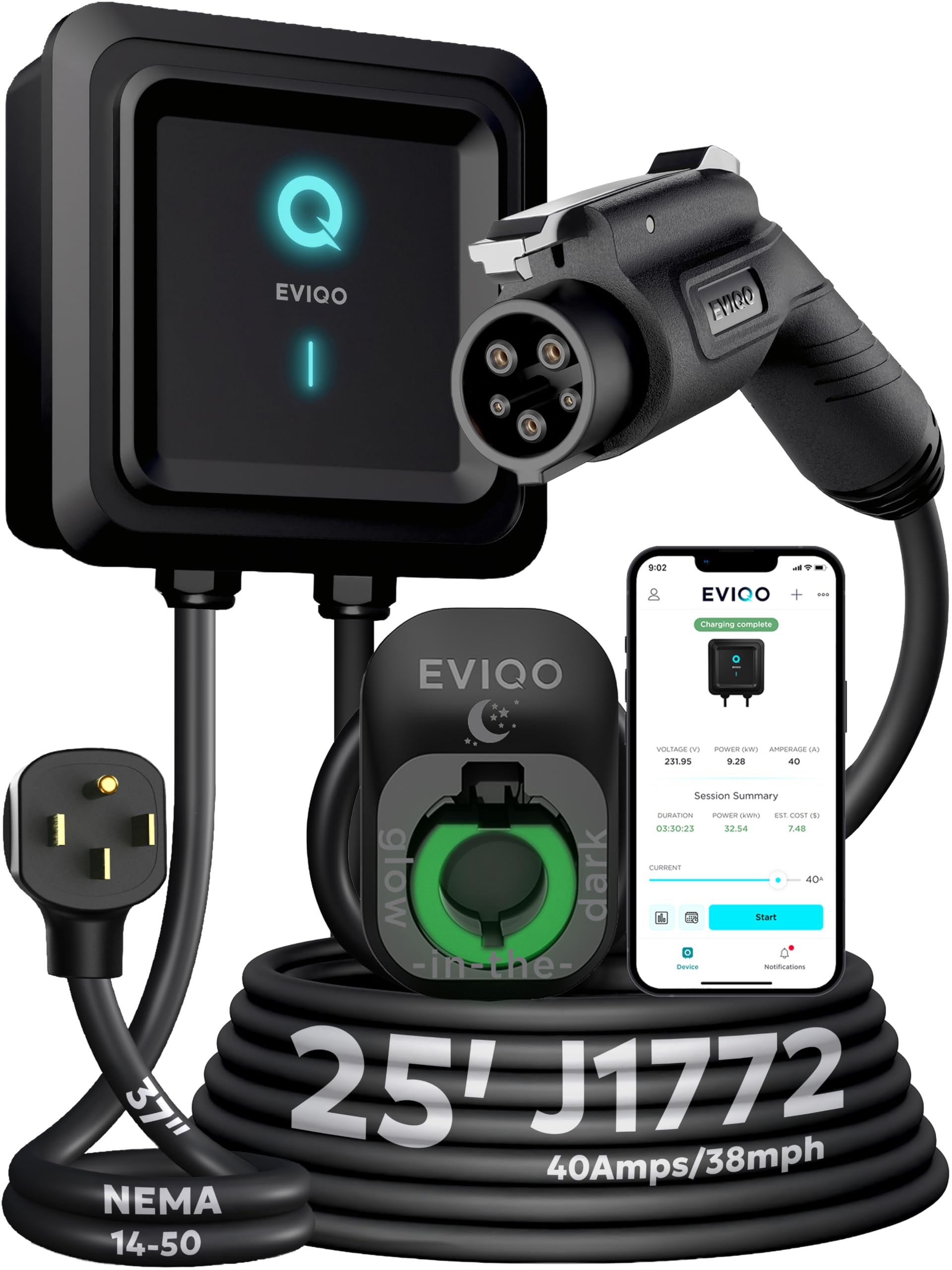
Best for non-Tesla EVs with a 14-50 outlet: EVIQO Level 2 EV Charger J1772 40A
Best for maximum charging speed via hardwired install: ChargePoint HomeFlex 50A
Best for a permanent hardwired setup: EMPORIA 48A Hardwired Charger
Best for flexible plug-in or hardwired conversion: EMPORIA 48A NEMA 14-50 Charger
Best for adjustable amperage and portability: AIMILER 40A Portable Charger
Best for Tesla and other NACS-equipped EVs: EVIQO NACS 48A Hardwired Charger
Best for smaller circuits or budget-conscious buyers: AIMILER 32A Portable Charger
Best for renters or standard outlet charging: EVDANCE Level 1/2 Portable Charger
EVIQO Level 2 EV Charger J1772 40A NEMA 14-50

This charger suits anyone with a NEMA 14-50 outlet already installed who wants a plug-in Level 2 charger with strong app support.
Pros
- Plug-in install, no electrician needed if the outlet exists
- Adjustable 6-40A output with app control
- IP66 weatherproof housing for indoor or outdoor mounting
Cons
- Requires a dedicated 50A circuit and correct outlet
- Not hardwired, so max output tops out at 40A
- Tesla owners need a separate J1772 adapter
- Electric Car Chargers
The 25-foot cable reaches most garages and driveways without strain, and the glow-in-the-dark holster is a small but useful touch for nighttime plug-ins. Wi-Fi performance stands out thanks to the reinforced antenna, which keeps the charger connected even in a basement or detached garage. Scheduling off-peak charging through the app helps lower electricity costs over time. The side reset button also makes troubleshooting easier without shutting off breaker power.
ChargePoint HomeFlex 50A
This is the pick for drivers who want the highest charging speed available in this roundup and are willing to pay for professional hardwired installation.
Pros
- Adjustable output from 16A to 50A
- Access to ChargePoint’s large public charging network through the app
- UL-certified with cold-resistant cable for outdoor mounting
Cons
- Requires hardwiring by a licensed electrician
- Shorter 23-foot cable than most competitors
- Needs a dedicated circuit up to 80A for full 50A output
ChargePoint built its reputation on public charging infrastructure, and that experience carries over to the HomeFlex. The app links home charging data with public station access, which is useful for drivers who charge on the road often. Delivering up to 45 miles of range per hour depends on the vehicle’s onboard charger, so actual results vary by EV model. Installation costs run higher than plug-in units, but the flexibility to dial down amperage for smaller panels adds long-term versatility.
EMPORIA 48A Hardwired Charger
Choose this charger for a permanent, higher-amperage install without the need for a NEMA outlet.
Pros
- Delivers up to 48A hardwired for faster overnight charging
- UL listed and Energy Star certified
- Real-time energy tracking through the app
Cons
- Requires professional hardwired installation
- No plug-in option out of the box
- J1772 only, so Tesla drivers need an adapter
Hardwiring removes the outlet from the equation entirely, which reduces failure points and can support the full 48A rating more reliably than a plug-in setup. The 25-foot cable gives solid reach for most garage layouts. Scheduling charging sessions around off-peak utility rates through the app is straightforward, and the wall mount with handle holster keeps the cable tidy between uses. This model fits well for owners committed to one home and one EV setup for years.
EMPORIA 48A NEMA 14-50 Charger
This version gives buyers the option to start with a plug-in NEMA 14-50 setup and convert to hardwired later for higher output.
Pros
- Works as plug-in (40A) or hardwired (48A)
- Broad compatibility including Tesla via adapter
- Strong track record with a large volume of buyer feedback
Cons
- Full 48A output requires hardwiring, not just plugging in
- Plug-in mode caps speed lower than hardwired mode
- Still needs an adapter for NACS vehicles
Flexibility is the standout feature here. Buyers who rent or plan to move can start plug-in, then convert to hardwired after a future installation. The 25-foot cable and wall mount match the hardwired sibling model, and the app experience carries over the same energy tracking and scheduling tools. It’s a sensible middle ground for anyone unsure whether they want a permanent installation right away.
AIMILER 40A Portable Charger
This portable charger fits buyers who want adjustable amperage and the option to unplug and take the unit along when traveling.
Pros
- Adjustable output from 16A to 40A via touchscreen or app
- Comes with a carrying bag for portability
- Built-in leak protection, no extra GFCI breaker required
Cons
- Plastic-heavy housing feels less premium than hardwired competitors
- App setup requires a 2.4GHz-only Wi-Fi connection
- Tesla drivers need a separate J1772 to NACS adapter
Reviewers highlight the sturdy 25-foot cable and straightforward plug-and-charge operation, useful for owners who don’t want to fuss with an app every time. The touchscreen displays amperage, voltage, and charging status clearly. Amperage can be tuned to match a 20A, 30A, or 50A breaker, which makes it adaptable across different homes. It’s a practical option for renters or anyone likely to bring the charger to a new address.
EVIQO NACS 48A Hardwired Charger
Tesla owners and drivers of newer NACS-equipped EVs get a direct-plug charger here without needing a J1772 adapter.
Pros
- Native NACS connector opens the Tesla charge port automatically
- Adjustable up to 48A, or 50A with a DIP switch change
- Weatherproof IP66 housing for outdoor mounting
Cons
- Requires professional hardwired installation on a 60A circuit
- Non-Tesla J1772 vehicles need a separate adapter
- Higher amperage settings demand a larger electrical panel
Buyer feedback frequently mentions smooth installs for Rivian, Kia, Cadillac, and Hyundai NACS-equipped models alongside Teslas. The 25-foot cable and reinforced Wi-Fi antenna match the J1772 EVIQO model, keeping the app connection reliable in garages. Setting DIP switches 4 and 5 unlocks 50A for owners with a 70A circuit, giving some room to grow. This is a strong option for households standardizing on NACS as more automakers adopt the connector.
AIMILER 32A Portable Charger
This lower-amperage AIMILER model works well for homes with a smaller circuit breaker or drivers who don’t need the fastest charging speed.
Pros
- Works with 20A, 30A, or 40A circuit breakers
- Adjustable amperage from 16A to 32A
- Includes wall-mount nozzle holder and carrying bag
Cons
- Lower max output than the 40A AIMILER model
- Plastic housing less rugged than hardwired units
- Requires 2.4GHz Wi-Fi for app features
For plug-in hybrid owners or EVs with smaller batteries, 32A often delivers enough charging speed without needing a 50A circuit. The app tracks charging cost and history, useful for households monitoring electricity bills. Setup mirrors the 40A version, with the same touchscreen and factory reset process. It’s a sensible pick for anyone prioritizing panel compatibility over top-end speed.
EVDANCE Level 1/2 Portable Charger
This charger suits renters or backup charging needs, plugging into a standard household outlet instead of requiring a 240V circuit upgrade.
Pros
- Works with common 120V and 240V outlets (NEMA 5-15 and 6-20)
- Lightweight and easy to store or transport
- Includes an LED display for charging status
Cons
- Maxes out at 16A, far slower than other chargers here
- Not compatible with 14-50, 14-30, or 10-30 outlets without an adapter
- Shorter 1-year warranty compared to 3-year terms elsewhere
Charging speed on a 120V outlet lands between 2 and 5 miles of range per hour, better suited for plug-in hybrids or overnight top-offs than daily full charges. Switching to the 240V NEMA 6-20 plug speeds things up to roughly 10 to 12 miles per hour. This charger fits apartment dwellers or anyone without access to a dedicated 240V circuit, offering flexibility rather than speed.
Buying Guide
Match Amperage to the Electrical Circuit
Charger output only matters if the home’s electrical panel can support it. A 40A charger needs a dedicated 50A circuit, while a 48A hardwired unit typically requires a 60A circuit. Check the panel’s available capacity before choosing a charger, and consult a licensed electrician if unsure.
| Charger Amperage | Circuit Needed | Approx. Range Added Per Hour* |
|---|---|---|
| 16A | 20A-30A | 2-12 miles |
| 32A | 40A | 20-25 miles |
| 40A | 50A | 25-30 miles |
| 48A | 60A | 35-46 miles |
*Actual range varies by vehicle and onboard charger limits.
Hardwired vs. Plug-In Installation
Hardwired chargers connect directly to the panel and often support higher amperage, but require a licensed electrician for setup. Plug-in chargers use an existing outlet, most commonly a NEMA 14-50, and offer more flexibility if the charger needs to be reinstalled elsewhere later.
Connector Type: J1772 vs. NACS
J1772 is the standard connector for nearly every non-Tesla EV and plug-in hybrid sold in North America. NACS is Tesla’s connector design, now adopted by several other automakers. Confirm the vehicle’s port type before buying, since adapters add cost and a small amount of setup complexity.
Cable Length and Placement
A 25-foot cable covers most garage and driveway layouts, reaching around a vehicle parked in either direction. Shorter cables around 20 feet may limit placement options, especially in larger garages or driveways with the charging port on one side only.
Weather Resistance for Outdoor Installs
Chargers mounted outside need a weatherproof rating like IP66 or NEMA 4 to handle rain, snow, and temperature swings. Indoor-only chargers can skip this feature, which sometimes lowers upfront cost.
Smart Features and Wi-Fi Control
App-connected chargers allow scheduling for off-peak electricity rates, energy use tracking, and remote start/stop control. Look for 2.4GHz Wi-Fi compatibility specifically, since some home routers default to 5GHz and won’t pair with certain chargers.
Portability vs. Permanent Mounting
Portable EVSE units work well for renters or drivers who split time between two homes. Permanent hardwired or wall-mounted chargers suit long-term homeowners who want a fixed setup and don’t need to relocate the charger later.