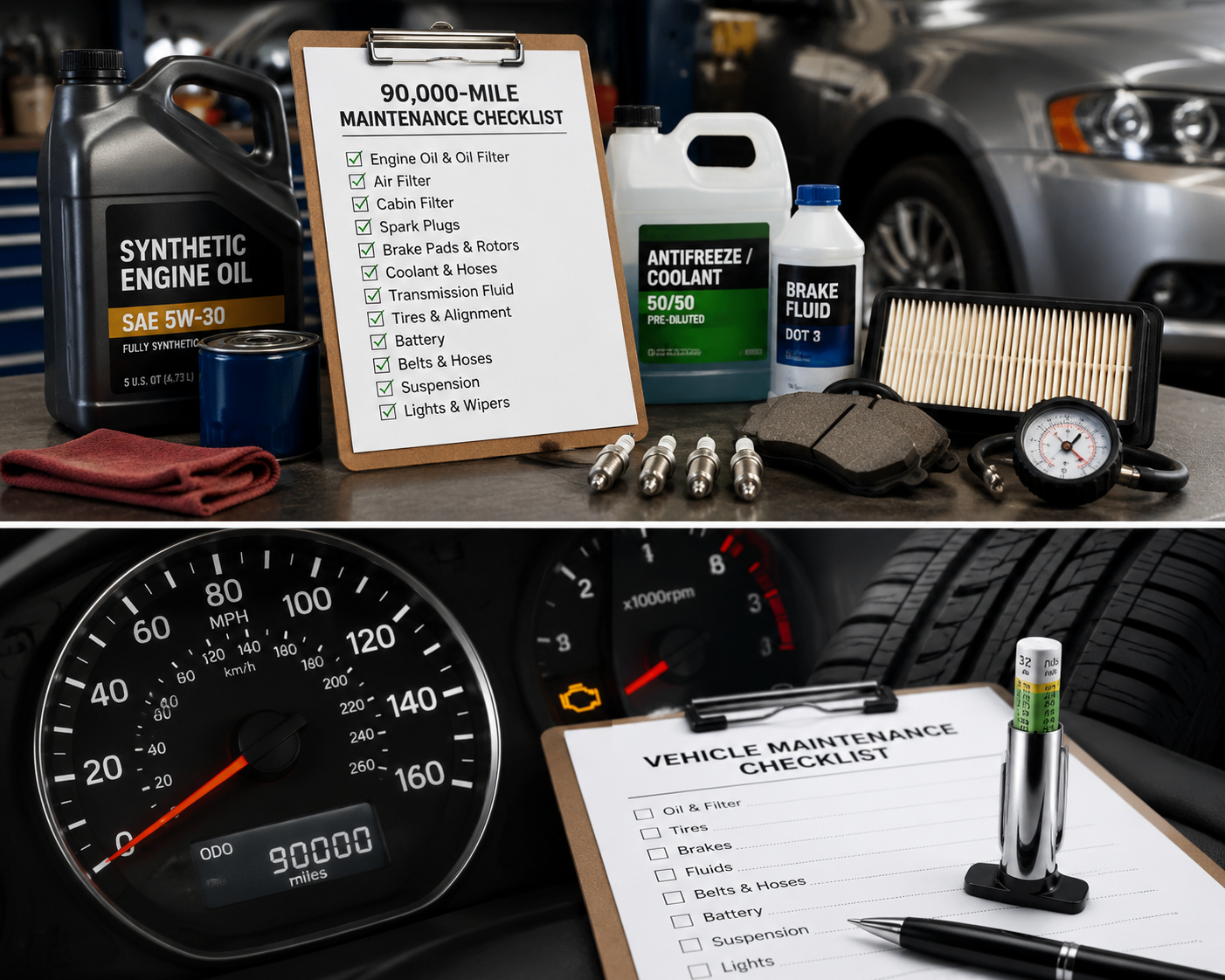
If your car is getting close to 90,000 miles, you may be wondering what actually needs attention. Do you need a major service? Should you replace the spark plugs? What about transmission fluid, brakes, tires, belts, or coolant?
I’m Alex Carter, and I like to keep car care simple and practical.
Reaching 90,000 miles does not mean your car is worn out. A properly maintained vehicle may still have many reliable miles ahead. However, this is an important mileage because fluids, filters, ignition parts, belts, hoses, brakes, tires, batteries, and suspension components may already have years of wear.
In this guide, I’ll walk you through what to inspect, what may need replacement, what can sometimes wait, and how to avoid paying for unnecessary repairs.
Affiliate Disclosure: As an Amazon Associate I earn from qualifying purchases. If you purchase through links in this article, I may earn a commission at no additional cost to you.
Quick Answer: What Maintenance Should Be Done at 90,000 Miles?
At around 90,000 miles, your car should receive a thorough maintenance inspection.
The main areas to check include:
- Engine oil and oil filter
- Engine air filter
- Cabin air filter
- Brakes
- Tires
- Coolant
- Brake fluid
- Transmission fluid
- Spark plugs
- Battery
- Belts and hoses
- Cooling system
- Suspension
- Steering components
That does not mean every item needs to be replaced immediately.
Your exact maintenance requirements depend on your vehicle’s make, model, engine, previous service history, driving conditions, and factory maintenance schedule.
The goal of a 90k service is simple: identify worn or overdue items before they become expensive problems.
What Does 90k Car Maintenance Usually Include?
A 90,000-mile service is not identical for every vehicle.
A Toyota, Honda, Ford, Chevrolet, Hyundai, Subaru, BMW, or other vehicle may have different factory-recommended maintenance intervals.
Always start by checking your owner’s manual and previous service records.
Still, there are several areas that deserve attention around this mileage.
Engine Oil and Oil Filter
Change the engine oil and filter if your normal oil-change interval is due.
Do not wait specifically for 90,000 miles if an oil change is already overdue.
Engine Air Filter
A dirty engine air filter can restrict airflow.
Inspect it and replace it when it becomes dirty or restricted.
Cabin Air Filter
The cabin air filter helps keep dust, pollen, and debris out of your vehicle’s ventilation system.
Replace it when it becomes dirty or when airflow through the vents starts to feel weak.
Spark Plugs
Many vehicles use long-life spark plugs, but replacement intervals vary.
Check your owner’s manual instead of assuming every vehicle needs new spark plugs exactly at 90,000 miles.
Brakes
Inspect:
- Brake-pad thickness
- Brake rotors
- Brake-fluid condition
- Brake noise
- Pedal feel
- Vehicle pulling while braking
Tires
Check:
- Tire pressure
- Tread depth
- Uneven wear
- Tire age
- Sidewall damage
- Alignment symptoms
Coolant and Cooling System
Inspect coolant condition, hoses, radiator, thermostat-related symptoms, and the water-pump area for signs of leakage.
Transmission Fluid
Transmission-fluid service varies significantly between vehicles.
Follow the maintenance schedule and fluid specification recommended for your exact transmission.
Battery
Check battery age, terminal corrosion, starting performance, and charging-system condition.
Belts and Hoses
Inspect the serpentine belt and coolant hoses for:
- Cracks
- Fraying
- Swelling
- Glazing
- Leaks
- Other deterioration
Suspension and Steering
Check for worn shocks, struts, bushings, ball joints, tie rods, wheel bearings, and related components when symptoms are present.
Alex’s Tip: Do not approve a large “90k service package” simply because a repair shop recommends it. Ask for an itemized estimate and compare each service with your vehicle’s factory maintenance schedule.
How to Tell If Your Car Really Needs 90k Service
Your vehicle does not suddenly become unreliable when the odometer reaches 90,000 miles.
However, years of heat, vibration, weather, highway driving, stop-and-go traffic, and normal wear can begin affecting different components.
Watch for symptoms such as:
- Rough idle
- Slow starting
- Difficult starting
- Check-engine light
- Reduced fuel economy
- Weak acceleration
- Squeaking brakes
- Grinding brakes
- Steering-wheel vibration
- Uneven tire wear
- Fluid leaks
- Unusual smells
- Engine overheating
- Hard shifting
- Clunking over bumps
These symptoms do not automatically mean you need an expensive repair.
They mean the vehicle should be properly inspected and diagnosed.
90k Car Maintenance Checklist by System
1. Engine and Ignition System
Start with the engine.
Make sure routine oil maintenance is current and inspect the engine compartment for visible leaks, damaged wiring, loose connections, or unusual noises.
Check the following:
- Change engine oil and filter if due.
- Inspect for oil leaks.
- Inspect for coolant leaks.
- Check the engine air filter.
- Review the spark-plug replacement interval.
- Investigate rough running or misfires.
- Do not ignore a check-engine light.
- Read stored diagnostic trouble codes when necessary.
If the check-engine light is on, reading the stored diagnostic code can give you a useful starting point before replacing parts.
Recommended Tool: BlueDriver Bluetooth Pro OBDII Scan Tool

Check the price on Amazon
I like the BlueDriver because it gives everyday drivers a convenient way to investigate a check-engine warning before replacing parts blindly.
It can be useful when:
- Your check-engine light comes on
- You want to read stored trouble codes
- You want more information before visiting a repair shop
- You are troubleshooting a higher-mileage vehicle
A diagnostic trouble code is still only a starting point.
For example, a code related to an oxygen sensor does not necessarily mean the oxygen sensor itself has failed. Other engine or electrical problems can sometimes trigger related codes.
Always diagnose the actual cause before buying replacement parts.
2. Fluids
Fluids protect some of the most expensive components in your vehicle.
At around 90,000 miles, you should know when each important fluid was last inspected or serviced.
Engine Oil
Engine oil lubricates moving engine parts and helps control heat and contamination.
Follow your normal oil-change schedule.
Coolant
Coolant helps regulate engine temperature and protects the cooling system.
Check:
- Coolant level
- Coolant condition
- Service history
- Manufacturer replacement interval
Never open a hot cooling system.
Brake Fluid
Brake fluid transfers hydraulic pressure through the braking system.
Follow your vehicle manufacturer’s service recommendations.
Transmission Fluid
Transmission fluid lubricates and protects internal transmission components.
Do not automatically perform a transmission flush simply because your vehicle reaches 90,000 miles.
First check:
- Manufacturer recommendations
- Previous service history
- Correct fluid specification
- Transmission condition
- Correct service procedure
Power Steering Fluid
If your vehicle uses hydraulic power steering, inspect the fluid condition and level as recommended.
Many newer vehicles use electric power steering and do not have conventional power-steering fluid.
3. Brakes and Tires
Brakes and tires should be high on your maintenance priority list because they directly affect vehicle safety.
Brake Inspection
Check:
- Brake-pad thickness
- Rotor condition
- Brake-fluid condition
- Grinding noises
- Squeaking noises
- Brake-pedal feel
- Vibration during braking
- Vehicle pulling while braking
Grinding brakes should not be ignored.
Tire Inspection
Check:
- Cold tire pressure
- Tread depth
- Uneven tread wear
- Sidewall cracking
- Tire damage
- Tire age
- Alignment symptoms
Uneven tire wear can be caused by more than the tire itself.
Possible causes include:
- Incorrect pressure
- Wheel alignment
- Worn suspension components
- Steering problems
If your steering wheel is off-center or your car pulls to one side, have the alignment and suspension inspected.
Recommended Tool: AstroAI Digital Tire Pressure Gauge 150 PSI
Check the price on Amazon
I like this type of digital gauge because checking tire pressure takes only a few seconds, yet it can help you catch an underinflated tire before it becomes a bigger problem.
Incorrect tire pressure can contribute to:
- Uneven tire wear
- Poor handling
- Reduced fuel efficiency
- Excess tire heat
- Shorter tire life
Use the tire-pressure specification provided by your vehicle manufacturer.
You can normally find the correct PSI:
- On the driver-side door-jamb label
- In the owner’s manual
Do not automatically inflate your tires to the maximum PSI printed on the tire sidewall.
4. Belts, Hoses, and Cooling System
Rubber components deteriorate over time because of heat, age, vibration, and repeated engine operation.
Around 90,000 miles, inspect:
- Serpentine belt
- Accessory-drive belt if applicable
- Radiator hoses
- Coolant hoses
- Radiator
- Coolant condition
- Thermostat-related symptoms
- Water-pump area
Look for:
- Cracking
- Swelling
- Fraying
- Glazing
- Leaking
- Soft spots
- Other deterioration
Warning Signs of Cooling-System Problems
Pay attention to:
- Rising temperature gauge
- Coolant leaks
- Sweet smell
- Steam from the engine compartment
- Frequent coolant loss
- Overheating
If your engine begins overheating, avoid continuing to drive unnecessarily.
Severe overheating can cause major engine damage.
5. Battery and Charging System
A weak battery can cause:
- Slow starting
- Difficult starting
- Electrical problems
- Unexpected breakdowns
Check:
- Battery age
- Terminal corrosion
- Loose connections
- Slow engine cranking
- Battery condition
- Charging-system performance
Do not replace the battery simply because your car has reached 90,000 miles.
Battery life depends on:
- Battery age
- Climate
- Driving habits
- Vehicle electronics
- Charging-system condition
6. Suspension and Steering
Suspension and steering components may begin showing noticeable wear as vehicle mileage increases.
Possible warning signs include:
- Clunking over bumps
- Excessive bouncing
- Vehicle wandering
- Uneven tire wear
- Steering looseness
- Steering vibration
- Poor handling
- Vehicle sitting lower on one side
A proper inspection may include:
- Shocks
- Struts
- Bushings
- Ball joints
- Tie rods
- Wheel bearings
- Control arms
- Other steering and suspension components
Do not replace suspension parts simply because of mileage.
Inspect them first.
Do Spark Plugs Need to Be Replaced at 90,000 Miles?
Maybe.
Spark-plug replacement intervals depend on the vehicle and plug type.
Some vehicles require spark-plug replacement earlier, while others may use plugs designed to last around or beyond 100,000 miles.
Check your owner’s manual first.
Possible symptoms of ignition problems include:
- Rough idle
- Engine misfires
- Difficult starting
- Weak acceleration
- Reduced fuel economy
- Check-engine light
If your spark plugs are due according to the manufacturer, replacing them on schedule can help prevent future ignition problems.
Should You Change Transmission Fluid at 90,000 Miles?
There is no single answer that applies to every car.
Different transmissions use different:
- Fluids
- Service intervals
- Procedures
- Maintenance requirements
Before authorizing transmission service, check:
- Your owner’s manual.
- Factory maintenance schedule.
- Previous transmission-service history.
- Current transmission performance.
- Correct fluid specification.
- Correct service procedure.
If you bought a used car and do not know its transmission history, get professional advice before performing aggressive transmission service.
How to Plan 90k Car Maintenance Without Overspending
A 90,000-mile service can become expensive if you approve every recommendation without checking whether the work is actually necessary.
I recommend prioritizing maintenance in this order:
1. Safety
Start with:
- Brakes
- Tires
- Steering
- Serious suspension problems
2. Reliability
Next, address problems that could leave you stranded or damage expensive components.
Examples include:
- Cooling-system problems
- Major fluid leaks
- Worn belts
- Starting problems
3. Scheduled Preventive Maintenance
Complete maintenance that is actually due according to the manufacturer.
4. Comfort and Convenience
Non-critical items can usually come after safety and reliability concerns.
Step 1: Read Your Owner’s Manual
Find the maintenance schedule for your exact:
- Make
- Model
- Engine
- Transmission
- Model year
This should be your starting point.
Step 2: Review Your Service History
Do not pay for maintenance that was already performed recently.
Check receipts and previous service records.
Step 3: Get a Full Inspection
Ask the mechanic to document worn components.
When possible, request:
- Photos
- Measurements
- Technician notes
- Written recommendations
This makes it easier to understand what actually needs repair.
Step 4: Separate Urgent Repairs From Future Maintenance
Ask the repair shop:
What needs to be repaired today?
Then ask:
What can safely wait?
For example, badly worn brake pads are a higher priority than a cabin air filter that still has some usable life.
Step 5: Ask for a Written Estimate
Review:
- Parts cost
- Labor cost
- Taxes
- Shop fees
- Warranty
- Total price
before approving expensive work.
Step 6: Keep Your Own Maintenance Records
Keep track of:
- Date
- Mileage
- Service performed
- Parts installed
- Fluids used
- Repair shop
- Next recommended service
A simple maintenance record can prevent you from paying for the same maintenance twice.
Common 90,000-Mile Maintenance Mistakes
Avoid these common mistakes:
- Replacing parts only because a shop says “it’s time”
- Ignoring grinding brakes
- Ignoring badly worn tires
- Using incorrect fluids
- Ignoring dashboard warning lights
- Performing transmission service without checking the correct procedure
- Buying replacement parts before diagnosing the problem
- Forgetting tire-pressure checks
- Ignoring coolant leaks
- Confusing an OBD2 code with a complete diagnosis
The best approach is simple:
Inspect first. Diagnose second. Replace parts when necessary.
Can You Do 90k Maintenance Yourself?
Some maintenance tasks are realistic DIY jobs for many car owners.
Depending on your experience, you may be able to:
- Check tire pressure
- Inspect tire tread
- Replace windshield wipers
- Replace some air filters
- Check accessible fluid levels
- Inspect exterior lights
- Read OBD2 diagnostic codes
- Keep maintenance records
More complicated work may require professional tools and experience.
Examples include:
- Brake repairs
- Suspension repairs
- Transmission service
- Cooling-system repairs
- Complex electrical diagnosis
- Difficult spark-plug replacement
Know your limits.
Saving money on labor is not worth creating a safety problem or damaging an expensive component.
My Simple 90k Car Maintenance Priority List
Priority 1: Brakes and Tires
These directly affect vehicle safety.
Priority 2: Cooling System and Major Leaks
Cooling-system failure can cause expensive engine damage.
Priority 3: Engine Oil and Overdue Maintenance
Keep all required factory maintenance current.
Priority 4: Belts and Hoses
Worn belts and hoses can cause unexpected breakdowns.
Priority 5: Spark Plugs and Ignition System
Service them when required by the manufacturer or when symptoms indicate a problem.
Priority 6: Battery and Charging System
Checking battery health may prevent unexpected starting problems.
Priority 7: Suspension and Steering
These components affect handling, tire wear, ride quality, and safety.
Expert Tips From Alex
Alex’s Tip: If you bought your car used and do not know its maintenance history, take the 90k inspection more seriously. Unknown maintenance history is where expensive surprises can hide.
Alex’s Tip: Ask the repair shop to show you worn components or provide photos when practical.
Alex’s Tip: Do not replace a part simply because you hear a noise. Tires, brakes, wheel bearings, suspension components, and engine mounts can sometimes produce similar symptoms.
Alex’s Tip: Keep your repair receipts and maintenance records. Good documentation makes future troubleshooting easier.
Key Takeaways
- 90k car maintenance is about safety, reliability, and preventing expensive repairs.
- Always check your owner’s manual before approving major maintenance.
- Brakes and tires should be high priorities.
- Inspect fluids, belts, hoses, spark plugs, battery, suspension, and cooling-system components.
- Do not automatically replace everything simply because your vehicle reaches 90,000 miles.
- Use your maintenance history to avoid repeating unnecessary services.
- An OBD2 scanner can be useful when diagnosing a check-engine warning.
- A tire-pressure gauge is useful for routine tire maintenance.
- Ask for an itemized estimate before approving expensive repairs.
- Diagnose problems before buying replacement parts.
Frequently Asked Questions
What is included in 90k car maintenance?
A typical 90,000-mile inspection may include engine oil, filters, brakes, tires, fluids, spark plugs, belts, hoses, battery condition, cooling-system components, steering, and suspension.
The exact maintenance schedule depends on your vehicle.
Is a 90,000-mile service necessary?
A detailed inspection around 90,000 miles is usually a smart idea because many vehicle components have accumulated significant wear by this stage.
However, you should not automatically replace every component.
How much does 90k car maintenance cost?
The cost varies significantly depending on your vehicle, location, labor rates, and which maintenance items actually need attention.
A basic inspection and routine maintenance may cost relatively little, while brakes, tires, spark plugs, suspension repairs, or cooling-system work can increase the total considerably.
Do spark plugs need to be replaced at 90,000 miles?
It depends on your vehicle.
Check the spark-plug replacement interval in your owner’s manual.
Should transmission fluid be changed at 90,000 miles?
Maybe.
Follow the maintenance schedule and correct service procedure for your exact transmission instead of using a universal mileage rule.
Can I do 90k maintenance myself?
Some basic inspections and maintenance can be done at home, including checking tire pressure, replacing certain filters, checking lights, replacing wipers, and reading basic diagnostic trouble codes.
More complicated repairs may require a qualified technician.
Is an OBD2 scanner useful for a high-mileage vehicle?
Yes.
An OBD2 scanner can help retrieve stored diagnostic trouble codes when a compatible vehicle has a check-engine warning.
However, the code should be treated as a starting point for diagnosis rather than proof that a particular component needs replacement.
How often should I check tire pressure?
Check tire pressure regularly and before long trips.
Measure tire pressure when the tires are cold and follow the vehicle manufacturer’s recommended PSI.
Conclusion
Reaching 90,000 miles should not make you panic about your car.
Instead, treat it as an opportunity to review your maintenance history and inspect the components that affect safety and reliability.
Start with your owner’s manual and check what has already been serviced.
Then inspect:
- Brakes
- Tires
- Fluids
- Belts
- Hoses
- Spark plugs
- Battery
- Cooling system
- Suspension
- Steering components
For basic at-home maintenance, a few useful tools can make car care easier.
The BlueDriver Bluetooth Pro OBDII Scan Tool can help you investigate diagnostic trouble codes when a check-engine warning appears.
The AstroAI Digital Tire Pressure Gauge 150 PSI can make routine tire-pressure checks quick and convenient.
My advice is simple:
Inspect first, understand the problem, and spend money on the maintenance your vehicle actually needs.