
A dead battery rarely picks a convenient moment. It happens in a cold driveway before work, in a parking garage, or at the end of a long weekend trip. A jump starter kit solves that problem without needing a second car or a stranger’s help, and modern lithium models are small enough to live permanently in a glovebox or trunk.
These kits have moved well past a basic battery pack with clamps. Many now double as tire inflators, USB power banks, work lights, and even roadside tool kits with tow ropes and safety gloves. The right one depends on what vehicles need starting, how much extra gear is worth carrying, and how much space is available in the vehicle.
Buyers should pay attention to peak amps versus claimed engine size, since a high amp number does not always mean a stronger real-world start. Battery capacity (measured in watt-hours or mAh), charging speed, safety protections like reverse-polarity detection, and included accessories all affect how useful a unit is in practice. A jump starter kit rated for a large diesel engine will almost always have enough reserve power for a smaller gas engine, but the reverse is not true. Weight and size matter too, especially for anyone who wants to keep the kit in a glovebox rather than a trunk.
Best for compact everyday carry: NOCO Boost GB20
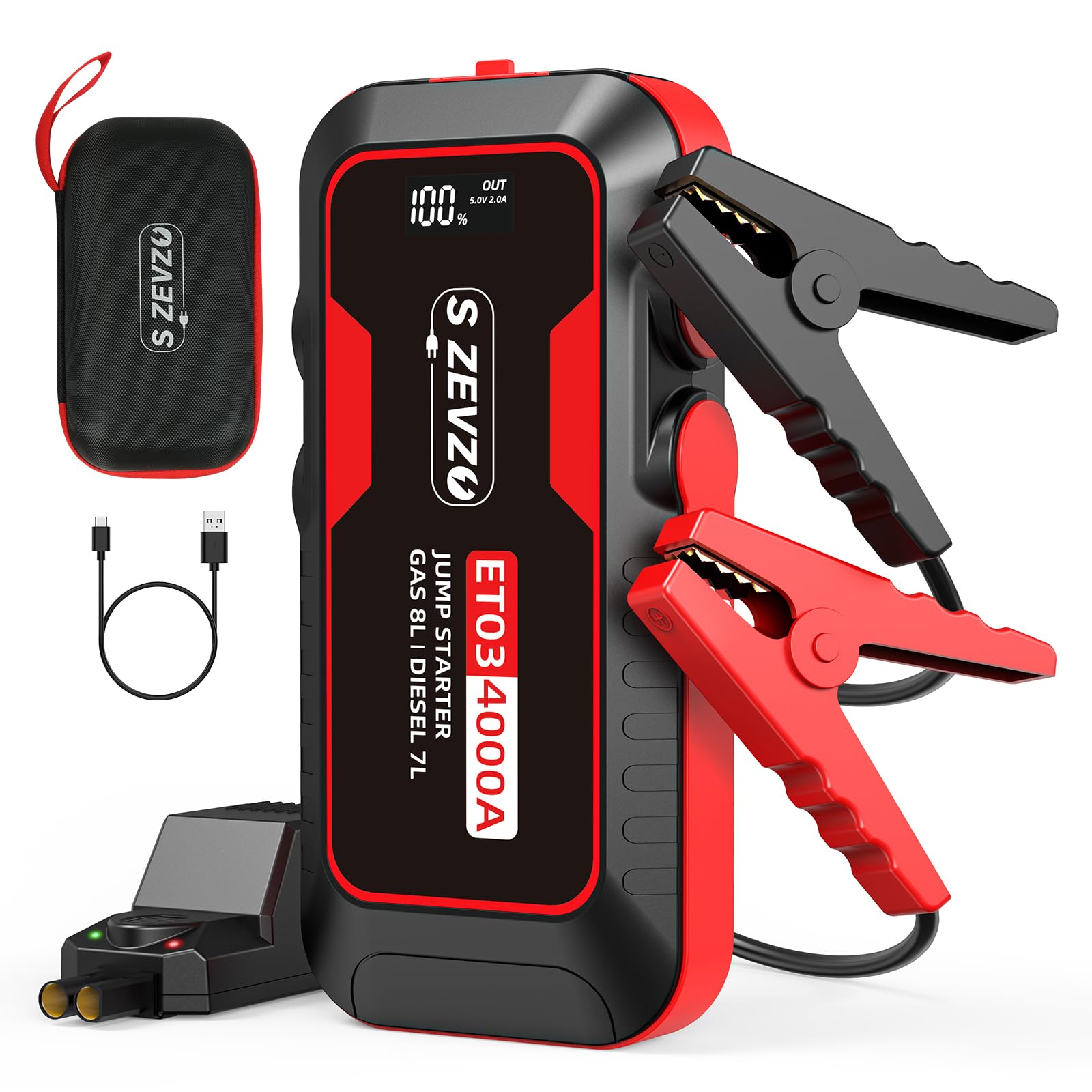
Best for diesel trucks and larger engines: S ZEVZO ET03
Best all-in-one with air compressor: WOLFBOX MV24A
Best for high-pressure tire inflation: DECHANIE Jump Starter with Air Compressor
Best for full roadside emergency prep: YaberAuto 16-in-1
Best value multi-tool jump starter: MAIDELI 6000A
Best for fast USB-C charging: WOLFBOX MV24 (MegaVolt24)
Best budget air compressor combo: AstroAI S8 Air
Best slim profile with smart display: LOKITHOR J400
Best for larger gas and diesel engines on a budget: DBPOWER 5000A
NOCO Boost GB20

This is the pick for drivers who want a small, trustworthy jump starter for a standard gas car without extra bulk.
Pros
- Compact 2.4-pound build fits easily in a glovebox
- UltraSafe spark-proof and reverse-polarity protection
- IP65-rated housing resists water and dust
Cons
- Rated only for engines up to 4.0L gas
- Lower peak amps than most other kits here
- No air compressor or tool kit extras
- Read more: Jump Starter Kit
The GB20 delivers 500 peak amps, which sounds modest next to some of the 4000A-plus units on this list, but it is sized for typical passenger car engines, not diesel trucks. NOCO’s UltraSafe technology is a real differentiator: the spark-proof clamps make it hard to connect incorrectly, which matters for less experienced users. It also works as a USB-C power bank and includes a 100-lumen flashlight with SOS mode. For anyone with a sedan, motorcycle, or small SUV, this smaller, well-built unit can be the smarter buy over a bigger multifunction kit that goes unused.
S ZEVZO ET03
This kit suits truck and SUV owners who need enough claimed capacity for larger gas or diesel engines without paying for an air compressor.
Pros
- Claimed support for up to 8.0L gas and 7.0L diesel engines
- Force-start function for fully dead 0V batteries
- LCD screen shows battery status at a glance
Cons
- No built-in air compressor
- Bulkier than slim single-purpose starters
- Smart clamps add a learning curve for first-time users
The ET03’s 74Wh battery and 4000A peak rating put it in a higher capacity tier than basic compact starters. The force-start feature is designed for batteries that read close to 0V, though NOCO’s manual guidance that the unit itself needs a solid charge above 14V still applies. Two USB ports let it double as a power bank, and the 500-lumen light is bright enough for actual roadside repair work, not just visibility.
WOLFBOX MV24A
This is the stronger of two similarly named WOLFBOX kits, built for drivers who want jump-starting and tire inflation in one unit.
Pros
- Built-in 160 PSI air compressor inflates a sedan tire in under a minute
- 65W USB-C fast charging recharges the unit in about two hours
- Claimed rating up to 10L gas or 10L diesel engines
Cons
- Heavier at roughly 3.4 pounds plus accessories
- No charging adapter included for the 65W port
- Larger footprint than non-compressor models
Labeled the “MV24A” or MegaVolt24 Air, this model should not be confused with the standalone WOLFBOX MV24 further down this list, which skips the compressor entirely. The compressor here is genuinely useful, rated to fill a pickup tire in a few minutes. Combined with a 400-lumen light and 24,000mAh power bank function, it covers more roadside situations than a jump starter alone, at the cost of extra size and weight.
DECHANIE Jump Starter with Air Compressor
This kit fits drivers who inflate tires often and want precise pressure control alongside jump-starting power.
Pros
- Four preset inflation modes for cars, motorcycles, bikes, and balls
- LCD switches between PSI, BAR, KPA, and kg/cm² units
- Claimed 5000A peak with automatic boost for low batteries
Cons
- Battery capacity is not listed in watt-hours, making comparison harder
- Bulkier housing than slim jump-only units
- Limited to a single USB-A output for device charging
The auto-shutoff inflation feature stands out here. Set a target pressure and the pump stops on its own, which helps prevent overinflating a tire. Ten safety protections cover reverse polarity and overcurrent, and the accessory bundle includes five nozzles for everything from car tires to sports equipment. Reviewers note the setup sequence needs to be followed closely for the jump-start function to engage correctly.
YaberAuto 16-in-1
This is the choice for drivers who want a full roadside emergency kit built around a jump starter rather than a jump starter with a few extras.
Pros
- Claimed 8000A peak rated for gas engines and up to 14L diesel
- Includes tow rope, insulated gloves, tire repair kit, and safety hammer
- 99.9Wh battery with 800-lumen light and 160 PSI compressor
Cons
- Larger and heavier than single-function jump starters
- Higher price reflects the added tool kit
- More components to keep track of and recharge
The 16-in-1 label is accurate: this kit bundles a jump starter, compressor, power bank, and a genuine emergency tool set including a stone hook and luggage tie-downs. For drivers who take long road trips or drive older diesel trucks, that breadth of coverage can replace several separate purchases. Those who just want a jump starter and nothing else will find this more kit than they need.
MAIDELI 6000A
This model offers a reasonable middle ground between basic jump starters and fully loaded emergency kits.
Pros
- Claimed 6000A peak with force-start function for drained batteries
- 160 PSI compressor with four inflation modes and auto memory
- Honeycomb heat dissipation design for extended use
Cons
- No published customer review excerpts to reference for real-world feedback
- Battery capacity listed inconsistently across specification fields
- Bulkier than jump-only alternatives
The YL03’s standout feature is its thermal design, which the manufacturer says improves heat dissipation and extends the unit’s working lifespan. Thirteen safety protections and auto-detect jumper cables add a layer of reassurance for less experienced users. The 800-lumen light and 26,800mAh power bank round out a kit built for drivers who want compressor and jump-start functions without paying for a full tool kit.
WOLFBOX MV24 (MegaVolt24)
This is the leaner WOLFBOX option for drivers who want fast charging and a jump starter without the added weight of a compressor.
Pros
- 65W USB-C charging brings a full recharge in about 1.3 hours
- Slimmer, lighter build than the MV24A compressor version
- LCD display shows real-time status information
Cons
- No air compressor, unlike the MV24A
- Same 4000A claimed rating as the heavier compressor model
- Charging adapter sold separately
This MegaVolt24, without the “Air” suffix, shares its 88.8Wh battery and 4000A peak rating with the MV24A but drops the compressor for a lighter, more glovebox-friendly shape. Buyers who already own a separate tire inflator, or who don’t need one, get the same claimed engine coverage (up to 10L gas or diesel) in a smaller package. The 65W fast charging is genuinely quick compared to older jump starters that take four or more hours to top off.
AstroAI S8 Air
This kit works well for smaller vehicles and drivers who want compressor convenience at a lower claimed amperage.
Pros
- 150 PSI compressor with five preset modes and clear 2.4-inch screen
- Rated for engines up to 9L gas or 6.5L diesel
- Accessories store inside the unit itself, reducing lost parts
Cons
- Lower peak amps (3000A) than most competitors on this list
- Compressor needs a cooldown period after 10 minutes of use
- One reviewer reported an error code after repeated use
The S8 Air’s built-in storage for its power cord and nozzles is a small but practical touch that larger kits often skip. Its screen stays readable in direct sunlight, useful when checking tire pressure outdoors at midday. The lower peak amp rating compared to 4000A-plus competitors means it suits smaller engines better than large trucks or diesel equipment.
LOKITHOR J400
This slim jump starter fits drivers who want a clear digital readout and dependable connection detection without extra bulk.
Pros
- Large 5.75-inch display shows battery status and connection alerts
- ConnectMax technology adjusts output automatically for a cleaner start
- Rated for up to 8.0L gas or 6.0L diesel engines
Cons
- No air compressor or power tool accessories
- 2000A peak is lower than several rivals in this price range
- Shorter 1-year warranty than some competitors’ 2-year coverage
The J400’s screen is genuinely larger and easier to read than most jump starters in this category, showing real battery voltage rather than a vague charge bar. That data point helps confirm whether a “dead” battery is truly drained or just low. This is a strong option for anyone who wants clear diagnostics in a slim unit and does not need a compressor or tool kit.
DBPOWER 5000A
This is a budget-friendly option for drivers who want high claimed amperage for larger engines without paying for compressor or tool kit extras.
Pros
- Claimed rating up to 10.0L gas and 8.0L diesel engines
- 74Wh battery with dual USB outputs for device charging
- IP65-rated housing built for harsh outdoor conditions
Cons
- No published customer reviews available to verify long-term reliability
- No compressor or bundled emergency tools
- Type-C input charging cable must match the original for accurate readings
The Z07’s 10-protection system covers the essentials: reverse polarity, overload, and temperature protection for both hot and cold extremes. Its 500-lumen light offers three modes, including SOS, and the two USB outputs let it serve double duty as a power bank. The manufacturer’s note about needing the original charging cable for accurate battery readings is worth following closely to avoid confusion about remaining charge.
Buying Guide
Match Peak Amps to Engine Size, Not the Other Way Around
Peak amp ratings describe the maximum current a jump starter can deliver in a short burst, not a guarantee of a successful start every time. Manufacturers list these numbers under ideal lab conditions with a fully charged unit and clean cable connections.
A kit claiming to start a 10L diesel engine likely has more than enough reserve for a compact sedan or motorcycle. The reverse is not true: a unit built for small gas engines will struggle or fail on a large diesel truck.
| Vehicle Type | Typical Engine Size | Suggested Peak Amps |
|---|---|---|
| Motorcycle, ATV, lawn mower | Under 1.5L | 500A – 1000A |
| Sedan, small SUV | 1.5L – 4.0L gas | 500A – 2000A |
| Truck, large SUV, van | 4.0L – 8.0L gas | 2000A – 5000A |
| Diesel truck, RV, boat | 6.0L – 14L diesel | 4000A – 8000A |
Watt-Hours Tell the Real Capacity Story
Peak amps describe burst power, but watt-hours (Wh) describe how much total energy the battery holds. A 12V unit near 74-99Wh generally supports more jump starts per charge and more use as a power bank than a smaller 20-30Wh unit.
Higher capacity also means a longer shelf life between charges, which matters for a kit that might sit in a trunk for months.
Extra Features Worth Paying For
Many jump starters now include a compressor, USB power bank, and LED work light in one housing. Each adds convenience, but also size, weight, and potential points of failure.
- Air compressor: Look at PSI rating and inflation speed. 150-160 PSI models handle car, truck, and even off-road tires. Auto-shutoff prevents overinflation.
- Power bank function: USB-C ports with higher wattage (45W+) charge phones and tablets faster and can top off laptops in some cases.
- Work light: Multiple modes (steady, strobe, SOS) add value for roadside visibility and repairs at night.
- Digital display: A screen showing voltage or connection status helps confirm a proper connection before attempting a start.
Safety Features to Confirm Before Buying
Reverse-polarity protection and spark-proof clamps prevent a common and dangerous mistake: connecting the cables backward. Look for language confirming these protections explicitly, along with overcurrent, overcharge, and short-circuit protection.
An IP65 rating indicates resistance to dust and water spray, useful for anyone storing the kit in a trunk or truck bed rather than a climate-controlled glovebox.
Real-World Factors That Affect Performance
A jump starter’s actual performance depends on more than its spec sheet. Cable length and gauge affect how much power reaches the battery terminals, especially in tight engine bays. A partially charged unit delivers less power than its rated peak amps suggest, so recharging every two to three months maintains readiness.
Cold weather reduces lithium battery output temporarily, which is why many kits list a minimum operating temperature around -4°F. Storing the unit inside the cabin rather than an unheated trunk in freezing climates helps preserve performance when it’s needed most.