
For drivers shopping for cheap EV cars. the biggest savings often come from choosing the right charging setup and accessories to match the vehicle’s connector. parking situation. and daily driving needs. A good charger can make an affordable EV easier to live with. especially if you rely on home charging or need flexibility between Level 1 and Level 2 charging.
This guide focuses on EV charging products that can help smart buyers keep ownership costs under control. If you’re comparing home charging options. portable setups. or installation-friendly choices. the picks below can help you narrow down what fits your vehicle. your outlet. and your routine.
The best cheap EV cars support is usually a charger that matches your connector, outlet, and charging speed needs. For a permanent home setup. the EVIQO Level 2 J1772 EV Charger is the strongest overall pick. while portable options like EVDANCE. the upgraded J1772 charger. and the 16A portable charger make more sense for drivers who want flexibility or lower upfront cost.
We used only the product details supplied for this guide, including connector type, charging format, safety claims, ratings, review counts, and listed features. Because no verified first-hand testing evidence is available. the recommendations below use evidence-based editorial judgment and should be cross-checked against your vehicle manual. outlet type. and the current product page before buying.
Quick Comparison Table.
| Product | Image | Best For | Compatibility Check | View on Amazon |
|---|---|---|---|---|
| EVIQO J1772 EV Charger. |  |
Hardwired home charging. | Confirm J1772 port and electrical panel capacity. | View on Amazon |
| EVDANCE Level 2 EV Charger. | |
Portable Level 2 charging. | Confirm J1772 port and NEMA 14-50 outlet. | View on Amazon |
| Upgraded J1772 EV Charger. | |
Flexible Level 1 and Level 2 use. | Confirm J1772 port and outlet support for 120V or 240V charging. | View on Amazon |
| EVIQO J1772 EV Charger. | |
Plug-in home wall charging. | Confirm J1772 port and NEMA 14-50 outlet. | View on Amazon |
| 16A Portable EV Charger. | |
Dual-level portable charging. | Confirm outlet type and current setting before use. | View on Amazon |
What to Look for in cheap ev cars.
Vehicle fitment and compatibility.
Start with the charging port on your EV or plug-in hybrid. Most of the products here use a J1772 connector. so non-Tesla EVs and many plug-in hybrids are the main fit. while Tesla drivers may need an adapter depending on the product and vehicle setup. For a broader overview of plug types, see.our guide to EV connectors.
Installation style.
Decide whether you want a hardwired wall charger, a plug-in wall unit, or a portable charger you can move between locations. Hardwired units usually need a licensed electrician. while portable units are easier to set up but still depend on the right outlet and safe circuit capacity. If you’re planning a permanent setup, our.EV charger installation guidecan help you think through the basics.
Electrical and connector requirements.
Check the outlet type, circuit rating, and charging level before you buy. Some chargers are built for 240V home charging, while others can also work at 120V for slower charging. If you want a deeper comparison of charging levels, our.Level 1 vs Level 2 EV charging guideis a useful place to start.
Durability and weather resistance.
Look for sealed housings, cable length that works in your garage or driveway, and enough protection for indoor or covered outdoor use. A charger i. e. easier to store, dock, and protect from weather can be a better long-term value than one that only looks cheaper up front.
Safety and charging control.
Adjustable amperage, temperature protection, and certification claims matter because they affect how safely the charger works on different circuits. Features like app control. scheduled charging. or a screen can also help you manage energy use and reduce unnecessary stress on the battery and electrical system.
Value and ownership cost.
For cheap EV cars owners, the best value is often the charger that matches your daily mileage without overbuying speed you won’t use. If you only need top-ups, a portable charger may be enough. If you charge every night at home, a dedicated wall unit can be the better long-term choice.
Before ordering any EV charger. verify your vehicle’s connector type. your outlet or panel capacity. and whether you need a hardwired installation or a plug-in unit. When in doubt, check the owner’s manual, the charger’s product page, and a licensed electrician’s guidance for your home setup.
Our Top 5 Cheap Ev Cars Picks.
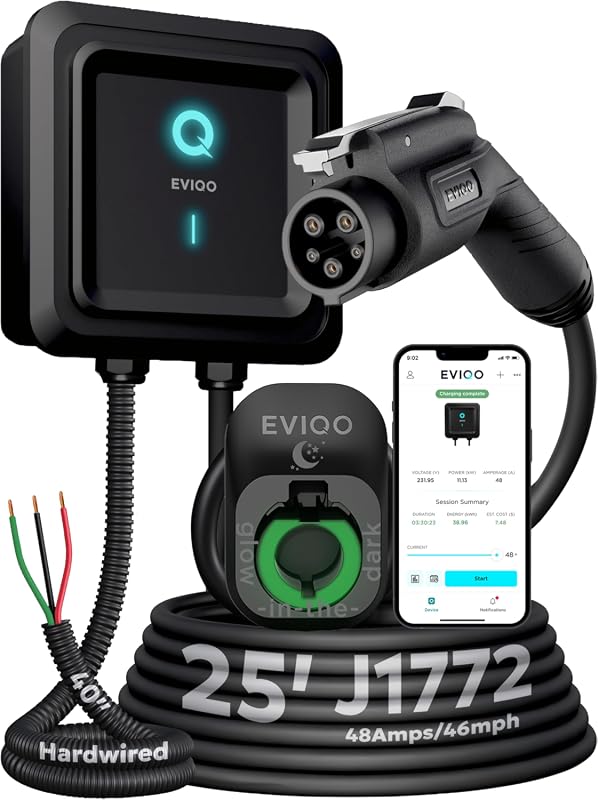
EVIQO Level 2 J1772 EV Charger, 48A Hardwired 240V Wall Charging Station
This hardwired Level 2 charger is designed for drivers who want a permanent home charging setup and broad J1772 compatibility. It supports app-based control, weather-resistant construction, and a long cable that should suit many garage or driveway layouts.
Key Features.
- Works with non-Tesla EVs and plug-in hybrids that use J1772.
- Hardwired installation with licensed electrician support recommended.
- App control for charging start/stop, speed, reminders, and energy tracking.
- Sealed housing with weather resistance for indoor or outdoor use.
- 25 ft cable for flexible reach.
Why It Stands Out.
It combines higher charging output with strong compatibility and app-based control, which makes it a practical home base charger for many EV owners. The review volume is also much higher than the smaller portable options, which may matter to buyers who want a more established product listing.
Best For.
Best for non-Tesla EV drivers who want a dedicated home charger, have electrician access, and plan to charge overnight on a consistent schedule.
- Broad J1772 compatibility.
- App control and scheduling.
- Long cable reach.
- Weather-resistant design.
- Requires hardwired installation.
- Needs panel and circuit verification.
- Not the most portable option.
Verify current specifications, vehicle fitment, availability, and price on the product page and manufacturer documentation before purchasing or installing.
EVDANCE Level 2 Portable EV Charger, 32A 240V NEMA 14-50P, 25ft Cable
This portable Level 2 charger is aimed at drivers who want faster charging without committing to a hardwired installation. It includes adjustable current settings, a display for charging data, and a long cable for easier placement in a garage or covered area.
Key Features.
- Portable Level 2 charging with adjustable output.
- J1772 connector for non-Tesla EVs.
- LED screen showing amperage, voltage, speed, and delay settings.
- 25 ft cable for flexible parking setups.
- IP66-style protection for garage or covered outdoor use.
Why It Stands Out.
The adjustable amperage makes it easier to match different household circuits, which is useful for buyers balancing charging speed and electrical limits. it’s also a strong fit if you want a charger you can move or store instead of mounting permanently.
Best For.
Best for non-Tesla EV owners with a compatible NEMA 14-50 outlet who want portable home charging and more control over current settings.
- Portable and easy to move.
- Adjustable charging current.
- Clear LED charging display.
- Long cable.
- Requires the right 240V outlet.
- Tesla needs an adapter.
- Not meant for direct sunlight or heavy rain.
Verify current specifications, vehicle fitment, availability, and price on the product page and manufacturer documentation before purchasing or installing.
Upgraded Level 1 & 2 J1772 EV Charger, Adjustable 8-16A, 110V-240V Timer
This compact charger is built for drivers who want a lower-cost way to cover both Level 1 and Level 2 charging. Its adjustable amperage and timer features make it a flexible option for mixed-use charging situations.
Key Features.
- Level 1 and Level 2 charging support.
- Adjustable 6A to 16A output.
- J1772 compatibility for many North American EVs and PHEVs.
- Touch-style controls and OLED display.
- ETL and FCC compliance claims listed.
Why It Stands Out.
It offers more flexibility than a basic plug-in charger because it can work across different outlet types and current settings. For buyers who are trying to keep upfront spending down, that versatility can be a strong value point.
Best For.
Best for drivers who need a budget-friendly portable charger for occasional home use, travel, or mixed outlet access.
- Works with Level 1 and Level 2 setups.
- Adjustable current range.
- Compact portable format.
- Lower upfront cost than larger wall units.
- Lower charging ceiling than larger units.
- Small review count.
- Compatibility still depends on outlet type.
Verify current specifications, vehicle fitment, availability, and price on the product page and manufacturer documentation before purchasing or installing.
EVIQO Level 2 J1772 EV Charger, 40A NEMA 14-50 240V Wall Station
This plug-in wall charger is a strong fit for buyers who want a more permanent home solution without hardwiring. It uses a NEMA 14-50 outlet, includes app control, and supports the same broad J1772 compatibility as the other EVIQO model.
Key Features.
- Plug-in Level 2 design for a NEMA 14-50 outlet.
- J1772 connector for non-Tesla EVs and PHEVs.
- App control for charging speed, reminders, and energy tracking.
- Weatherproof housing for indoor or outdoor placement.
- 25 ft cable for flexible parking reach.
Why It Stands Out.
Compared with the hardwired EVIQO option, this model is easier to install if you already have the correct outlet. That makes it appealing for homeowners who want a wall-mounted charger but don’t want to commit to a hardwired setup.
Best For.
Best for non-Tesla EV drivers with a compatible 240V NEMA 14-50 outlet who want a wall-mounted charger and simpler installation than a hardwired unit.
- Plug-in installation.
- App-based charging control.
- Long cable.
- Broad vehicle compatibility.
- Requires the correct outlet.
- Still needs circuit verification.
- Not as portable as a travel charger.
Verify current specifications, vehicle fitment, availability, and price on the product page and manufacturer documentation before purchasing or installing.
16A Portable Level 1&2 EV Charger, ETL Certified 110V-240V Car Charger
This dual-level portable charger is built for drivers who need one charger that can work at home and away from home. It includes a Level 2 plug option and a Level 1 adapter, plus temperature-based protection behavior.
Key Features.
- Portable Level 1 and Level 2 charging support.
- J1772 compatibility.
- Fixed NEMA 6-20 plug plus NEMA 5-15 adapter.
- Temperature protection that reduces power if overheated.
- Manual current adjustment required for Level 1 use.
Why It Stands Out.
Its dual-outlet approach gives it more flexibility than a single-purpose portable charger, especially for drivers who may charge in different locations. That flexibility can be useful if you’re trying to keep EV ownership simple without buying multiple charging tools.
Best For.
Best for budget-conscious EV owners who need a portable charger for both home and travel, and who can confirm outlet compatibility before ordering.
- Dual-level charging support.
- Portable for travel or backup use.
- Temperature protection behavior.
- Lower-cost option.
- Requires careful outlet matching.
- Level 1 charging is much slower.
- Manual current adjustment is needed in some cases.
Verify current specifications, vehicle fitment, availability, and price on the product page and manufacturer documentation before purchasing or installing.
EV charging equipment must match your vehicle’s connector and your home’s electrical setup. Hardwired chargers usually require a licensed electrician, and portable chargers still need the correct outlet, breaker capacity, and safe placement. If anything about your panel, outlet, or vehicle compatibility is unclear, verify it before installation or use.
Complete Buying Guide for Cheap Ev Cars.
Budget and Value.
For cheap EV cars ownership support. value is less about buying the most powerful charger and more about choosing the right charging tier for your routine. Entry-level chargers are usually best for occasional charging or backup use. mid-range options fit most daily drivers. and premium choices make sense when you want faster home charging. app control. and more installation convenience.
Vehicle Fitment and Compatibility.
Always match the charger to your vehicle’s connector type first. Most products here are built around J1772, which is common on many non-Tesla EVs and plug-in hybrids. If you own a Tesla, check whether the charger needs an adapter or whether your vehicle setup supports the product as listed.
Electrical and Outlet Requirements.
Check whether the charger needs a hardwired circuit, a NEMA 14-50 outlet, a NEMA 6-20 outlet, or a standard household outlet. Also confirm whether the charger is designed for 120V, 240V, or both. If you’re unsure about the outlet or breaker, review the product page and consult a qualified electrician.
Charging Speed and Daily Use.
Faster charging isn’t always necessary for every driver. If you drive short daily distances, a slower portable unit may be enough. If you commute farther or need overnight recovery after longer trips, a Level 2 unit with higher current can be a better fit.
Durability and Storage.
Look for long cables, weather resistance, and a design i. e. easy to store when not in use. Portable chargers should be packed and handled carefully, while wall-mounted units should be installed where the cable can reach the car without strain.
Care and Maintenance.
EV chargers are low-maintenance, but they still need basic care. Keep connectors clean and dry, inspect cables for wear, and avoid using a charger in conditions the manufacturer doesn’t recommend. If the charger has app features or adjustable settings, review them periodically so the charger stays matched to your needs.
- Confirm your EV or plug-in hybrid uses the same connector as the charger.
- Check whether the charger requires a hardwired circuit or a specific outlet.
- Verify breaker size and voltage before using a Level 2 charger.
- Use a qualified electrician for hardwired installations or unclear panel setups.
- Keep portable chargers away from standing water and unsafe weather exposure.
- Match amperage settings to the circuit and the charger’s instructions.
- Store the cable so it doesn’t kink, pinch, or sit under vehicle tires.
- Inspect the cable and plug before each charging session.
- Keep the connector clean and dry.
- Check app settings or current limits after setup changes.
- Confirm the outlet and breaker still match the charger’s needs.
- Replace or service any charger with heat damage, cracked housing, or loose connectors.
- EVIQO hardwired charger: best for drivers who want a permanent home charging setup with app control.
- EVDANCE portable charger: best for flexible Level 2 charging with adjustable current.
- Upgraded J1772 charger: best for buyers who want lower-cost dual-level charging.
- EVIQO plug-in wall station: best for homeowners with a compatible NEMA 14-50 outlet.
- 16A portable charger: best for budget-minded drivers who need Level 1 and Level 2 support.
- Always verify connector type and electrical compatibility before buying.
- For permanent installs, confirm circuit capacity and use a qualified electrician when needed.
Frequently Asked Questions About Cheap Ev Cars.
Here, cheap EV cars refers to the practical ownership side of affordable EV driving, especially charging gear that helps keep costs manageable.
Not always. A Level 2 charger is helpful for faster overnight charging. but some drivers can get by with Level 1 or a portable charger if their daily mileage is low.
Some of these chargers can work with Tesla vehicles using a J1772 adapter, but you should verify the exact setup before buying.
Hardwired chargers are often a good fit for permanent home charging. while plug-in chargers are easier to install if you already have the right outlet.
Check the exact outlet type listed by the charger. such as NEMA 14-50. NEMA 6-20. or NEMA 5-15. and confirm that your circuit matches the charger’s requirements.
Choose based on your commute, parking setup, and installation budget. If you charge at home every night, a wall unit may be best; if you need flexibility, a portable charger can be more useful.
If you want the simplest long-term home setup, the hardwired EVIQO model is the strongest fit for many non-Tesla drivers. If you want more flexibility. the EVDANCE or one of the portable dual-level chargers may make more sense depending on your outlet and charging habits.
For most shoppers, the best choice is the charger that fits the vehicle first and the home electrical setup second. That approach gives you a safer, more practical setup and helps you avoid paying for charging speed or features you won’t use.