
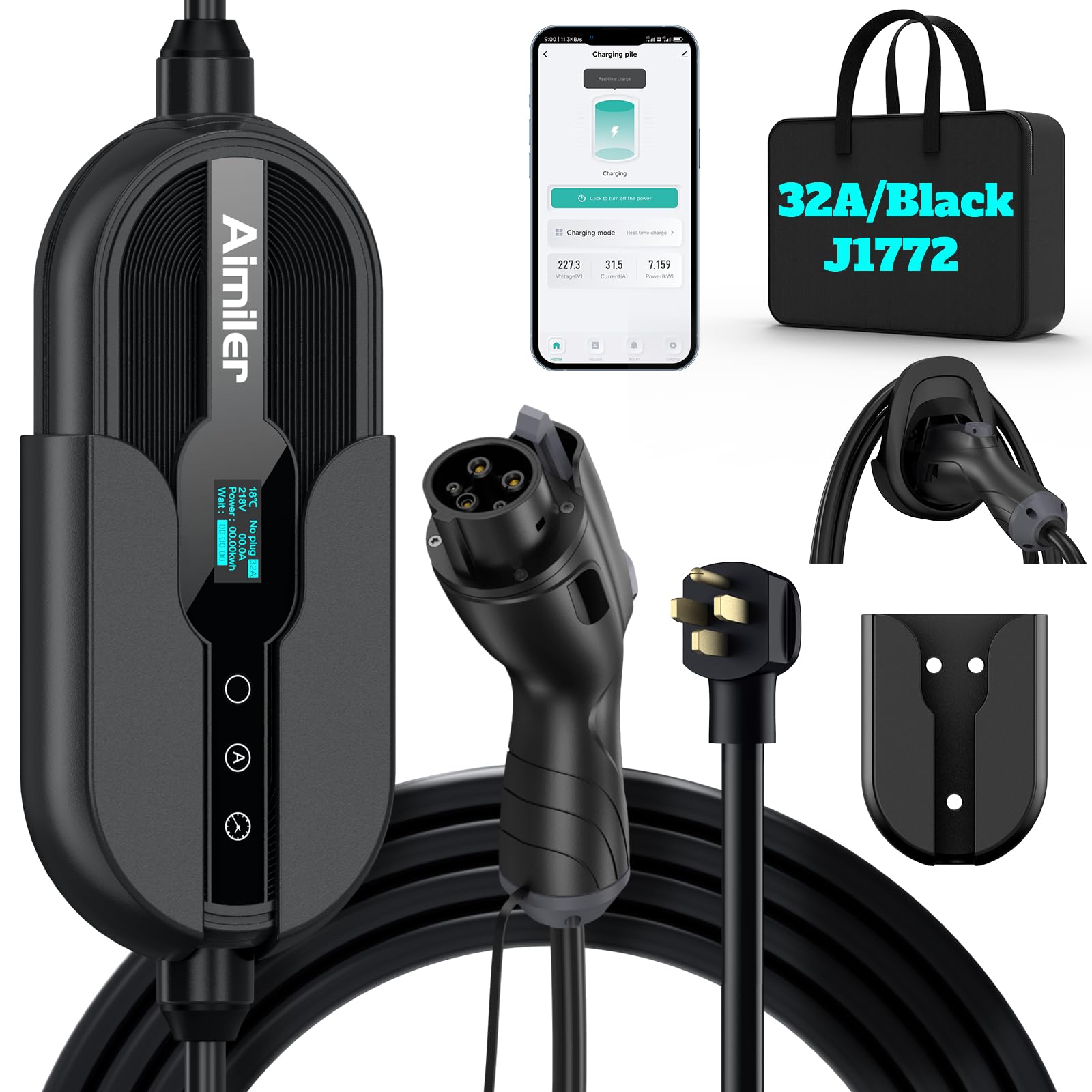
A portable EV car charger solves a specific problem: the charging cable that comes with most electric vehicles is slow, and a hardwired home station is expensive to install and impossible to take on a trip. These plug-in units sit in the middle. They connect to a standard household outlet or a 240V receptacle, then deliver power to the car through a J1772 connector (or a NACS adapter for Tesla-style ports).
Charging speed depends on two things: the outlet the charger plugs into and the amperage the unit is set to draw. A NEMA 5-15 household outlet delivers Level 1 charging, typically 3 to 5 miles of range per hour. A 240V NEMA 14-50 or 6-20 outlet enables Level 2 charging, which can add 20 to 40 miles per hour depending on the charger’s amperage and the vehicle’s onboard charger limit. The charger itself never increases what a car can accept; it only delivers up to its rated output, so matching the unit to the home’s wiring and the vehicle’s charging capacity matters more than chasing the highest amp number on the box.
Buyers should check three things before ordering: the outlet type already installed at home (or the adapter needed to use one), the circuit breaker rating that supports the charger’s max amperage, and whether the vehicle uses a J1772 port or requires a separate NACS/Tesla adapter. Weatherproofing (IP66 or similar), cable length, and safety certification (ETL, UL, or CSA) separate the units built for daily outdoor use from those meant for occasional or indoor charging. The chargers below cover the full range, from bare-bones Level 1 units to adjustable 40-amp Level 2 chargers with smartphone apps.
Best overall Level 2 charger: AIMILER Level 2 EV Charger
Best for wall-mount or portable flexibility: WOLFBOX PE40
Best for maximum home charging speed: EVDANCE 40Amp Level 2 Charger
Best budget Level 1/2 combo: EVDANCE 16A Charger
Best lightweight travel charger: bokman Portable Charger
Best for simple plug-and-play setup: ELEGRP 40Amp Charger
Best basic Level 1 charger: Lectron Level 1 Charger
Best for rugged build quality: DEWALT Portable EV Charger
Best for Tesla and J1772 dual compatibility: MACH 3 40 Amp Charger
Best for smart home integration: EVIQO Level 2 Charger
AIMILER Level 2 EV Charger

This charger suits owners who want adjustable Level 2 speed with app control and a long cable for garage flexibility.
Pros
- Adjustable 16A to 32A output for 20A, 30A, or 40A circuits
- WiFi app tracks charging cost, history, and schedules
- Built-in leakage protection removes the need for a separate GFCI breaker
Cons
- Requires a 240V NEMA 14-50 outlet for full Level 2 speed
- Tesla drivers need a separate J1772-to-NACS adapter
- Touchscreen buttons only respond with the connector unplugged
The 25-foot cable and NEMA Type 4 housing make this a reasonable fit for a garage or covered driveway. Reviewers charging Model 3s, Audi Q5 PHEVs, and Chevy Bolts report consistent speeds in the 5.8 to 8.6 kW range once the amperage is dialed in. The app requires a 2.4GHz WiFi connection, which trips up some first-time setups, but plug-and-play charging works without it.
WOLFBOX PE40
This unit works equally well mounted on a garage wall or thrown in the trunk for road trips.
Pros
- Functions as both a wall-mounted station and a portable charger
- 40A max output with adjustable range down to 6A
- NEMA 6-20 and 5-15 adapters cover both 120V and 240V outlets
Cons
- Newer to market, so long-term reliability data is limited
- Physical buttons only, no app control
- Full 40A speed depends on having a 50A circuit available
The 2-in-1 design avoids buying a separate wall mount, and the aluminum alloy housing with IP66 waterproofing supports outdoor use. Reviewers highlight the 25-foot cable’s reach and the ease of switching between Level 1 and Level 2 with the included adapters. Physical buttons instead of a touchscreen keep the controls usable in freezing temperatures or rain.
EVDANCE 40Amp Level 2 Charger
This charger delivers the highest amperage in this lineup for owners with a 50A circuit who want the fastest possible home charge.
Pros
- 40A max output at 240V for up to 9.6kW charging
- Six selectable amperage steps from 10A to 40A
- Large 2.4-inch display shows real-time voltage, current, and power
Cons
- One reviewer reported a serious safety incident; check wiring and breaker sizing carefully
- No WiFi app, control is manual only
- Some units cap at 32A even on a 50A circuit
The NEMA 14-50 plug and 25-foot cable make this a straightforward swap for a factory charging cord. Most reviewers charging Hyundai Ioniqs, Cadillac Lyriqs, and Chevy models report reliable performance at their chosen amperage. Given one report of overheating, confirming a properly rated 240V outlet and dedicated circuit before use is worth the extra step.
EVDANCE 16A Charger
This charger fits owners who need both a basic 120V option and a faster 240V option without paying for a 40A unit.
Pros
- Includes both NEMA 6-20 (240V) and 5-15 (120V) connections
- Simple LED display shows charging status and errors
- IP66 housing rated for outdoor use
Cons
- Tops out at 16A, slower than dedicated 40A Level 2 chargers
- Not compatible with NEMA 14-50, 14-30, 6-15, or 10-30 outlets without an adapter
- 1-year warranty, shorter than several competitors
At 16A on a 240V NEMA 6-20 outlet, this charger delivers roughly 10 to 12 miles of range per hour, a solid middle ground between a basic Level 1 cord and a full 40A station. The 25-foot cable and travel bag support use away from home. Owners of Mini Cooper Electric Hardtop, Prius Prime, or Porsche Taycan models should check compatibility first, since the manufacturer excludes those from support.
bokman Portable Charger
This charger suits owners who want tactile controls that work reliably in cold or wet weather without relying on a smartphone.
Pros
- Physical buttons work with gloves on and in rain
- Adjustable 6A to 16A range with a 1-12 hour delay timer
- ETL certified with an IP65 rating for outdoor use
Cons
- Maximum 16A output is Level 2 on the low end
- 20-foot cable is shorter than several competitors’ 25-foot cables
- Requires a NEMA 6-20 outlet for full Level 2 speed, adapter needed for 5-15
The lack of an app is a feature here, not a limitation. The LED screen and tactile buttons stay responsive when touchscreens might lag or freeze in cold weather. This unit fits owners who want a no-frills charger for a known outlet setup, whether at home, an apartment, or a campsite.
ELEGRP 40Amp Charger
This charger offers a straightforward plug-in setup for owners who want 40A Level 2 speed without WiFi or app dependency.
Pros
- Five current settings from 16A to 40A to match circuit capacity
- IP67 rating covers a wide temperature range, from -21°F to 121°F
- 1-12 hour delay timer for off-peak charging
Cons
- No app or WiFi control
- Tesla owners need a separate NACS adapter
- Newer product with a smaller review history than established competitors
The NEMA 14-50 plug connects directly to a 240V outlet, and the 25-foot cable extends across most garages without repositioning the car. ELEGRP’s PBE overheat protection system and 2-year warranty back up the ETL certification. This is a reasonable option for owners who want Level 2 speed and don’t need app-based scheduling or usage tracking.
Lectron Level 1 Charger
This charger works best as a backup or budget option for owners who only need standard 120V household charging.
Pros
- Plugs into any standard NEMA 5-15 household outlet
- ETL certified and Energy Star rated for efficiency
- Compact and easy to store in a trunk
Cons
- 15A output caps range gain at roughly 40-50 miles overnight
- Level 1 only, no 240V charging option
- Slower than any Level 2 unit in this lineup
At 1.65kW, this charger won’t replace a home Level 2 station for daily driving, but it works well as a travel backup or for plug-in hybrids with smaller batteries. Reviewers charging Kia Niro EVs and Ford C-Max hybrids report steady, dependable performance over years of use. The included carrying case makes it easy to keep in the car for emergencies.
DEWALT Portable EV Charger
This charger appeals to owners who want a rugged build from a familiar tool brand over the fastest charging numbers.
Pros
- Durable outer cage and anti-slip handle built for daily handling
- CSA certified with IP66 waterproofing
- Includes both NEMA 6-20 plug and 5-15 adapter
Cons
- Capped at 16A, slower than the 40A units in this list
- A few reviewers reported units arriving defective
- Instructions reportedly conflict with online marketing claims on waterproofing
The 25-foot cable, two feet longer than some competitors, reduces the need for precise parking. Build quality earns consistent praise, with several owners comparing it favorably to pricier chargers they replaced. The 16A ceiling limits this to a mid-speed Level 2 option rather than a fast-charging solution for owners who need a full charge in a few hours.
MACH 3 40 Amp Charger
This charger stands out for including both a J1772 connector and a Tesla NACS adapter in one package.
Pros
- Dual J1772 and Tesla NACS compatibility out of the box
- 40A max output with Bluetooth and WiFi app control
- 5-year manufacturer warranty
Cons
- Some reviewers report the charging head getting hot at full amperage
- Cable material shows scratching after repeated use on concrete
- One reviewer noted button failures after two weeks of outdoor exposure
Reviewers replacing older JuiceBox units and charging Tesla Model Ys and Model 3s describe a smooth setup process on 50A circuits. The included adapter and 5-15 plug for Level 1 emergencies add flexibility other chargers in this list don’t offer. Weather resistance claims deserve some skepticism given at least one report of button failure after outdoor exposure.
EVIQO Level 2 Charger
This unit works best as a semi-permanent home charging station rather than a charger meant to travel.
Pros
- Strong app connectivity even in garages or basements
- UL, ETL, FCC, and Energy Star certified with IP66/NEMA 4 housing
- Glow-in-the-dark holster and side reset button for easy upkeep
Cons
- Designed for wall mounting, less suited to portable use than other units here
- Some reviewers note the cable from the outlet to the control box is short
- Requires a dedicated 50A circuit for full 40A output
Owners consistently praise the build quality and installation clarity, with several noting the app schedules off-peak charging reliably over a year or more of use. Tesla owners need the standard J1772-to-NACS adapter that ships with their vehicle. This charger fits a garage setup better than a trunk, since the NEMA 14-50 plug and control box favor a fixed mounting location over frequent travel.
Portable EV Car Charger Buying Guide
Match the Charger to the Outlet
The outlet at home determines charging speed before amperage settings matter. A NEMA 5-15 outlet (standard household plug) delivers Level 1 charging at 120V. A NEMA 6-20 or 14-50 outlet delivers Level 2 charging at 240V, which charges two to three times faster.
| Outlet Type | Voltage | Typical Amperage | Charging Level |
|---|---|---|---|
| NEMA 5-15 | 120V | 12-15A | Level 1 |
| NEMA 6-20 | 240V | 16-20A | Level 2 |
| NEMA 14-50 | 240V | 32-40A | Level 2 |
Confirm the outlet type and breaker rating before buying. A charger rated for 40A needs a 50A circuit breaker; running it on an undersized circuit trips the breaker or creates a fire risk.
Understand Connector Compatibility
Every non-Tesla EV or PHEV sold in North America uses a J1772 connector. Tesla vehicles use a NACS port and need either a charger with a built-in NACS adapter or a separate J1772-to-Tesla adapter cable. Check the vehicle’s charging port type before assuming any charger will work without an adapter.
Prioritize Adjustable Amperage
Chargers with adjustable current settings (commonly 16A to 40A) let one unit work safely across different circuits. This matters when traveling to a location with an unknown or lower-rated outlet. Fixed-amperage chargers offer less flexibility but simplify setup.
Check Certifications and Weatherproofing
Look for ETL, UL, or CSA certification, which confirms the charger passed independent electrical safety testing. For outdoor or garage use without climate control, an IP66 rating protects against dust and water exposure. Built-in ground fault protection (GFCI or CCID) adds a layer of safety without requiring a separate breaker in many cases, though local electrical codes should be checked.
Weigh Portability Against Features
| Priority | Look For |
|---|---|
| Travel and backup use | Shorter cable, lighter weight, carrying bag, Level 1 and 2 flexibility |
| Daily home charging | Longer cable (25ft+), 32-40A output, wall-mount option |
| Smart scheduling | WiFi app, off-peak delay timer, usage tracking |
| Cold or wet climates | Physical buttons over touchscreens, high IP rating |
A charger that plugs into an outlet without hardwiring offers more flexibility than a fixed wall unit, but wall-mounted stations sometimes provide more consistent long-term reliability for a single home. Balancing portability against raw charging speed depends on whether the charger needs to travel or stay in one garage.