
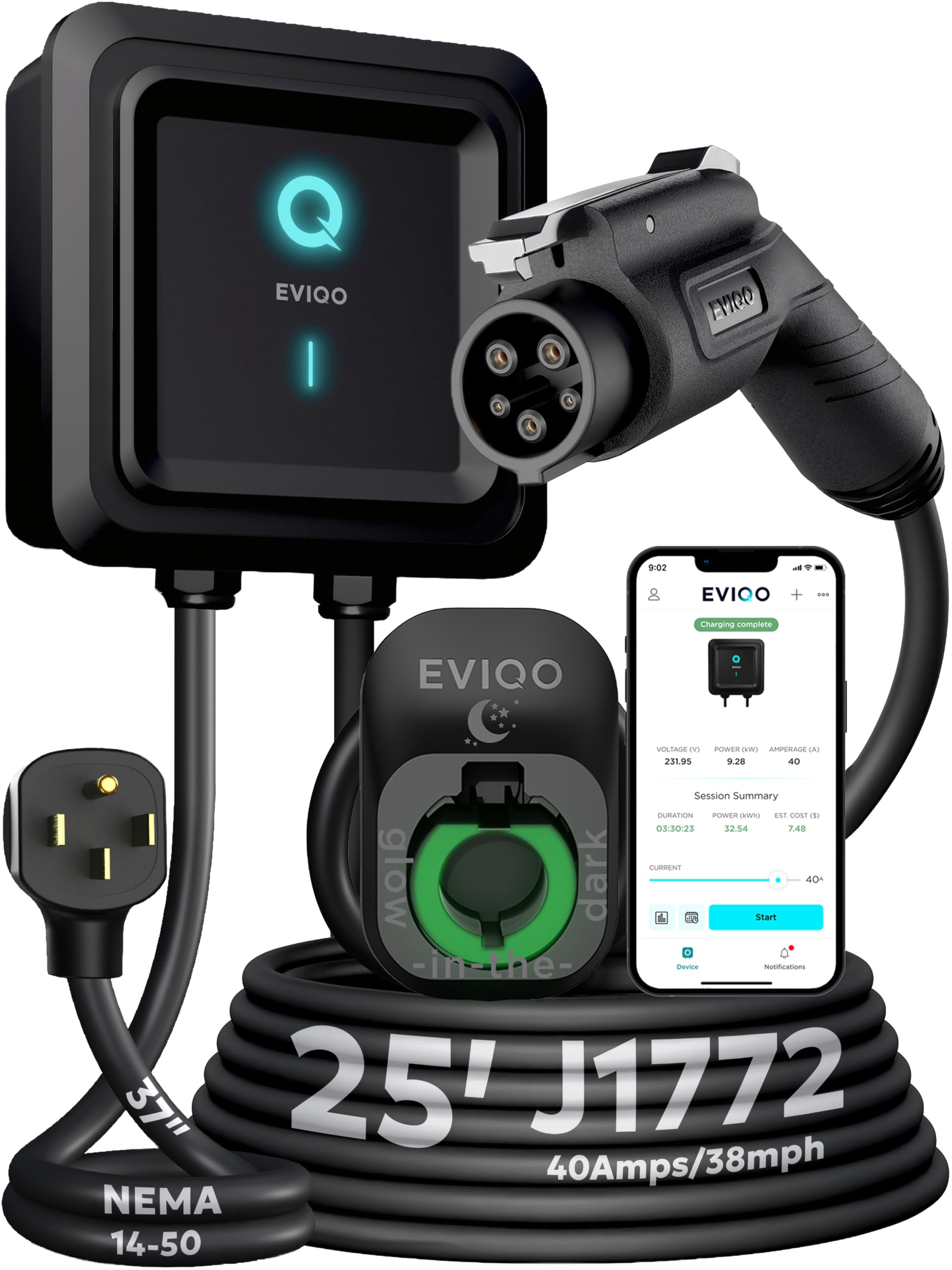
A Level 2 EV charger fills the gap between a slow wall outlet and an expensive public fast charger. Most electric vehicles and plug-in hybrids ship with a basic 120V charging cord, but that setup can take more than a day to fill an empty battery. A dedicated home charger that runs on a 240V circuit changes that math, often cutting charging time to a few hours overnight.
Mobile EV charging options add another layer of flexibility. Portable EVSE units (electric vehicle supply equipment) let drivers carry a charger between homes, apartments, garages, or road trips instead of committing to a single hardwired station. Some connect with a standard J1772 plug used by most non-Tesla EVs, while others use the NACS connector built for Tesla vehicles and newer NACS-compatible models.
Buying the right charger means checking connector type, amperage, circuit requirements, and cable length before anything else. A 40A charger on a 50A circuit charges faster than a 32A unit on a 40A circuit, but only if the home’s electrical panel can support it. Matching the charger’s plug type and amperage to both the vehicle and the household wiring prevents wasted money and failed installations. The chargers below cover hardwired stations, plug-in models, Tesla-specific connectors, and portable options built for travel.
Best overall smart charger: EVIQO Level 2 EV Charger
Best for Tesla and NACS EVs: AIMILER Level 2 Tesla Charger
Best hardwired home install: EMPORIA Level 2 EV Charger
Best established charging network: ChargePoint HomeFlex
Best adjustable amperage for shared circuits: SEGUMA NEMA 14-50 32A Charger
Best budget-friendly backup charger: SEGUMA 16A Level 1/2 Charger
Best for larger garages needing reach: ELEGRP 40A Portable Charger
Best Tesla-specific fast charger: SEGUMA Tesla NACS Charger
Best dual-connector flexibility: MACH 3 Portable EV Charger
Best factory Tesla travel charger: Tesla Mobile Connector
EVIQO Level 2 EV Charger

This 40A charger suits drivers who want smart app controls and weatherproof durability in one plug-in unit.
Pros
- Adjustable 6-40A output through the app
- IP66-rated housing for indoor or outdoor mounting
- Strong WiFi antenna designed for garage use
Cons
- Requires a dedicated NEMA 14-50 outlet, not a dryer plug
- Some reviewers note a short factory cable from wall to unit
- Full 40A speed needs a 50A circuit
The J1772 connector works with nearly every non-Tesla EV on the market, and Tesla owners can use their vehicle’s included adapter. The 25-foot cable reaches across most garages and driveways without repositioning the car.
App-based scheduling lets owners charge during off-peak utility hours to reduce electricity costs. A side reset button handles troubleshooting without cutting power at the breaker, which simplifies maintenance for less technical users.
AIMILER Level 2 Tesla Charger
This NACS charger fits Tesla owners and drivers of newer NACS-equipped EVs who want plug-and-play charging without a J1772 adapter.
Pros
- Native NACS connector for Tesla and NACS-compatible vehicles
- Adjustable output from 16A to 32A via touchscreen or app
- Portable handbag design plus wall-mount hardware included
Cons
- Not compatible with J1772 vehicles without a separate adapter
- Requires a 240V NEMA 14-50 outlet for full-speed charging
- WiFi setup needs a 2.4GHz-only network connection
The touch-button display shows amperage, charging speed, and delay timers directly on the unit. Built-in CCID-20 leakage protection means most installations skip an added GFCI breaker.
Reviewers note solid cable quality and a NEMA Type 4 enclosure rated for outdoor exposure. The 25-foot cable and portable bag make it a reasonable option for owners who split time between two properties.
EMPORIA Level 2 EV Charger
This hardwired 48A charger fits homeowners who want a permanent, high-output installation rather than a plug-in unit.
Pros
- 48A output for faster overnight charging on compatible circuits
- UL listed and Energy Star certified
- U.S.-based customer support team
Cons
- Requires professional hardwired installation
- No portability between locations
- Less flexible for renters or apartment dwellers
Hardwiring removes the outlet as a potential failure point, which some electricians consider more reliable for daily high-amperage use. The J1772 connector covers the wide range of non-Tesla EVs sold in North America.
The 25-foot cable and included wall mount with handle holster keep the setup tidy in a garage. This model fits best as a long-term home installation rather than a mobile charging solution.
ChargePoint HomeFlex
This charger fits buyers who want a well-known brand backed by a large public charging network for trip planning.
Pros
- Adjustable output from 16A up to 50A
- Access to a large public charging network through the app
- Choice of plug-in NEMA 14-50 or hardwired installation
Cons
- Higher price point than several competitors here
- Some owners report inconsistent WiFi connectivity
- Full 50A speed needs a 50A dedicated circuit
The flexibility to choose plug-in or hardwired setup makes this a good fit for both renters with existing 14-50 outlets and homeowners planning a permanent install. The cold-resistant cable holds up in outdoor installations through winter weather.
ChargePoint’s mobile app also shows nearby public stations, useful for owners who charge away from home. A 23-foot cable gives solid reach in most garages.
SEGUMA NEMA 14-50 32A Charger
This charger works well for households that need adjustable amperage to match an existing circuit without an electrical upgrade.
Pros
- Five amperage settings from 10A to 32A
- Doubles as a portable unit with a carrying bag
- Clear TFT display shows real-time charging data
Cons
- Lower total output than 40A or 48A competitors
- Shorter track record with fewer buyer reviews
- IP66 rating still calls for care in heavy rain
The adjustable current settings let owners dial down output for a 20A or 30A circuit instead of requiring a full 50A setup. That flexibility suits older homes with limited panel capacity.
The J1772 connector fits nearly all non-Tesla EVs, and the 25-foot cable covers typical garage layouts. Built-in protections cover overvoltage, overheating, and grounding faults.
SEGUMA 16A Level 1/2 Charger
This lower-amperage charger suits budget-conscious buyers or plug-in hybrid owners who don’t need a full 40A setup.
Pros
- Works with both 120V and 240V outlets
- Includes a NEMA 5-15 adapter for standard household plugs
- Lower price point than most Level 2 options here
Cons
- Maxes out at 16A, slower than higher-amp chargers
- Shorter one-year warranty
- Best suited to plug-in hybrids or smaller EV batteries
The NEMA 6-20 plug delivers 240V Level 2 charging, while the included 5-15 adapter allows Level 1 charging from any standard household outlet. That dual setup gives owners a backup option during travel or power outages at a dedicated station.
The 25-foot cable and IP66-rated jacket handle outdoor storage and temperature swings. This model fits drivers prioritizing affordability and flexibility over charging speed.
ELEGRP 40A Portable Charger
This charger fits owners with larger garages who need both high amperage and a long reach to the vehicle.
Pros
- Five adjustable current levels from 16A to 40A
- IP67-rated for wider temperature and weather range
- Built-in timing delay for off-peak charging
Cons
- Power cord to the wall outlet is shorter than some expect
- Tesla vehicles need a separate NACS adapter
- 2-year warranty is shorter than some competitors
The NEMA 14-50 plug and 25-foot cable make this a straightforward plug-in option for garages or driveways with existing 240V outlets. Reviewers report noticeably faster charging than a stock Level 1 cord, cutting multi-day charges down to a few hours.
The triple-layer overheat protection system adds a safety margin for daily high-amp use. This model works well for Ford, Hyundai, Kia, and other J1772 vehicles needing dependable Level 2 speed.
SEGUMA Tesla NACS Charger
This charger fits Tesla owners who want six adjustable amperage settings paired with a native NACS connector.
Pros
- Six current settings from 10A to 40A
- Built-in delay start timer for off-peak scheduling
- IP66 waterproof rating for garage or driveway use
Cons
- NACS connector limits use to Tesla and NACS-compatible EVs
- Shorter one-year warranty
- Fewer buyer reviews than more established competitors
The NACS connector covers Tesla Model Y, 3, S, X, and Cybertruck, along with other NACS-adopting EVs. Full 40A output needs a 50A circuit, though the adjustable settings allow safe use on smaller circuits too.
A 2.4-inch TFT screen displays charging rate, voltage, and time, making it easy to confirm the session is running correctly. The 25-foot cable and portable storage bag suit both home and travel charging.
MACH 3 Portable EV Charger
This charger fits drivers who want one unit that works with both J1772 and Tesla NACS vehicles through a dual connector setup.
Pros
- Includes both J1772 and Tesla NACS connectors
- Works on 120V or 240V power with included adapter
- Long 5-year manufacturer warranty
Cons
- Some reviewers report cable durability issues over time
- Buttons may malfunction with prolonged outdoor exposure
- Cable length falls short in larger garages, per reviewer feedback
Households with more than one EV brand benefit most from the dual-connector design, since one charger covers both a Tesla and a J1772 vehicle. The NEMA 14-50 plug delivers full 40A Level 2 speed, while the included 5-15 adapter allows emergency Level 1 charging from a standard outlet.
Bluetooth and WiFi connectivity let owners monitor charging remotely. Reviewers report mixed durability outdoors, so covered installation is worth considering.
Tesla Mobile Connector
This factory Tesla charger fits owners who want a compact, travel-ready backup rather than a primary home charging station.
Pros
- Genuine Tesla build quality and NACS compatibility
- Includes both NEMA 5-15 and NEMA 14-50 adapters
- Compact enough to store in the trunk
Cons
- Lower 32A max output than several dedicated home chargers
- Shorter 20-foot cable than most competitors
- Best suited as a backup, not a full-time home charger
The included adapters let this connector work with a standard household outlet or a 240V NEMA 14-50 outlet, covering both Level 1 and Level 2 charging. That range suits road trips, RV parks, or homes without a dedicated EV circuit.
Owners note noticeably faster charging on 240V power compared to the stock 120V cord. Its compact size makes it a practical trunk companion rather than a full replacement for a dedicated home charger.
Mobile EV Charging Buying Guide
Match the Connector to the Vehicle
Connector type determines whether a charger works at all. J1772 connectors fit nearly every non-Tesla EV and plug-in hybrid sold in North America. NACS connectors fit Tesla vehicles directly and increasingly fit other automakers adopting the same standard.
Tesla owners can use a J1772 charger with an adapter, but a native NACS charger skips that extra step. Non-Tesla EV owners should avoid NACS-only chargers unless they already own the correct adapter.
Check the Circuit Before Buying
| Circuit Type | Voltage | Typical Amperage | Charging Level |
|---|---|---|---|
| Standard household outlet | 120V | 12-15A | Level 1 |
| NEMA 6-20 outlet | 240V | 16-20A | Level 2 |
| NEMA 14-50 outlet | 240V | 32-50A | Level 2 |
| Hardwired circuit | 240V | Up to 48A+ | Level 2 |
A charger’s maximum amperage only matters if the home circuit and breaker can support it. A 40A charger plugged into a 30A circuit either won’t run at full speed or won’t work safely at all. An electrician can confirm existing outlet capacity or install a new circuit if needed.
Decide Between Plug-In and Hardwired
Plug-in chargers connect to an existing NEMA 14-50 or NEMA 6-20 outlet, making them easier to move, replace, or take along when relocating. Hardwired chargers connect directly to the electrical panel, skipping the outlet entirely.
Hardwired installation often supports higher amperage and removes a potential point of failure at the plug. Plug-in units work better for renters, apartment dwellers, or anyone who might want to bring the charger to a new home.
Consider Portability for Travel and Backup Use
A portable EVSE with a carrying bag serves as a backup charger for road trips, rentals, or a second property. Look for a model that includes a NEMA 5-15 adapter for standard outlets alongside the primary 240V plug.
Compact size and cable management (a holster or wall mount) also matter for daily use, since a dangling connector can trip hazards in a garage or driveway.
Weigh Smart Features Against Simplicity
WiFi-enabled chargers allow scheduling for off-peak electricity rates, real-time energy tracking, and remote start/stop. These features need a 2.4GHz WiFi network, since most units don’t support 5GHz.
Basic models without app connectivity cost less and involve fewer setup steps, which suits buyers who want a charger that works without any account creation or software.
Look for Certification and Weatherproofing
UL, ETL, and Energy Star certifications confirm a charger has passed independent safety testing. An IP66 or NEMA 4 rating indicates strong resistance to rain, dust, and temperature swings, important for any charger mounted outdoors or in an unheated garage.