
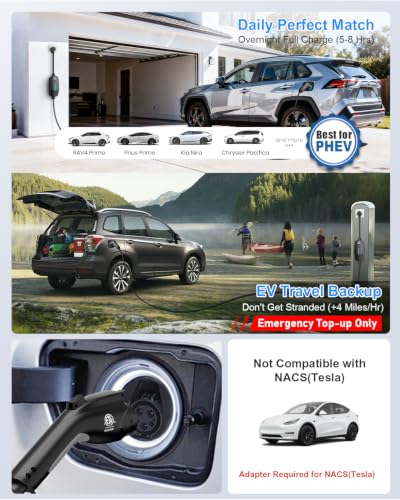
A level 1 car charger uses a standard 120V outlet for overnight EV charging.
You bought an EV. You get home, the battery is low, and the garage has only a normal wall outlet. No 240V. No fancy wall box. This is where a level 1 car charger makes life easy. It plugs into a common household outlet and adds steady miles while you sleep. It is not fast. But it is simple, safe, and cheap to run. For daily top-ups and lower-mileage driving, a good level 1 car charger can cover your needs without new wiring.
See the differences between my top picks at a glance.
| Product | Max Amps | Voltage | Cable Length | Plug(s) | Level 2 Capable | Certification |
|---|---|---|---|---|---|---|
| EVDANCE Level 1&2 Portable EV Charger | 16A (max) | 120V / 240V | 25 ft | NEMA 5-15 & 6-20 | Yes | ETL Listed |
| Lectron Level 1 EV Charger | 15A (rated) | 120V | 16 ft | NEMA 5-15 | No | ETL Certified |
| BETUMODA Level 1 EV Charger | Not stated | 110V / 240V | 25 ft | Not stated | Yes | Not stated |
| leheyhey Level 1 & 2 EV Charger | 8–16A adjustable | 110V / 240V | Not stated | Not stated | Yes | Not stated |
| YLITES Level 1&2 Portable EV Charger | Not stated | 120V / 240V | Not stated | NEMA 5-15 / 6-20 | Yes | Not stated |
EVDANCE Level 1&2 Portable EV Charger (25 ft)

This EVDANCE unit covers both daily needs and future plans. It works as a level 1 car charger on 120V. It also steps up to 240V level 2 when you have a suitable outlet. The 25-foot cable gives plenty of reach for garage setups and driveway parking. ETL listing adds peace of mind for safety and build quality.
The kit includes both NEMA 5-15 and 6-20 plugs. That means you can charge from a standard home outlet now. You can also plug into a 240V circuit later for faster charging. The J1772 connector works with most non-Tesla EVs and PHEVs in North America. If you drive a Tesla, a J1772-to-NACS adapter solves that.
Pros:
- Works on 120V and 240V for flexible use
- Long 25 ft cable reaches most parking spots
- ETL listed for safety and quality assurance
- Includes both NEMA 5-15 and 6-20 plug options
- J1772 standard fits most EVs and PHEVs
- Good step-up path from Level 1 to Level 2
Cons:
- Level 1 speed is slow for large battery EVs
- 240V use needs a proper 6-20 outlet
- Control box adds bulk in tight spaces
What Amazon Buyers Are Saying
Public reviews and Q&A for this listing often point to the flexible two-plug setup. Many discuss the long cable and easy setup with a wall outlet. Some note that Level 1 charging is slow, which is expected. A few mention questions about using the 6-20 plug and circuit requirements. Themes include safety labeling, plug options, and daily convenience.
My Recommendation
I see this as the best all-around option if you want one cord for now and later. It acts as a solid level 1 car charger today. It also becomes a faster Level 2 when you add a 240V outlet. The value is strong thanks to the long cable and safety listing.
| Category | Rating |
|---|---|
| Build Quality & Safety | 4.7/5 |
| Charging Flexibility (L1/L2) | 5/5 |
| Ease of Use | 4.6/5 |
| Cable Reach | 4.8/5 |
| Value for Money | 4.7/5 |
| Overall Rating | 4.8/5 |
Lectron Level 1 EV Charger (16 ft, 120V)
This Lectron is a simple, proven level 1 car charger. It plugs into a standard NEMA 5-15 outlet and uses the J1772 connector. It is ETL certified, which signals compliance with safety standards. The 16-foot cable is enough for many garages and carports.
The listing shows a 15A rating. On a 15A household circuit, EVSEs typically draw 12A continuous for safety. That is standard practice for Level 1. Expect slow and steady charging that fits overnight top-ups. If you need faster, you can upgrade later to a Level 2 unit.
Pros:
- ETL certified for safety confidence
- Simple plug-and-charge operation
- Budget-friendly way to start charging at home
- Works with most J1772 EVs and PHEVs
- Compact control box for easy storage
Cons:
- 16 ft cable may be short for driveway use
- Level 1 only; no 240V option
- Slower charge rate than dual-voltage models
What Amazon Buyers Are Saying
Feedback trends for this kind of Lectron unit often focus on ease of use and safety marks. Many buyers describe a smooth setup on a common 120V outlet. Some mention cable length as a planning point. Others note the realistic pace of Level 1 charging. The general tone reflects dependable, entry-level home charging.
My Recommendation
Choose this if you want a straightforward level 1 car charger with a trusted name and ETL certification. It is a great starter or backup cord. Make sure 16 feet is enough for your space before you buy.
| Category | Rating |
|---|---|
| Safety & Certification | 4.8/5 |
| Ease of Setup | 4.7/5 |
| Cable Length | 3.9/5 |
| Charging Performance (L1) | 4.2/5 |
| Value | 4.5/5 |
| Overall Rating | 4.4/5 |
BETUMODA Level 1 Charger, 2.8” Screen (25 ft)
This BETUMODA unit adds a 2.8-inch touch screen to a portable EVSE. It supports 110V for Level 1 and 240V for Level 2. The 25-foot cable is a big plus if you park outside or in a long garage. The screen can make status checks quick and clear.
Dual-voltage support helps if you plan to upgrade outlets later. The display may show live charging data and settings, which many owners find useful. This can help you spot trips, delays, or off-peak schedules. It also makes it easier for first-time EV owners to learn charging basics.
Pros:
- 2.8” touch screen improves visibility and control
- Works at 110V and 240V
- Long 25 ft cable for flexible parking
- Clear status at a glance
- Portable form for travel or home use
Cons:
- Touch screens can be hard to use with gloves
- Screen adds complexity vs. simple LED units
- Certification details not stated
What Amazon Buyers Are Saying
Review themes for listings like this often praise the clear display and longer cable. Some mention easy setup at 120V and the option to move up to 240V. There are also notes about learning the on-screen settings. A few mention that touch controls can be sensitive in cold weather.
My Recommendation
Pick this if you want a level 1 car charger with a handy screen and a long cable. The dual-voltage option gives you room to grow. It is a smart choice for visual learners and tech-friendly owners.
| Category | Rating |
|---|---|
| Display & Controls | 4.7/5 |
| Charging Flexibility (L1/L2) | 4.6/5 |
| Cable Reach | 4.8/5 |
| Ease of Use | 4.3/5 |
| Value | 4.5/5 |
| Overall Rating | 4.6/5 |
leheyhey L1 & L2 EV Charger, 8–16A Timer
This leheyhey model mixes smart control with simple charging. It supports 110–240V and lets you adjust current from 8A to 16A. That helps on older circuits or shared outlets. A built-in timer allows planned starts to match off-peak rates.
Adjustable amperage is a big plus for apartment or condo life. You can dial down current to avoid tripping a 15A breaker. Later, you can set 16A for faster charging on a 20A or 240V circuit. It is a flexible pick for mixed home setups.
Pros:
- 8–16A adjustable current for tricky circuits
- Timer for off-peak or overnight starts
- Works on 110V and 240V
- Good control for older homes
- Portable for travel and daily use
Cons:
- Extra settings can confuse first-time users
- Cable length not stated
- May need reading the manual to optimize
What Amazon Buyers Are Saying
Many buyers of adjustable EVSEs value the current control and timer features. They talk about fewer breaker trips when dialing down amps. Some report simple daily use once settings are set. Others note a learning curve to tune current and schedules.
My Recommendation
If you need control over current draw and timing, this is a winner. It is a capable level 1 car charger today and a flexible Level 2 option later. It suits older homes and shared garages well.
| Category | Rating |
|---|---|
| Adjustability & Control | 4.9/5 |
| Charging Flexibility (L1/L2) | 4.7/5 |
| User Learning Curve | 4.0/5 |
| Apartment/Old Home Fit | 4.8/5 |
| Value | 4.6/5 |
| Overall Rating | 4.6/5 |
YLITES Level 1 & 2 Portable EV Charger
The YLITES charger ships ready for both 120V and 240V with NEMA 5-15 and 6-20 support. That gives you Level 1 at home and faster Level 2 when you have the outlet. It uses the J1772 standard to fit most EVs and PHEVs.
This is a portable pick that balances price and flexibility. It serves as an everyday level 1 car charger. It can also work on road trips at 240V stops that match the plug. It is a nice fit if you travel and want options.
Pros:
- Dual plug support (5-15 and 6-20)
- Works on Level 1 and Level 2
- J1772 connector for wide EV support
- Portable for home and travel use
- Good value flexibility
Cons:
- Amperage and cable length not stated
- Requires correct 240V outlet for Level 2
- May lack advanced controls
What Amazon Buyers Are Saying
Comment themes for listings with dual plugs often mention convenience and flexibility. Many talk about easy 120V use and the option to charge faster on 240V. Some bring up outlet and adapter questions. A few note basic controls, which keeps use simple.
My Recommendation
Get this if you want a straightforward dual-voltage cord that covers most situations. It is a practical level 1 car charger with an easy path to faster charging. Ideal as a travel backup too.
| Category | Rating |
|---|---|
| Plug Options & Flexibility | 4.7/5 |
| Ease of Use | 4.5/5 |
| Feature Set | 4.0/5 |
| Travel Readiness | 4.6/5 |
| Value | 4.6/5 |
| Overall Rating | 4.5/5 |
How to Choose a Level 1 Car Charger
Picking the right level 1 car charger is simple when you match it to your space, driving, and goals. I look at outlet fit, cable reach, safety, and smart features that truly help. Here is the checklist I use for real daily life.
1. Match the Charger to Your Outlets and Circuits
First, check your outlet. Most homes have 120V NEMA 5-15 in garages. That works for Level 1. If you also have a 240V outlet like NEMA 6-20, a dual-voltage EVSE can charge faster. Make sure your circuit rating matches the charger’s draw.
On 15A circuits, Level 1 charging usually runs at about 12A continuous. That is normal and safe. If your home has older wiring, pick a unit that lets you set 8A or 10A. That lowers the load and helps avoid breaker trips. If you share a circuit with a fridge or tools, consider a timer or a dedicated line.
If you plan to install a 240V outlet later, choose a Level 1/Level 2 model now. That saves you from buying twice. Check the plug type. A 6-20 plug needs a 6-20 outlet. Do not assume adapters without confirming safety and code compliance.
2. Get the Right Cable Length and Build
Measure your parking space. A 16-foot cable is fine for many garages. If you park outside, 25 feet is easier. More length reduces strain and keeps the cord off the ground. Avoid tight bends near the control box and connector. That extends life.
Look for a tough J1772 handle with a firm latch. A sturdy control box with clear status lights or a simple screen helps. I also like units with weather-resistant housings for outdoor use. If you charge in rain or snow, keep the control box off the ground on a hook.
Check certifications. ETL or UL listings are a plus. They signal tested safety. If you camp or visit friends, a compact travel-ready unit is nice. Keep a clean, dry bag for the cord to protect the contacts.
3. Choose Features That Save Time and Protect Your Home
Some features matter more than others. Adjustable current is very useful in older homes. It can stop nuisance trips. A basic delay timer can hit off-peak hours and save money. A clear screen can show time, voltage, and charge status.
Smartphone apps are not common on basic Level 1 cords, and that is okay. You often do not need them. Your car may already handle schedules. I also like cords with simple fault indicators. Clear alerts help you fix problems fast. Do not use extension cords with EVSEs. It is safer to install the outlet closer or get a longer cable.
Final Verdict: Which Should You Buy?
The EVDANCE Level 1&2 Portable EV Charger is my top pick. It is safe, long, and flexible. It works as a level 1 car charger today and a faster Level 2 later.
If you want simple and cheap, go Lectron. If you want control, go leheyhey. For a clear screen and reach, pick BETUMODA. YLITES is a great travel backup.
FAQs Of level 1 car charger
What is a level 1 car charger and how fast is it?
It is a 120V EV charger that plugs into a standard outlet. Expect about 2–5 miles of range per hour, depending on the car.
Can I use a level 1 charger with any EV?
Yes, if your car has a J1772 port. Tesla owners can use a J1772-to-NACS adapter.
Do I need a dedicated circuit for a level 1 charger?
It is best. A dedicated 15A or 20A circuit prevents trips. Avoid sharing the circuit with big appliances.
Is it safe to use an extension cord with a level 1 charger?
No. Do not use an extension cord. Install an outlet close to the car or use a longer EVSE cable.
Can I leave a level 1 charger outside?
Many are weather resistant, but keep the control box off the ground. Use a covered outlet and follow the manual.