
Free Electric Vehicle Charging Points usually means home charging, not a plug that’s actually free. Public fast chargers charge by the kilowatt-hour or by the minute, and those costs add up fast for daily drivers. A home Level 2 charger changes that math by using off-peak residential electricity rates, often cutting the cost per mile dramatically compared to public charging networks.
A Level 2 charger runs on a 240-volt circuit, the same type of power used by an electric dryer or oven. It delivers far more range per hour than the 120-volt outlet that comes standard with most EVs, turning an overnight trickle charge into a full charge in a few hours. Picking the right one depends on the vehicle’s connector type, the home’s electrical capacity, and whether the charger needs to be hardwired or plug into an existing outlet.
Choosing between a plug-in and hardwired charger, matching the correct connector to the vehicle, and confirming the home’s circuit can handle the amperage are the three factors that matter most before buying. Renters and apartment dwellers should lean toward portable, plug-in units, while homeowners planning a permanent setup may prefer hardwired installation for a cleaner look and higher amperage support. The lineup below breaks down chargers for J1772 vehicles, NACS/Tesla vehicles, and the adapters and accessories that round out a home charging setup.
Best for whole-home reliability: ChargePoint HomeFlex
Best for Tesla and NACS vehicles: IYILO 48Amp NACS Charger
Best for J1772 drivers wanting smart scheduling: IYILO 40Amp J1772 Charger
Best for no-app simplicity: NexCyber 48A Touch Screen Charger
Best for limited electrical panels: NexCyber 32Amp Charger
Best for portability and travel: ELEGRP 40Amp Charger
Best for adapting a J1772 charger to Tesla: FOCSPROD J1772 to Tesla Adapter
Best for cable organization: LZSTEC J1772 Wall Mount Holder
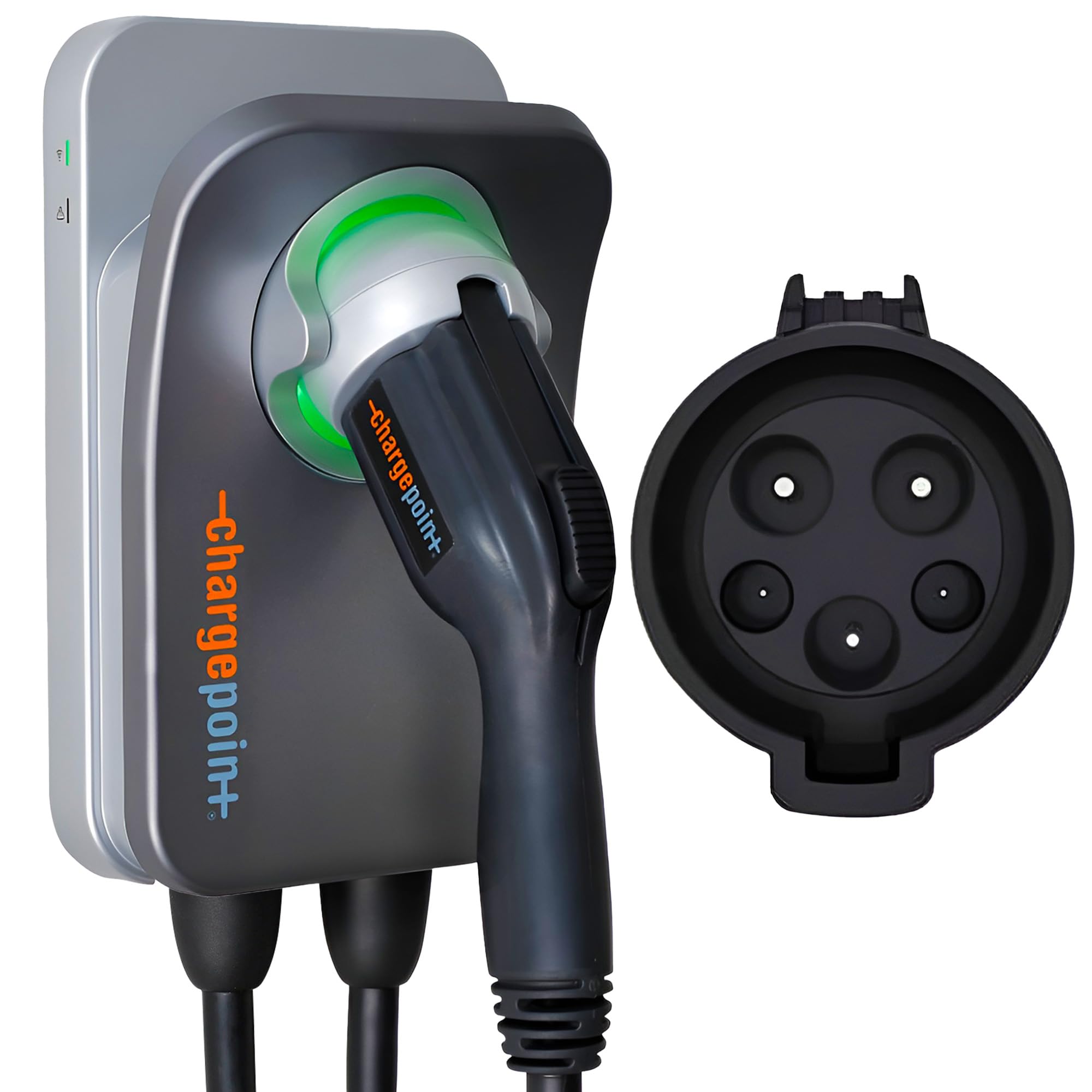
ChargePoint HomeFlex Level 2 EV Charger

This charger suits buyers who want a proven, adjustable unit that works with nearly any home electrical setup and any non-Tesla EV.
Pros
- Adjustable from 16 to 50 amps to match different circuit sizes
- Works as plug-in or hardwired, indoors or outdoors
- Long 23-foot cable with a matching holster for cable storage
Cons
- Requires a separate adapter for Tesla vehicles
- Some owners report the companion app feels clunky
- Multiple chargers can’t share one account easily
The HomeFlex earns its reputation through flexibility. Because the amperage is adjustable, one unit can serve a home with a 40-amp circuit today and a 50-amp upgrade later. The NEMA 14-50 plug version installs into an existing outlet, which keeps electrician costs down for homes already wired for a range or RV hookup.
Owners consistently mention reliable, consistent charging over several years of daily use. The mobile app adds scheduling and monitoring, though several reviewers say a hardwired setup with app-free operation performs just as well for those who don’t need remote features.
IYILO 48Amp NACS Charger for Tesla
This hardwired charger fits Tesla and other NACS-equipped vehicles that want maximum charging speed without an adapter.
Pros
- Native NACS connector for direct Tesla charging
- Built-in temperature sensor with automatic power reduction
- Supports power sharing between two chargers on one breaker
Cons
- Requires hardwired installation by a licensed electrician
- Needs a 60-amp breaker to reach full 48A output
- App works only with 2.4GHz Wi-Fi networks
At 48 amps and 11.5kW, this charger delivers some of the fastest home charging speeds available for NACS vehicles, adding up to 46 miles of range per hour under ideal conditions. The built-in NTC temperature sensor monitors the connector in real time and throttles power if it overheats, a useful safety layer for daily fast charging.
The 25-foot cable gives flexibility for garages or driveways with awkward parking angles. Since it’s hardwired, installation costs run higher than a plug-in unit, but the connection is more permanent and can support higher sustained amperage.
IYILO 40Amp J1772 Charger
This plug-in charger fits homes with a 50-amp NEMA 14-50 outlet already installed and drivers who want smart scheduling without hardwiring.
Pros
- Plugs into a standard NEMA 14-50 outlet
- Adjustable from 6 to 40 amps in 1-amp increments
- Time-of-use scheduling helps shift charging to cheaper rate periods
Cons
- Tops out at 38 miles of range per hour, slower than 48A models
- Tesla drivers need a separate NACS adapter
- No customer reviews yet to confirm long-term reliability
The 40-amp rating covers most daily charging needs without requiring a panel upgrade to support a 48-amp circuit. A licensed electrician still needs to install the 50-amp breaker and outlet, but the charger itself is a simple plug-in device after that.
Its temperature sensor and app-based monitoring mirror the higher-amperage IYILO model, just tuned for a 40A ceiling. The energy meter accessory (sold separately) adds dynamic load balancing for homes running other high-draw appliances.
NexCyber 48A Touch Screen Charger
This charger works well for buyers who want full charging speed without depending on a smartphone app to operate it daily.
Pros
- Touch screen displays amperage and charging status without the app
- Adjustable from 16 to 48 amps for different circuit sizes
- NEMA Type 3 rating adds weather resistance for outdoor mounting
Cons
- 48A output requires an 8AWG cable and proper circuit sizing
- App only syncs charging history over the same Wi-Fi network
- Bulkier unit dimensions than some competitors
The plug-and-play default mode sets this charger apart. Owners can adjust amperage and set delayed start times directly on the touch screen, which matters for households that don’t want another app on their phone.
The 25-foot cable and drop-resistant plug are built for repeated daily use, rated for over 10,000 charge cycles. The Wi-Fi app remains available for those who want remote monitoring, but it’s optional rather than required for basic operation.
NexCyber 32Amp Charger
This lower-amperage charger fits homes without room on the electrical panel for a 40A or 48A circuit.
Pros
- Works on a smaller circuit, easing installation for older homes
- NEMA Type 4 rating gives strong weather resistance
- Well-rated by owners for consistent daily charging
Cons
- Maximum 24 miles of range per hour, the slowest in this lineup
- Not compatible with Tesla without a separate adapter
- Touch screen amperage range tops out at 32A, limiting future upgrades
A 32-amp charger asks less of a home’s electrical system, which can matter for older houses where a panel upgrade isn’t in the budget. It still charges roughly six times faster than a standard wall outlet, enough to fully recharge most EVs overnight.
Reviewers who switched from 110-volt charging describe major time savings, especially in hot climates where factory-included chargers can overheat. The plug-in NEMA 14-50 design keeps installation simple for anyone with the outlet already in place.
ELEGRP 40Amp Portable Charger
This charger suits drivers who split time between home and other locations and want one unit that travels well.
Pros
- IP67 weatherproof rating handles rain, snow, and temperature extremes
- Five adjustable current levels from 16A to 40A
- 25-foot cable reaches across most garages and driveways
Cons
- 2-year warranty is shorter than several competitors
- Tesla compatibility requires a separately sold NACS adapter
- No published customer reviews yet on real-world durability
The ELEGRP charger’s portability is its strongest selling point. It plugs into a NEMA 14-50 outlet and can move between a home garage, a second property, or a family member’s driveway without any reinstallation.
The adjustable current levels let drivers match output to whatever circuit is available, which helps when charging away from a dedicated home setup. The 1 to 12-hour delay timer supports charging during off-peak utility rate windows, a straightforward way to reduce electricity costs.
FOCSPROD J1772 to Tesla Adapter
This adapter lets Tesla owners use any J1772 charger, including several models in this roundup, without buying a Tesla-specific unit.
Pros
- Rated for up to 80 amps and 250 volts of charging power
- Compact and easy to carry in a glove box or trunk
- UL 2252 safety certification backs its build quality
Cons
- Adds one more connection point that needs periodic cleaning
- Not needed for owners with a native NACS charger
- Silver-plated pins require care to avoid corrosion over time
This adapter solves a specific problem: it lets Tesla drivers use the far more common J1772 charging network, including home chargers built for non-Tesla EVs. That flexibility matters for households with a Tesla and a second J1772-based vehicle sharing one charger.
Built from polycarbonate with silver-plated pins, it’s designed to handle Level 1 and Level 2 charging currents without excess heat buildup. Keeping the charging port and adapter clean helps maintain a solid connection over repeated use.
LZSTEC J1772 Wall Mount Holder
This wall mount keeps a J1772 charging cable off the garage floor and protects the connector from damage between charges.
Pros
- Arc-shaped hook design avoids pinching or cutting the cable
- Weatherproof cover protects the connector outdoors
- Simple screw-in installation with included hardware
Cons
- Fits J1772 connectors only, not NACS plugs
- Add-on accessory, not a charging solution by itself
- Wall space needed near the charging spot for mounting
A charging cable left coiled on the ground wears out faster and creates a trip hazard. This holder cradles the cable with curved edges instead of a sharp hook, reducing wear on the cable jacket over years of daily use.
The connector dock latches onto the J1772 nozzle to keep it secured and off the ground, while a small overhead lip shields it from rain. Installation takes a few minutes with a drill and the included screws and anchors.
Free Electric Vehicle Charging Points Buying Guide
Match The Connector To The Vehicle
J1772 is the standard connector used by most non-Tesla EVs and plug-in hybrids sold in North America. Tesla vehicles use the NACS connector natively, though many now ship with a NACS-to-J1772 adapter or can accept a separate J1772-to-Tesla adapter for home charging flexibility. Confirm which connector the vehicle uses before buying a charger, since retrofitting the wrong connector always requires an adapter.
Understand Amperage And Charging Speed
Charging speed depends on amperage, and amperage depends on the home’s electrical circuit. A higher amperage charger doesn’t charge faster unless the circuit and the vehicle’s onboard charger both support that output.
| Amperage | Approx. Range Added Per Hour | Circuit Needed |
|---|---|---|
| 32A | Up to 24 miles | 40A breaker |
| 40A | Up to 38 miles | 50A breaker |
| 48A | Up to 46 miles | 60A breaker |
A licensed electrician should confirm the home’s panel has capacity for the added circuit before installation.
Plug-In Vs. Hardwired Installation
A plug-in charger connects to an existing outlet, usually a NEMA 14-50, and can be unplugged or moved if the owner relocates. A hardwired charger connects directly to the electrical panel and generally supports higher sustained amperage, but installation costs more and the unit stays fixed in place. Renters and those without a dedicated 240V outlet often start with a plug-in model.
Smart Features Worth Considering
- Scheduled charging shifts electricity use to off-peak hours when utility rates drop
- Load balancing lets two chargers share one circuit without tripping a breaker
- Temperature sensors monitor the connector and reduce power if it overheats
- RFID access limits who can start a charging session
Certifications To Check
Look for ETL, UL 2594, or Energy Star certification, which confirm a charger has passed independent safety and efficiency testing. These certifications don’t guarantee compatibility with every vehicle, but they reduce the risk of electrical faults during daily use.
Local Incentives And Rebates
Many utility companies and state programs offer rebates for installing a Level 2 home charger, and some offer discounted electricity rates for EV charging during off-peak hours. Check with the local utility provider before installation, since some rebate programs require the charger to be enrolled in a specific program at setup.