
Switching to a Level 2 home charger cuts overnight charging time dramatically compared with a standard wall outlet, but the right unit depends on what your home’s electrical panel can support and how you plan to install it. A dedicated 240V circuit, the right NEMA plug or hardwired connection, and enough amperage capacity all factor into how fast a charger can actually deliver power. Buying based on max charging speed alone can leave a homeowner with a their garage circuit can’t run at rated output.
Most home chargers fall into two installation categories: plug-in models that connect to an outlet like a NEMA 14-50, and hardwired units wired directly into the electrical panel by a licensed electrician. Plug-in chargers offer more flexibility since they can be moved or swapped, while hardwired units often support higher amperage and skip the risk of a loose plug connection over time. The best choice balances your vehicle’s charging capability, your panel’s available capacity, and whether you want the flexibility of a plug or the permanence of a hardwired connection.
Cable length, weatherproofing, and smart app features also affect day-to-day usability, especially for chargers mounted outdoors or in unheated garages. An electrician can confirm your panel has room for a 40A, 50A, or 60A circuit before you buy, since local code and existing wiring often decide what’s realistic for a given home.
Best for smart home integration: ChargePoint HomeFlex
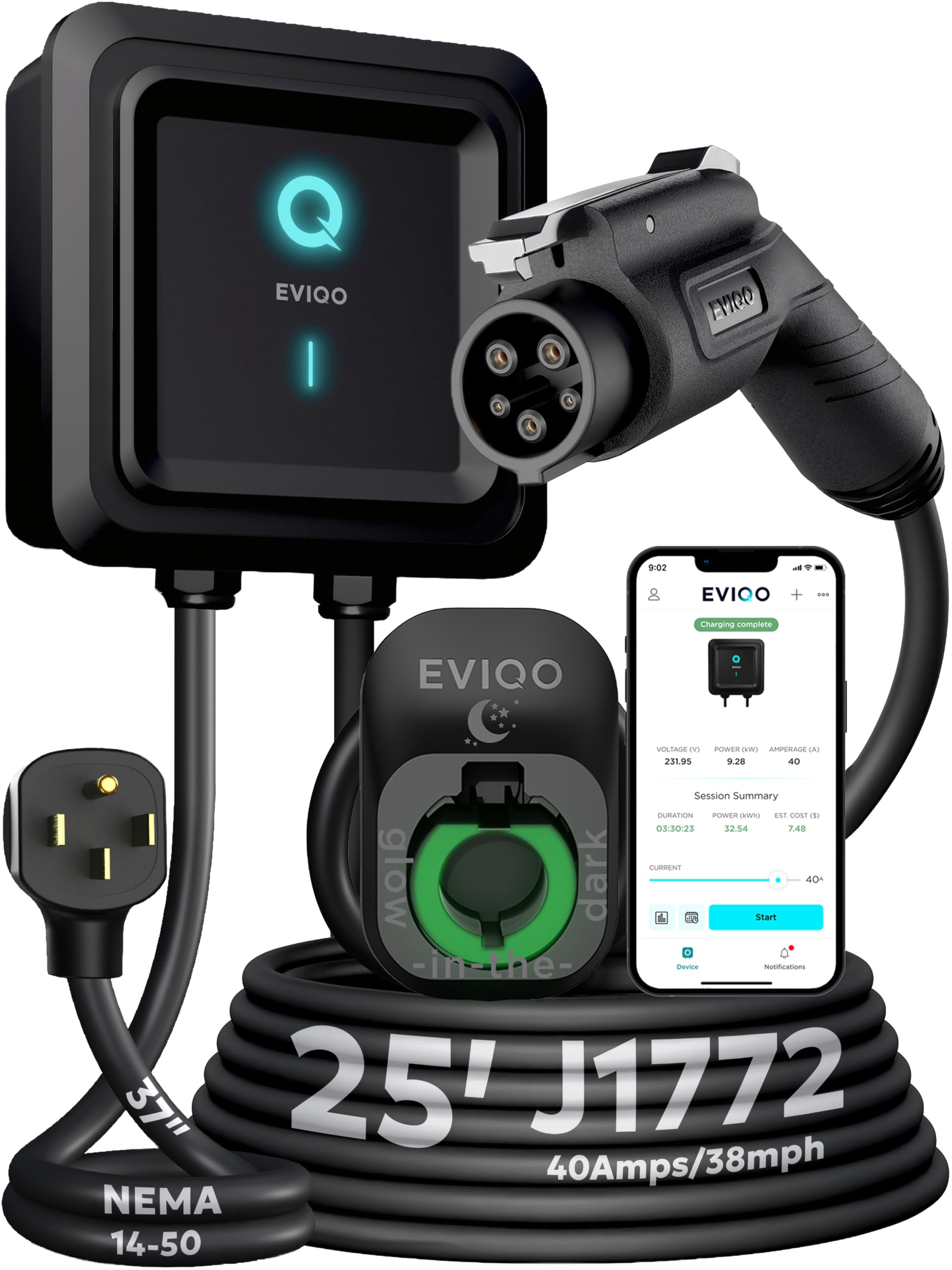
Best for plug-in flexibility: EVIQO 40A NEMA 14-50
Best for no-frills durability: Grizzl-E Classic
Best for Bluetooth setup: Autel MaxiCharger AC Home
Best for dedicated hardwired install: EMPORIA Hardwired with Whip
Best for switching between plug and hardwire: EMPORIA NEMA 14-50
Best for maximum hardwired amperage: EVIQO 48A Hardwired
Best for touch-screen controls: AIMILER 32A
Best for renters and portability: EVDANCE Level 1&2
Best for homes with limited panel capacity: EMPORIA Pro with PowerSmart
ChargePoint HomeFlex

This hardwired charger suits homeowners who want adjustable amperage and a well-established app ecosystem for daily charging management.
Pros
- Adjustable output from 16A to 50A to match different circuit breakers
- 23-foot cable reaches across most garages
- Access to a large public charging network through the same app
Cons
- Requires professional hardwiring, no plug-in option
- WiFi needed for full feature access
- Some owners report app connectivity hiccups
The HomeFlex needs a dedicated 240V circuit and must be installed by an electrician since it’s hardwired rather than plug-in. Its adjustable amperage setting (16A to 50A) means it can match a 20A, 40A, or 80A breaker, which gives flexibility for homes with different panel capacities.
The app lets owners track charging sessions and locate public stations, though it depends on a stable WiFi connection. Reviewers describe reliable daily charging once installed, with a few noting early WiFi pairing issues that customer support resolved.
EVIQO 40A NEMA 14-50
This plug-in charger fits homeowners who already have a NEMA 14-50 outlet or want to avoid hardwiring costs.
Pros
- Plugs into an existing NEMA 14-50 outlet, no hardwiring required
- 25-foot cable covers large garages and driveways
- Sealed IP66 housing rated for outdoor exposure
Cons
- Needs a dedicated 50A circuit for full output
- Requires 2.4GHz WiFi, won’t connect to 5GHz networks
- One reviewer noted the internal circuit cable was shorter than expected
Since this model plugs into a NEMA 14-50 outlet, it avoids the labor cost of hardwiring, provided that outlet already exists on a dedicated 50A circuit. That makes it a practical upgrade for homes with an existing RV-style outlet in the garage. EV Car Charger Installation
The 25-foot cord and sealed housing hold up well outdoors, according to reviewers who mention winter use without cable stiffening. The side reset button is a convenient touch for troubleshooting without cutting power at the breaker.
Grizzl-E Classic
Buyers who want a simple, rugged charger without an app or WiFi dependency will find this metal-cased unit reliable.
Pros
- Solid steel enclosure with no plastic housing
- Adjustable amperage (16A-40A) to match multiple breaker sizes
- No app or WiFi required to operate
Cons
- No smart features, scheduling, or remote monitoring
- Plug-in only version tested here, hardwired version sold separately
- Manual amperage switch requires opening the connector cover
The Grizzl-E Classic plugs into a NEMA 14-50 outlet and skips WiFi entirely, appealing to owners who just want dependable power delivery. Its steel casing stays cool under sustained 40A loads according to several reviewers.
The tradeoff is no scheduling or app-based monitoring, so charging happens whenever it’s plugged in. For anyone wanting basic, no-frills charging without troubleshooting an app, that’s a reasonable compromise.
Autel MaxiCharger AC Home
Homeowners comfortable with hardwired installation and who want both Bluetooth and WiFi setup options should consider this model.
Pros
- Supports up to 50A output on a hardwired connection
- Bluetooth pairing simplifies initial app setup
- NEMA Type 4 housing withstands rain, snow, and dust
Cons
- Hardwired only, requires an electrician
- Ethernet connection needed for the most stable remote updates
- Limited third-party review history compared to competitors
The MaxiCharger requires hardwiring into a dedicated circuit, so installation costs should factor into the total price. Its 25-foot cable and NEMA 4 rating make it a solid fit for exposed outdoor mounting in cold or wet climates.
Bluetooth setup is a nice convenience during initial pairing, letting owners configure settings before connecting to home WiFi. The three-year warranty and CSA certification back up its durability claims for long-term outdoor use.
EMPORIA Hardwired with Whip
This preconfigured hardwired unit fits homeowners planning a permanent installation without wanting to convert a plug-in model later.
Pros
- Preconfigured for hardwired install up to 48A
- UL listed and Energy Star certified
- Compatible with most J1772 EVs sold in North America
Cons
- No NEMA plug option on this configuration
- Requires professional installation for safety and warranty compliance
- Limited review volume compared to Emporia’s plug-in version
Since it’s preconfigured for hardwiring, this version skips the plug conversion step, which simplifies installation for anyone already planning a dedicated circuit. It supports up to 48A, delivering close to the fastest Level 2 speeds most home panels can handle.
The 25-foot cable and wall mount kit cover typical garage layouts. Emporia’s US-based support team gets consistent praise from owners troubleshooting setup questions.
EMPORIA NEMA 14-50
This version gives buyers a choice between plugging into a NEMA 14-50 outlet now or converting to hardwired later for higher output.
Pros
- Works as a 40A plug-in unit or 48A hardwired unit
- Strong app reviews for tracking and scheduling
- Frequently mentioned as good value among owners
Cons
- Converting from plug-in to hardwired adds installation labor
- Rear-panel screws take extra time during hardwire conversion
- Requires 2.4GHz WiFi for smart features
Choosing between the NEMA plug and hardwired setup on this model comes down to whether a 14-50 outlet already exists. Plugging in gets the unit running at 40A immediately, while hardwiring unlocks 48A output but needs an electrician.
Owners frequently mention the app as a highlight, citing straightforward scheduling and real-time energy tracking. A few reviewers noted the back panel has more mounting screws than expected, adding a few minutes to installation.
EVIQO 48A Hardwired
Homeowners with a 60A or 70A dedicated circuit available can get near-maximum Level 2 speeds from this hardwired charger.
Pros
- Delivers up to 48A standard, adjustable to 50A via DIP switch
- Sealed IP66 / NEMA 4 housing for outdoor mounting
- Side reset button simplifies troubleshooting
Cons
- Requires a 60A circuit minimum, 70A for the 50A setting
- Professional installation mandatory, no plug-in version
- Newer model with a smaller review history than the 40A version
This charger needs a dedicated 60A circuit for its standard 48A output, or a 70A circuit if the DIP switches are set for 50A. That makes it a strong option only for homes where an electrician confirms the panel has that capacity.
The same sealed housing and app features from EVIQO’s plug-in model carry over here, including scheduling and real-time usage tracking. Its 25-foot cable and steel-shielded internals suit a permanent garage or driveway install.
AIMILER 32A
This portable plug-in charger works well for renters or anyone who wants to move the unit between locations.
Pros
- Plugs into a NEMA 14-50 outlet, portable design with carry bag
- Touch-screen display shows amperage and charging status
- Adjustable from 16A to 32A to match different breakers
Cons
- Tops out at 32A, slower than 40A-48A hardwired options
- WiFi setup requires a 2.4GHz-only network
- Not compatible with Tesla without an added adapter
At a maximum of 32A, this charger runs slower than the 40A-48A hardwired models in this lineup, but its portability is the tradeoff. The included bag and plug-in design mean it can move from a rental garage to a new home without a rewiring project.
The touch screen gives quick visual feedback on amperage and charge time without opening the app every session. Reviewers across several EV brands, including Tesla with an adapter, report consistent results.
EVDANCE Level 1&2
This dual-level portable charger suits drivers who need a flexible backup option rather than a primary fast-charging solution.
Pros
- Works with standard 120V outlets or 240V NEMA 6-20 outlets
- No electrician needed if a compatible outlet already exists
- Compact and easy to store or travel with
Cons
- Maximum 16A output is far slower than dedicated Level 2 chargers
- Not compatible with several EV models, check the list first
- One-year warranty is shorter than most competitors
This charger works with a standard 120V household outlet or a 240V NEMA 6-20 outlet, so it doesn’t require a dedicated high-amperage circuit like most other chargers here. That flexibility comes at the cost of speed, since 16A output charges far slower than a 40A or 48A hardwired unit.
It suits drivers who need occasional backup charging or don’t have access to a dedicated 240V circuit. Reviewers describe it as reliable for overnight charging when paired with a 240V outlet, though it isn’t built for daily fast charging.
EMPORIA Pro with PowerSmart
Homeowners worried about panel capacity should consider this charger, which automatically adjusts output to stay within the home’s electrical limits.
Pros
- PowerSmart technology balances charging with whole-home energy use
- Includes a Vue 3 energy monitor for real-time usage data
- Works as a NEMA 14-50 plug-in or hardwired unit
Cons
- Higher cost than standard 48A chargers without load management
- Setup involves both the charger and a separate energy monitor
- Smaller number of reviews since it’s a newer release
The standout feature here is PowerSmart, which adjusts the charger’s output in real time based on the home’s total electrical load. That can help homeowners avoid a costly panel upgrade if their existing service doesn’t fully support a 48A circuit alongside other appliances.
The bundled Vue 3 monitor adds visibility into whole-home energy use beyond just the charger. Setup involves both devices, so budget extra time for initial configuration compared to a standalone charger.
Buying Guide
Plug-In vs. Hardwired Installation
Plug-in chargers connect to an outlet, most often a NEMA 14-50, and can be unplugged or relocated if you move. Hardwired chargers connect directly to the electrical panel through a dedicated circuit and must be installed by a licensed electrician.
Hardwired units often support higher amperage since they skip the resistance and wear points of a plug connection. Plug-in models offer more flexibility and a simpler swap if the charger ever needs replacing.
| Factor | Plug-In | Hardwired |
|---|---|---|
| Installation | Outlet required, no electrician needed if outlet exists | Electrician required |
| Flexibility | Can be moved or replaced easily | Permanent installation |
| Max amperage | Often capped around 40A-50A | Can support up to 48A-50A or higher |
| Upfront cost | Lower if outlet already exists | Higher due to labor |
Amperage and Circuit Requirements
Higher amperage means faster charging, but only if your home’s electrical panel and wiring support the circuit size needed. A 40A charger typically needs a 50A circuit breaker, while a 48A charger often needs a 60A breaker.
An electrician should evaluate your panel’s available capacity before choosing a charger. Installing a charger rated beyond what your panel supports isn’t safe and may violate local electrical code.
Cable Length and Placement
Measure the distance from your planned mounting spot to where your car parks before choosing a charger. Cables in this category commonly range from 18 to 25 feet, and a few extra feet can matter if your parking spot isn’t right next to the garage wall.
Outdoor installations need a charger rated for weather exposure. Look for an IP66 or NEMA Type 4 rating if the unit will face rain, snow, or direct sun.
Connector Type and Vehicle Compatibility
Most non-Tesla EVs sold in North America use a J1772 connector. Tesla owners need an adapter to use a J1772 charger, since Tesla vehicles use a different port design.
Check your vehicle’s onboard charger rating before buying a high-amperage unit. A 48A charger won’t charge faster than what your car’s onboard charger can accept, regardless of the circuit size.
Smart Features and App Control
WiFi-enabled chargers let owners schedule charging times, track energy costs, and receive firmware updates remotely. These features depend on a stable 2.4GHz WiFi connection, since many models don’t support 5GHz networks.
Basic chargers without WiFi still charge reliably, they just skip scheduling and remote monitoring. Consider whether app-based scheduling adds real value for your utility rate plan, especially if your area has off-peak electricity pricing.