
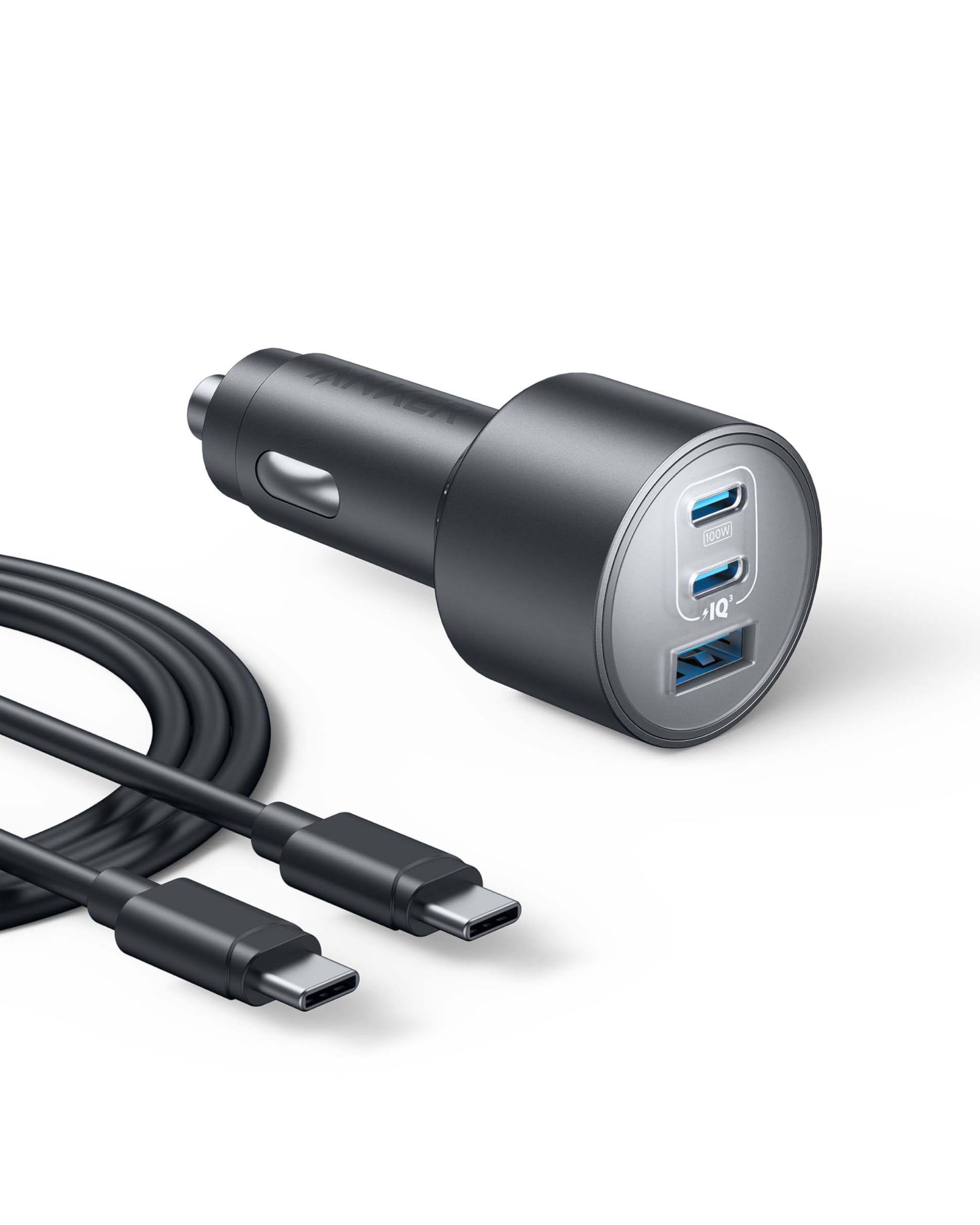
“DC Fast Charging Products” covers two different things in a car, and mixing them up leads to wasted money. One category is EV DC fast charging, where a vehicle’s battery pulls high-voltage direct current from a public charging station through a CCS1 or NACS connector. The other is USB-C car charging, where a small plug-in adapter converts a vehicle’s 12V or 24V system into fast charging power for a phone, tablet, or laptop.
Both rely on similar underlying ideas, delivering more power in less time, but the hardware, connectors, and safety standards are not interchangeable. A USB-C car charger cannot fast-charge an EV battery, and an EV adapter cannot charge a phone. Knowing which category a product belongs to before buying prevents a mismatched purchase that won’t work with a specific vehicle or device. Within USB-C chargers, output claims like “200W” or “PD 3.0” only matter if the ports actually negotiate that power with a connected device, which is where port sharing, PPS support, and thermal design come into play.
Buyers should check total wattage versus per-port wattage, confirm the charging protocols a device actually supports (PD, PPS, QC), and consider whether a charger’s build handles heat well during long drives. EV drivers need to confirm connector type, vehicle compatibility, and whether an adapter works with DC fast charging stations or only AC Level 2 charging. The picks below cover both categories, from compact multi-port USB-C chargers to a specialized CCS1-to-NACS adapter and a 12V/24V step-down power module.
Best compact high-output USB-C charger: Anker 167.5W 3-Port Car Charger
Best for power tool users who also need phone charging: DEWALT 120W 2-Port Car Charger
Best for laptop charging in a vehicle: LISEN 200W GaN Car Charger
Best for families needing dual high-power USB-C: ROADRESS 200W Dual PD Car Charger
Best budget-friendly everyday charger: Anker 323 52.5W Car Charger
Best compact metal-body dual USB-C charger: LISEN 90W Dual USB-C Car Charger
Best for built-in cable convenience: FLYLEAD 90W Car Charger with Coiled Cable
Best for charging four devices at once: TIBEITA 90W 4-Port Car Charger
Best for NACS EVs needing CCS1 access: LENZ CCS1 to NACS Adapter
Best for custom 12V/24V charging projects: ACEIRMC 60W Step-Down Power Module
Anker 167.5W 3-Port Car Charger

This charger suits drivers who need laptop-level power alongside phone charging without adding bulk to the car’s interior.
Pros
- 100W primary USB-C port can charge a laptop
- Three ports allow multiple devices at once
- Compact housing fits tight console spaces
Cons
- 167.5W is a shared total, not simultaneous full power to every port
- Only one included cable
- USB-A port limited to 22.5W
The 100W first port stands out since most car chargers cap USB-C output well below what a laptop needs. Anker rates it to bring a 16-inch MacBook Pro to 50% in under an hour, though that number assumes no other ports are drawing power at the same time. The second USB-C port drops to 45W and the USB-A port to 22.5W, and total combined output tops out at 167.5W across all three, so running all three simultaneously means each port gets less than its individual max. For most phone-and-tablet combinations, the shared power pool still leaves plenty of speed to go around.
DEWALT 120W 2-Port Car Charger
Worksite and job-site drivers who already own DEWALT battery gear get added value from this charger’s compatibility with the DEWALT USB Charging Kit.
Pros
- PD 3.0 with PPS support for modern phone fast charging
- Works with DEWALT DCB094K charging kit
- Backed by a limited lifetime warranty
Cons
- Listed output specs show some inconsistency between 120W and 3A/5V figures
- No bundled cable
- Two ports only, less flexible for multi-device households
DEWALT’s tool-branded design makes it easy to spot in a truck cab, and the PPS (Programmable Power Supply) support means it can fine-tune voltage for Samsung and newer Android phones during fast charging. The listed output current of 3A at 5V doesn’t match the advertised 120W figure at face value, which points to the charger negotiating higher voltages for its rated power rather than running flat 5V output. A 100W-rated cable is recommended for the fastest results, since a low-spec cable will bottleneck any high-wattage port.
LISEN 200W GaN Car Charger
Drivers who need to top off a laptop during a road trip get the most from this charger’s 140W primary port, one of the higher outputs available in a car adapter.
Pros
- GaN (gallium nitride) chipset improves efficiency and heat control
- Metal housing helps dissipate heat on long drives
- Includes a 240W-rated cable
Cons
- Marketing references unreleased devices like “iPhone 18 Pro Max,” which should be treated skeptically
- 200W total is a combined figure across all ports, not per-port
- Aluminum body adds some weight versus plastic chargers
The 140W USB-C1 port can push a laptop from empty toward half charge in well under an hour, assuming the laptop and cable both support that power level. LISEN’s product listing cites charging times for phones that have not launched as of this writing, which reads as forward-looking marketing rather than tested performance. Buyers should judge this charger by its confirmed PD 3.1, QC 4.0, and PPS support instead of by any specific future-phone claim.
ROADRESS 200W Dual PD Car Charger
This charger fits households or rideshare vehicles where two people might need high-power USB-C charging at the same time.
Pros
- Two 100W-capable USB-C ports plus a 60W USB-A port
- Broad protocol support including QC4.0, PPS, SCP, and AFC
- LED ring light aids nighttime plug-in
Cons
- 200W is a shared maximum, not additive per port
- Plastic (ABS) housing may run warmer under sustained load than metal designs
- Output voltage/current specs vary across the listing’s documentation
Having two 100W-rated USB-C ports gives flexibility for laptop or tablet charging from either side of the car, though real-world output drops once both ports draw power simultaneously. The broad protocol list (PD3.0, QC4.0, PPS, SCP, FCP, AFC) covers most Android and Apple devices sold in the past several years. The LED ambient ring is a small touch, but it does make the port easier to find in a dark cabin.
Anker 323 52.5W Car Charger
This charger works well for drivers who mainly need fast, dependable phone charging without paying for laptop-level wattage they won’t use.
Pros
- Well-reviewed for consistent day-to-day reliability
- Snug fit in 12V sockets, according to owner feedback
- Compact two-port design
Cons
- 30W USB-C max, not suited for laptops
- No bundled cable in some packaging
- Lower total wattage than other picks here
Anker’s PowerIQ 3.0 handles the negotiation between phone and charger automatically, which is why it charges an iPhone or Samsung phone close to its fastest supported speed without extra settings. The 30W USB-C and 22.5W USB-A ports won’t power a laptop, but for phone and earbud charging this remains one of the more consistent performers based on accumulated owner feedback. ActiveShield 2.0 monitors temperature during charging, a useful safeguard for older cables or hot cabin conditions in summer.
LISEN 90W Dual USB-C Car Charger
Two phones or a phone-and-tablet pairing both get genuine fast charging here, since each USB-C port carries an identical 45W rating rather than a large primary port and a weak second one.
Pros
- Matched 45W output on both ports
- Zinc alloy metal shell for heat dissipation
- Very compact, thumb-sized body
Cons
- No USB-A port for older accessories
- 90W total is split evenly, so it won’t push toward higher per-device speeds
- Metal body can get warm to the touch under heavy use
Unlike chargers that funnel most of their wattage into one dominant port, this design splits power evenly, which suits couples or families charging two phones on a road trip. The metal alloy shell handles heat better than plastic equivalents, an important detail for a charger running two 45W streams at once. Its small footprint means it won’t block a second nearby outlet or crowd a console tray.
FLYLEAD 90W Car Charger with Coiled Cable
This charger removes the need to carry a separate cable, thanks to its built-in 5-foot coiled USB-C cord.
Pros
- Retractable coiled cable stays tidy and reaches rear seats
- Rainbow LED indicator for visibility at night
- Multiple ports support phone, tablet, and accessory charging together
Cons
- Listing’s stated wattage figures are inconsistent (72W appears alongside 90W and 60W in spec fields)
- Coiled cable limits flexibility versus a detachable one if it wears out
- Older iPhones need their own Lightning cable for fast charging
The built-in cable is the main appeal, since it removes clutter and the risk of forgetting a charging cord during travel. Buyers should note the specification data for this listing shows overlapping numbers, 60W, 72W, and 90W all appear in different fields, so the true sustained output is less clear-cut than the headline number suggests. The 45W cable rating is what actually limits charging speed for compatible phones, regardless of which total wattage figure applies to the unit as a whole.
TIBEITA 90W 4-Port Car Charger
Families or rideshare drivers who need to charge four devices at once will get the most practical use out of this charger’s two USB-C and two USB-A port layout.
Pros
- Four total ports cover a full car of passengers
- Included 3-foot USB-C to USB-C cable
- Aluminum housing aids heat dissipation
Cons
- 45W max per USB-C port, well short of laptop charging needs
- 90W total spread across four ports means less power per device when all are in use
- Only a one-year warranty, shorter than some competitors
Four ports address a real pain point for families and carpools where everyone wants power at once. Each USB-C port tops out at 45W, and since total output is capped at 90W, four devices charging simultaneously each get a modest share rather than a fast individual charge. Owner feedback describes reliable performance for single-device charging with a Samsung phone, though multi-device speed will depend on which ports are active at once.
LENZ CCS1 to NACS Adapter
This adapter belongs in a completely different category from the USB-C chargers above, since it lets a NACS-port EV plug into a CCS1 DC fast charging station instead of charging a phone or laptop.
Pros
- UL 2251 and CSA-certified for DC fast charging safety
- Rated for up to 500V and high-power DC fast charging
- Opens access to CCS1 networks like Electrify America and EVgo
Cons
- Not compatible with Tesla Cybertruck
- Cannot be used at Tesla Superchargers
- Works only with DC fast charging, not Level 2 AC charging
This is EV charging hardware, distinct from every phone charger in this roundup, and it solves a specific problem: letting a NACS-equipped vehicle, including Tesla and newer NACS-adopting brands, connect to the widespread CCS1 fast charging network. The adapter is explicitly built for DC fast charging stations, not AC Level 2 chargers, and not Tesla’s own Supercharger network. Cybertruck owners should look elsewhere, since the manufacturer states this adapter does not support that vehicle.
ACEIRMC 60W Step-Down Power Module
This is a DIY-oriented power module for people building or modifying a vehicle’s electrical setup, not a plug-and-play cigarette lighter charger.
Pros
- Accepts a wide 6-35V DC input range
- Supports PD 3.0 and QC4 protocols
- Two units included per pack
Cons
- Requires wiring knowledge to install
- Tiny module size (about 50x17x12mm) with no included housing or cable
- Best used with a low-resistance USB meter to verify actual output
This module steps down voltage from a wide DC input range, making it suited to camper builds, boats, or custom console installs where a standard cigarette lighter charger won’t fit. It supports PD 3.0 and QC4 charging, but the manufacturer notes that a proper C-to-C cable and accurate USB meter matter for verifying real charging current. This is a component for someone comfortable with basic 12V/24V wiring, not a finished consumer charger.
DC Fast Charging Products Buying Guide
Know Which Category You Need
EV DC fast charging and USB-C car charging solve different problems. An EV DC fast-charging adapter moves high-voltage direct current into a vehicle’s battery through a CCS1 or NACS connector at a public station. A USB-C car charger plugs into a 12V or 24V outlet and converts that power for phones, tablets, and small electronics. No product in either category substitutes for the other.
For USB-C Car Chargers: Check Real Port Behavior
Total wattage listed on the box is a shared maximum across every port, not a guarantee per port. A “200W” charger with three ports might deliver 100W to one port only when the other two sit idle.
| Spec to check | Why it matters |
|---|---|
| Per-port wattage | Determines actual charging speed for each connected device |
| Total combined wattage | Shows the shared power pool across all active ports |
| Charging protocols (PD, PPS, QC) | Confirms compatibility with a specific phone or laptop |
| Cable rating | A low-wattage cable limits speed regardless of charger output |
| Port count | More ports mean more devices, but often less power per port |
Match Charging Protocol to Device
USB-C Power Delivery (PD) and Programmable Power Supply (PPS) are the protocols most modern phones and laptops rely on for fast charging. Quick Charge (QC) is a Qualcomm standard found on many Android phones. A charger that lists PD 3.0 and PPS support covers most iPhones and Samsung Galaxy phones from the past several years, but a device without PPS support won’t reach a phone’s advertised top charging speed even on a high-wattage charger.
Thermal Management and Build Material
Charging at high wattage generates heat, and heat buildup can force a charger to slow down output to protect itself. Metal or aluminum housings dissipate heat faster than plastic ones, which matters most for chargers rated above 90W or used on long drives in hot weather.
For EV DC Fast-Charging Adapters: Confirm Vehicle and Network Fit
An EV adapter needs to match the vehicle’s native connector, the charging network’s connector type, and the vehicle’s supported charging mode. Some adapters work only with DC fast charging stations and not with Level 2 AC charging, and some vehicles, such as certain truck models, are explicitly excluded by the manufacturer. Checking the adapter’s certification (UL, CSA) and voltage rating against the vehicle’s charging specifications avoids a wasted purchase.
For Custom Power Modules
A step-down power module suits a custom install where a device needs a specific input voltage range or where wiring won’t accommodate a standard console-mounted charger. These modules require basic electrical knowledge and typically arrive without a housing or cable, unlike a finished retail charger.