
A Best EV Chargers turns overnight parking into a full battery every morning, which matters more than any public charging network for most EV and plug-in hybrid owners. Level 2 chargers use a 240-volt circuit, similar to what powers a clothes dryer or an electric range, to deliver several times the power of the standard wall outlet that comes with most vehicles. That difference shows up as hours saved, not just miles gained.
Picking the right one means looking past the amperage number on the box. A charger’s actual speed depends on the circuit it’s plugged into, the onboard charger in the vehicle, and whether the unit is hardwired or uses a plug. Connector type matters too: J1772 covers nearly every non-Tesla EV in the US, while NACS chargers now serve Tesla vehicles directly without an adapter.
The best home charger is the one that matches your electrical setup, your vehicle’s charging capacity, and where it will physically live, whether that’s a heated garage or a driveway exposed to rain and snow. The following ten chargers cover plug-in and hardwired installs, portable and permanent setups, and both J1772 and NACS connectors.
Best all-around smart charger: EVIQO Level 2 EV Charger
Best for flexible amperage tuning: EMPORIA Level 2 EV Charger (J1772)
Best for public network access: ChargePoint HomeFlex
Best for extreme cold climates: Autel MaxiCharger AC Home
Best budget plug-in charger: AIMILER Level 2 EV Charger
Best portable backup charger: EVDANCE Level 1&2 Portable Charger
Best long-term durability: Enphase HCS-50 (Formerly ClipperCreek)
Best for Tesla owners: EMPORIA Level 2 EV Charger (NACS)
Best for shared household access: WOLFBOX E48 Hardwired Charger
Best for adjustable daily charging: EVDANCE Level 2 40A Charger
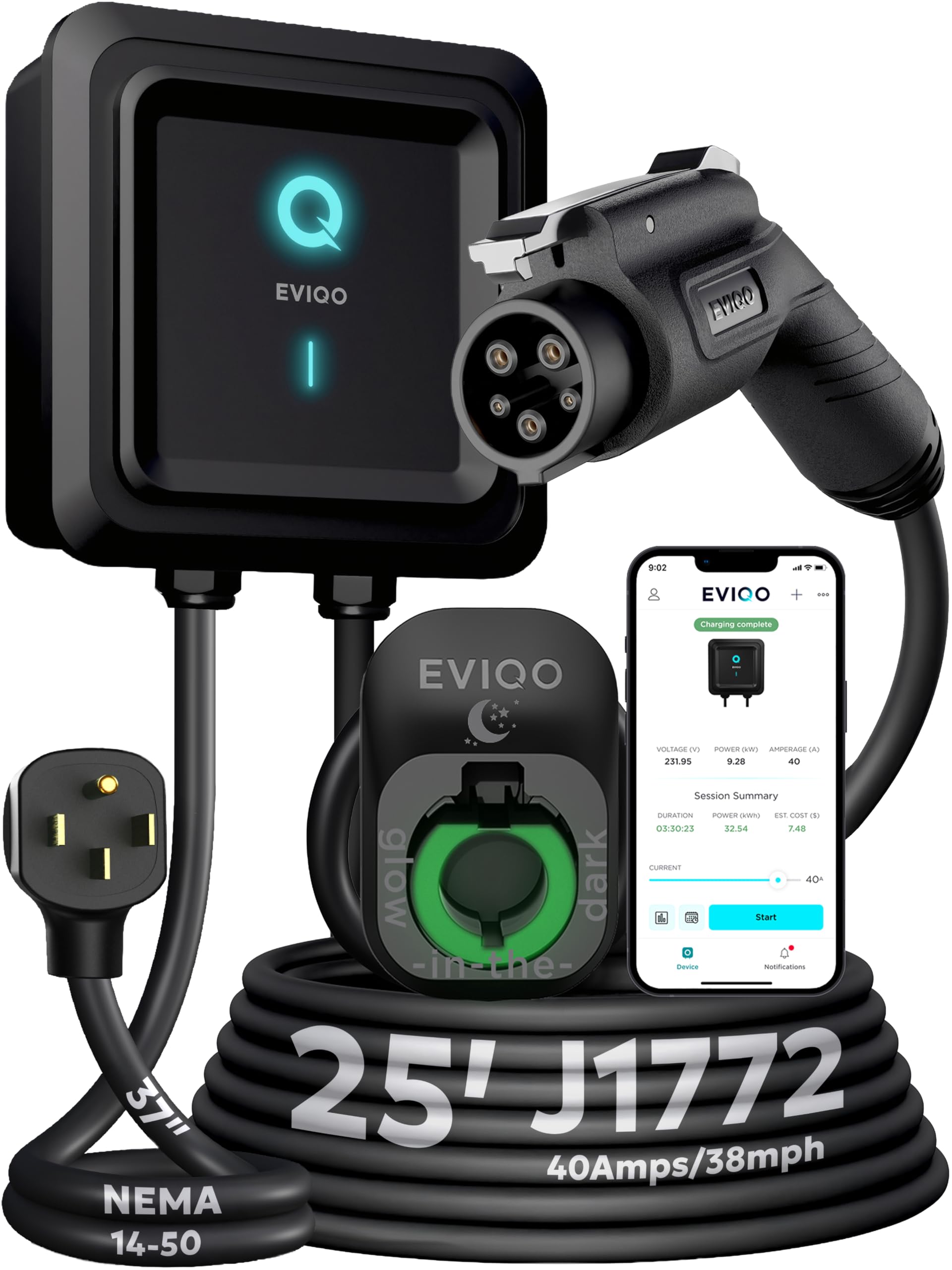
EVIQO Level 2 EV Charger

Buy this one for a plug-in setup that combines strong WiFi range with weatherproof housing built for garages and driveways alike.
Pros
- Plugs into a NEMA 14-50 outlet, no electrician needed for hardwiring
- IP66/NEMA 4 sealed housing rated for indoor and outdoor use
- Reinforced antenna keeps app connectivity stable in garages
Cons
- Requires a dedicated 50A circuit and the correct outlet type
- 25-foot cable length is fixed, no shorter option for tight spaces
- App-dependent features need 2.4GHz WiFi, not 5GHz
This charger delivers up to 40A on a properly wired 50A circuit, which fully charges most EVs overnight. The J1772 connector fits every non-Tesla EV sold in the US, and Tesla owners can use their vehicle’s included adapter. Reviewers highlight the solid build quality and glow-in-the-dark holster for nighttime docking.
Setup requires confirming the home already has, or can support, a NEMA 14-50 outlet on its own circuit. That outlet type is common for RVs and electric ranges but not universal in older homes. Once installed, the reset button and automatic firmware updates simplify long-term upkeep without opening the unit.
EMPORIA Level 2 EV Charger (J1772)
Buy this one for a charger that adapts to either a plug-in or hardwired install, giving buyers flexibility as their electrical setup changes.
Pros
- Converts between 40A plug-in and 48A hardwired configurations
- UL listed and Energy Star certified
- Compact wall-mount design with included holster
Cons
- Reaching the full 48A requires hardwiring by a licensed electrician
- Mounting hardware uses eight screws, which adds install time
- WiFi connection has occasionally been finicky per owner reports
The Emporia charger ships preconfigured for a NEMA 14-50 plug at up to 40A, but it can be hardwired for the full 48A rating if the home’s electrical panel supports a 60A circuit. That flexibility makes it a practical pick for buyers unsure whether they’ll upgrade their setup later. Read more: Best EV Chargers
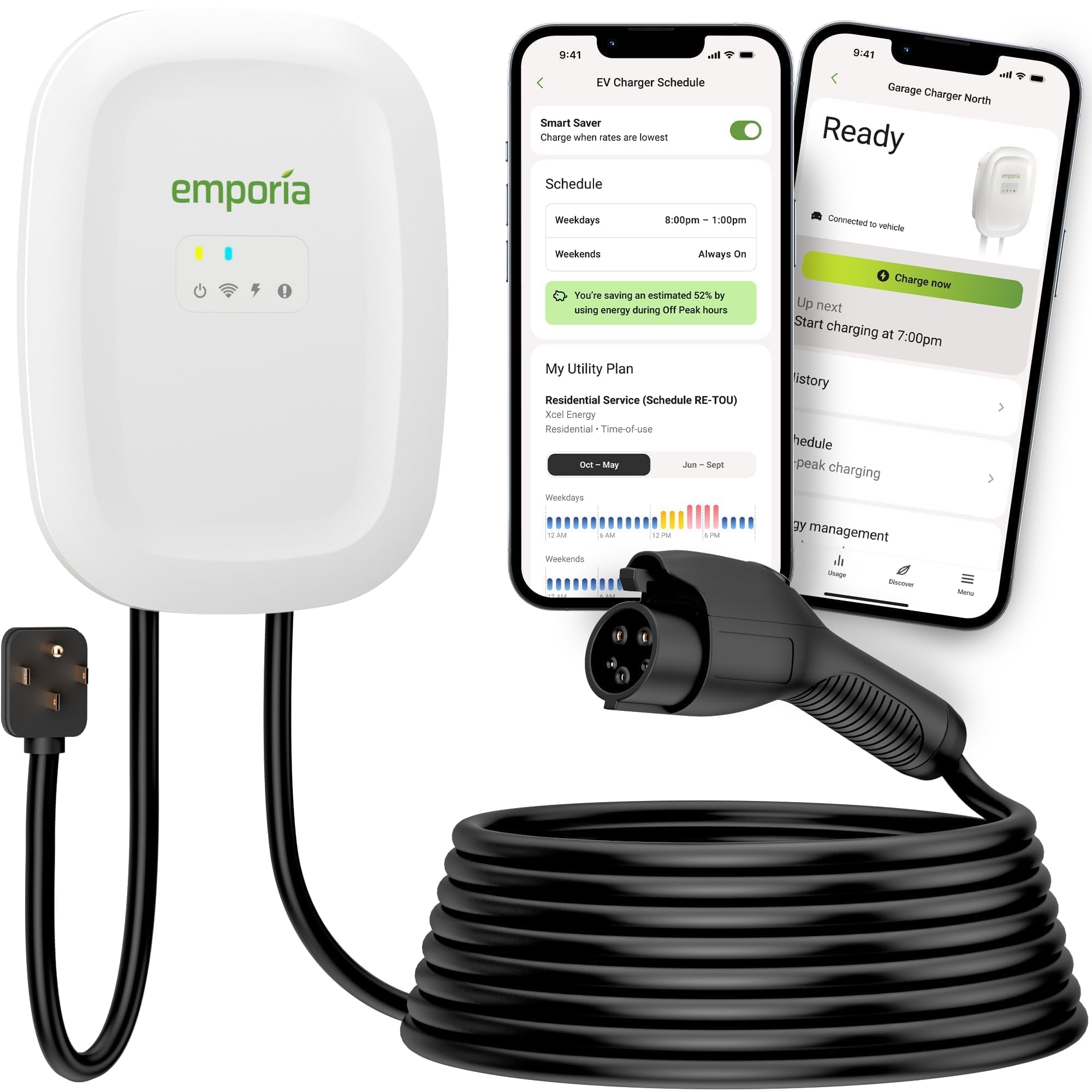
Owners consistently praise the app for tracking energy use and scheduling off-peak charging. Build quality gets called out as sturdy, and the J1772 connector fits the wide range of EVs sold in North America, including Tesla vehicles using an adapter.
ChargePoint HomeFlex
Buy this one if access to ChargePoint’s public charging network and adjustable amperage settings matter as much as home charging speed.
Pros
- Adjustable output from 16A to 50A to match different circuit sizes
- Ties into ChargePoint’s large public charging network through the app
- Cold-resistant 23-foot cable stays flexible in winter conditions
Cons
- Requires professional hardwiring, adding installation cost
- Some owners report inconsistent WiFi connectivity during setup
- Shorter cable length than most competitors on this list
This charger requires hardwiring to a circuit sized between 20A and 80A depending on the amperage selected, so an electrician needs to confirm the home’s panel capacity before installation. Once wired, the adjustable output lets one charger serve different circuit sizes across a move or panel upgrade.
Reviewers describe installation as straightforward with a qualified electrician and note the app is useful for scheduling and monitoring. A design flaw affecting some units has been noted in customer feedback, so checking current owner reviews before buying is worthwhile.
Autel MaxiCharger AC Home
Buy this one for a hardwired charger built to handle harsh outdoor conditions, including sub-zero temperatures.
Pros
- Cable stays flexible down to -40°F
- NEMA 4 rating protects against snow, rain, hail, and sleet
- CSA certification supports eligibility for rebate programs
Cons
- Requires hardwiring by a licensed electrician
- Heavier and bulkier than plug-in alternatives
- Fewer verified owner reviews compared to other chargers on this list
Autel built this unit for outdoor installations in climates with real winters, and the cold-rated cable is a meaningful advantage over chargers that stiffen in freezing temperatures. Output tops out at 50A, or 12kW, adding up to 37 miles of range per hour depending on the vehicle’s onboard charger.
Hardwiring is required, which adds electrician labor cost but removes the outlet compatibility question entirely. The brand’s automotive testing background shows in the build quality, though buyers should confirm local rebate eligibility before purchasing since programs vary by state.
AIMILER Level 2 EV Charger
Buy this one for solid Level 2 charging speeds at a lower price point without giving up smart features.
Pros
- Adjustable current from 16A to 32A matches different circuit breakers
- Built-in leakage protection removes the need for a separate GFCI breaker
- Touch-screen display shows charging data in real time
Cons
- Maximum output is capped at 32A, lower than several competitors here
- Not compatible with some newer NACS-only vehicles without an adapter
- WiFi setup requires strict adherence to the 2.4GHz-only connection
This charger plugs into a NEMA 14-50 outlet and adjusts its output to match a 20A, 30A, or 40A breaker, which makes it forgiving for homes with smaller existing circuits. The plug-and-charge default mode also works without WiFi if the app connection proves troublesome.
Owners across a range of EV and plug-in hybrid models report reliable performance and appreciate the cable’s heavier gauge compared to manufacturer-supplied chargers. The 32A ceiling means faster-charging vehicles won’t reach their maximum home charging speed with this unit.
EVDANCE Level 1&2 Portable Charger
Buy this one as a travel-friendly backup charger rather than a primary home charging solution.
Pros
- Works with both 120V and 240V outlets using included adapters
- Compact and light enough to carry in a trunk
- Lower cost than dedicated Level 2 wall units
Cons
- Maximum output of 16A is slower than full Level 2 chargers
- Not compatible with several newer EV models, including some Toyota and Porsche plug-ins
- Only a 1-year warranty, shorter than most competitors
This charger fills a different role than the wall-mounted units on this list. It works from a standard 120V household outlet at a slow trickle rate, or from a 240V NEMA 6-20 outlet at a faster but still modest 16A. That makes it best suited as a travel charger or emergency backup, not a primary daily charger for most drivers.
Owners who use it as their only home charging option report it works reliably for daily commuting distances, though full battery charging takes considerably longer than any 40A or 48A unit on this list.
Enphase HCS-50 (Formerly ClipperCreek)
Buy this one for a no-frills charger built for reliability over years of daily use, backed by an above-average warranty.
Pros
- 5-year manufacturer warranty, longer than most competitors
- Simple plug-in design with no app dependency required
- NEMA 4 enclosure rated for outdoor installation
Cons
- No smart app features for scheduling or energy tracking
- Lower price point reflects fewer bells and whistles
- 40A output tops out lower than some 48A hardwired units
This charger skips smart features entirely, relying on the vehicle’s own charging management instead of an app. For buyers who find WiFi-dependent chargers unnecessary, that simplicity is a selling point rather than a limitation.
Long-term owners report years of trouble-free use, and the extended 5-year warranty reflects the brand’s confidence in its hardware. The unit requires a dedicated 50A circuit and NEMA 14-50 outlet, plugging in rather than hardwiring.
EMPORIA Level 2 EV Charger (NACS)
Buy this one specifically for Tesla ownership, since it uses the NACS connector directly without an adapter.
Pros
- NACS connector works with Tesla vehicles without an adapter
- Can remotely open a Tesla’s charging port door from the app
- Same flexible 40A plug-in or 48A hardwired configuration as Emporia’s J1772 model
Cons
- Not compatible with non-Tesla EVs unless they support NACS natively
- Mounting bracket has been called out as flimsy by some owners
- App lacks utility rate data for Canadian users
This charger works exactly like a Tesla-branded charger, including the port-door-opening feature, while adding app-based scheduling and energy monitoring that some factory options lack. As more automakers adopt NACS, this connector type is becoming a more future-proof choice for garages with mixed vehicle types.
Owners report strong build quality and effective app performance, though a few flag the wall-mount bracket as underbuilt for the cable’s weight over time. Confirming a vehicle’s NACS compatibility before buying is essential, since this unit won’t work with a J1772 port without an adapter.
WOLFBOX E48 Hardwired Charger
Buy this one for a household with multiple drivers who need simultaneous app access to one charger.
Pros
- Supports multiple user accounts sharing control of the same charger
- Works with Alexa and Google Assistant for voice commands
- Large LCD screen displays charging rate, time, and voltage
Cons
- Requires hardwiring to a 60A or larger circuit for full output
- Some owners report needing to reconfigure the amperage setting after power outages
- Fewer long-term reviews available than more established competitors
This charger targets homes where more than one person needs to start or monitor a charging session, a feature many single-user chargers skip entirely. Voice assistant integration adds convenience for households already using Alexa or Google Assistant elsewhere.
Installers should confirm the panel can support a 60A circuit before choosing the 48A setting, since the unit requires hardwiring rather than a plug-in outlet. One recurring owner note involves the charger resetting to its highest amperage setting after a power blink, which is worth checking during initial setup.
EVDANCE Level 2 40A Charger
Buy this one for a plug-in charger with fine-grained current control across six preset amperage levels.
Pros
- Six selectable current settings from 10A to 40A
- Delayed-start timer helps shift charging to off-peak electricity hours
- 2.4-inch TFT display shows real-time charging data
Cons
- Plugs into a NEMA 14-50 outlet only, no hardwired option
- Tesla owners need a separate J1772-to-NACS adapter
- Newer product with a shorter track record of long-term reviews
This charger’s adjustable current settings, from 10A up to 40A in six steps, let one unit serve different circuit breaker sizes without needing a different charger for each home. The delay-start timer is a useful tool for households on time-of-use electricity rates.
The 25-foot cable and NEMA 14-50 plug mirror most other plug-in options on this list, and the display gives clear feedback during charging sessions. Buyers with a dedicated 50A circuit and standard J1772 vehicle get a capable charger at a reasonable cost.
Buying Guide
Match the Charger to Your Electrical Circuit
Every Level 2 charger needs a 240-volt circuit, and the breaker size determines how much current the charger can safely draw. A 40A charger needs a 50A dedicated circuit, following the National Electrical Code rule that continuous loads run at no more than 80% of a breaker’s rating. A licensed electrician should confirm the home’s panel has room for a new circuit before any charger is purchased.
Plug-In vs. Hardwired Installation
| Feature | Plug-In (NEMA 14-50) | Hardwired |
|---|---|---|
| Installation | Electrician installs an outlet; charger plugs in | Electrician wires charger directly to the panel |
| Flexibility | Charger can be unplugged and moved | Permanent, harder to relocate |
| Max amperage | Often capped around 40A | Can reach 48A or higher |
| Typical cost | Lower installation labor | Higher labor cost |
Plug-in chargers offer more flexibility if a household expects to move the unit or take it along during a relocation. Hardwired units support higher amperage in many cases and remove the risk of a loose plug connection over years of use.
Connector Type: J1772 vs. NACS
J1772 is the standard connector for nearly all non-Tesla EVs and plug-in hybrids sold in the US. NACS, originally Tesla’s proprietary connector, now works directly with Tesla vehicles and is being adopted by other automakers. Buyers with a Tesla should decide between a NACS charger for direct connection or a J1772 charger paired with the adapter Tesla includes with the vehicle.
Why Higher Amperage Doesn’t Always Mean Faster Charging
A charger’s amperage rating is a ceiling, not a guarantee. The vehicle’s onboard charger sets its own maximum acceptable rate, often between 32A and 48A depending on the model. A 48A charger won’t charge a car with a 32A onboard charger any faster than a 32A unit would. Checking the vehicle’s specifications before choosing a charger avoids paying for capacity that goes unused.
Weatherproofing and Location
Chargers installed outdoors or in unheated garages need a NEMA 4 or IP66 rating to resist rain, snow, and dust. Cable flexibility in cold weather also matters. Some cables stiffen significantly below freezing, making them harder to handle during winter charging sessions.
Smart Features and App Control
WiFi-enabled chargers allow scheduling for off-peak electricity rates, energy use tracking, and remote start/stop control. These features require a stable 2.4GHz WiFi connection, and some households report weaker connectivity in detached garages or basements. A charger without smart features still functions reliably using the vehicle’s own charge timer instead.
Warranty and Certification
Look for UL or ETL certification, which confirms the charger passed independent safety testing. Energy Star certification indicates efficient standby power use. Warranty length varies from one year on portable travel chargers to five years on some hardwired units, and longer coverage is a reasonable indicator of manufacturer confidence in long-term reliability.