
The best car battery chargers for home use offer safe charging, easy controls, and dependable maintenance for daily drivers.
A dead battery can ruin a morning, especially when your car sits outside, in a garage, or unused for weeks. A smart charger can restore charge, reduce battery stress, and help maintain a healthy battery over time. I compared charging power, battery support, safety features, controls, and home-use value across these popular models. This list includes automatic maintainers, high-output chargers, engine-start units, and one portable jump starter for drivers who want emergency backup.
See the differences between my top picks at a glance.
| Product | Battery Type / Voltage | Main Strength | Best For | Our Rating | Buy |
|---|---|---|---|---|---|
| 10A Smart Battery Charger | 12V / 24V lead-acid | 7-stage charging and repair | Home charging and maintenance | 4.6/5 | View on Amazon |
| E-FAST 25A Smart Charger | 12V / 24V, several battery types | High output and booster mode | Large batteries and faster charging | 4.5/5 | View on Amazon |
| TowerTop Smart Charger | 12V, AGM, STD, Gel, deep cycle | 25A output and engine start | Cars, trucks, boats, and RV use | 4.5/5 | View on Amazon |
| Schumacher SC1280 | 6V / 12V | 15A automatic charging | Mixed home and power-sport use | 4.4/5 | View on Amazon |
| 12V 10A LCD Smart Charger | 12V | LCD display and protection system | Simple visual monitoring | 4.3/5 | View on Amazon |
| 12V 10A Automatic LCD Charger | 12V | Automatic maintenance | Cars, motorcycles, and lawn equipment | 4.3/5 | View on Amazon |
| Schumacher SC1446 | 6V / 12V | 200A engine start | Emergency starting power | 4.2/5 | View on Amazon |
| NOONE Smart Battery Charger | 6V / 12V | 50A engine start and repair | Flexible home battery service | 4.3/5 | View on Amazon |
| 8000A Jump Starter | 12V vehicle systems | Jump starting and air compressor | Emergency roadside backup | 4.1/5 | View on Amazon |
10A Smart Battery Charger and Maintainer

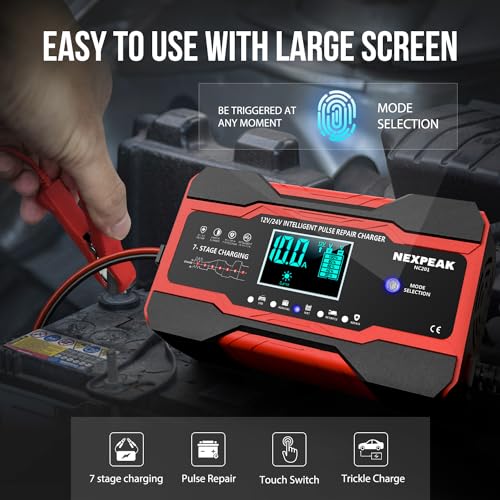
This 10A smart charger is a strong choice for basic home battery care. It supports 12V and 24V lead-acid batteries, so it can fit more than one vehicle type. The seven-stage charging design aims to move the battery from testing to charging, conditioning, and maintenance in a controlled way. Its large screen also makes it easier to check the charging state from across a garage.
I like this model for drivers who want more than a simple trickle charger. The pulse repair feature may help with some lightly sulfated batteries, although it cannot fix a battery that has failed internally. Multi-protection functions are useful during overnight charging. Still, you should match the charger to the battery label and follow the maker’s safety steps.
Pros:
- Supports both 12V and 24V lead-acid systems
- Seven-stage charging helps limit overcharging
- Large display is easy to read
- Pulse repair mode adds useful battery care
- Works well for cars, trucks, and home garage use
- Automatic maintenance suits vehicles stored for long periods
Cons:
- Designed mainly for lead-acid batteries
- Repair mode cannot restore a fully failed battery
- 10A output may feel slow on very large batteries
What Amazon Buyers Are Saying
Buyer feedback commonly focuses on the clear display, automatic operation, and useful charging modes. Some owners like leaving it connected during vehicle storage. As with many smart chargers, complaints tend to involve unclear battery status or charging problems caused by a battery that is too deeply discharged or damaged. Check current buyer feedback and the latest manual before purchase.
My Recommendation
I recommend this charger for most home users who want a flexible lead-acid maintainer with a screen. It offers a good balance of output, safety, and price. I would not choose it for a lithium battery unless the product instructions clearly approve that chemistry.
E-FAST 25A Smart Car Battery Charger
The E-FAST 25A charger is made for people who want a faster home charging option. It supports 12V and 24V systems and offers adjustable output for different charging needs. The product listing also names lead-acid, AGM, Gel, and LiFePO4 battery support. That wide range makes it one of the more flexible choices in this group.
Its 200-second booster mode may help when a battery needs extra support before normal charging. I see this as a useful tool for larger vehicles, work trucks, boats, and busy garages. High output demands more care, so I would verify the battery chemistry, voltage, and connection before switching it on. It is not the best pick if you only need a small motorcycle maintainer.
Pros:
- High 25A output can reduce charging time
- Supports 12V and 24V battery systems
- Lists support for several common battery chemistries
- Adjustable charging gives users more control
- Booster mode may assist with weak batteries
- Useful for larger vehicles and home workshops
Cons:
- High output requires careful setup
- May be more charger than a small car needs
- Users must confirm LiFePO4 settings before charging
What Amazon Buyers Are Saying
Reviews for high-output chargers often praise faster charging and broad vehicle use. Buyers may also value the digital controls and booster feature. The most common concerns with this type of product involve learning the controls, heat during heavy use, or uncertainty about battery mode selection. Read the current listing and manual for exact operating limits.
My Recommendation
This is a good fit for an experienced home mechanic or anyone with more than one vehicle type. It offers strong output and broad battery support. For a normal sedan that only needs occasional maintenance, a simpler 10A charger may offer better value.
TowerTop 25A Smart Battery Charger
The TowerTop charger combines several useful functions in one home unit. It provides 2A, 10A, and 25A settings for different charging tasks. It also includes engine-start support, automatic desulfation, battery repair, and a winter mode. The listed battery types include AGM, standard, Gel, and deep-cycle batteries.
I consider this a practical choice for a garage with several battery-powered vehicles. The low setting suits maintenance, while the higher setting can help charge a larger battery. Winter mode may be useful in cold conditions, but users should still protect the charger from moisture and extreme exposure. The engine-start function is helpful, yet it should not replace a proper jump starter for every emergency.
Pros:
- Offers 2A, 10A, and 25A charging choices
- Includes engine-start support
- Works with AGM, standard, Gel, and deep-cycle batteries
- Automatic desulfation adds maintenance value
- Winter mode suits cold-weather use
- Good choice for mixed home garage needs
Cons:
- Larger than a basic trickle charger
- Several modes may take time to learn
- Engine-start performance depends on battery condition
What Amazon Buyers Are Saying
Buyers commonly look for this model because it combines charging, maintenance, repair, and starting functions. Positive comments often focus on its range of settings and usefulness on more than one vehicle. Some users may find the controls less simple than a one-button maintainer. Reviews can also vary when the connected battery has a bad cell.
My Recommendation
I recommend the TowerTop for drivers who want one charger for cars, boats, motorcycles, and deep-cycle batteries. It is feature-rich and flexible. It may be too complex for someone who only wants to leave a small charger on a seasonal car.
Schumacher SC1280 15A Battery Charger
Schumacher is a familiar name in battery tools, and the SC1280 offers a useful mix of automatic charging and maintenance. It supports 6V and 12V batteries, which helps owners of cars, motorcycles, lawn equipment, and other power-sport items. The unit provides up to 15A charging and includes a 3A trickle function. A microprocessor-controlled design helps manage the charging process.
This charger stands out when you need one device for more than a standard car battery. The 6V option gives it an advantage over many 12V-only models. I also like the balance between a moderate 15A charge and a lower maintenance setting. Before use, check the battery label and connect the clamps in the order shown in the manual.
Pros:
- Supports both 6V and 12V batteries
- 15A charging suits many automotive batteries
- 3A trickle mode helps with maintenance
- Automatic control reduces the need for constant watching
- Useful for auto, marine, and power-sport batteries
- Established brand presence in battery equipment
Cons:
- Not the highest-output model on this list
- May not provide enough starting power for every vehicle
- Battery chemistry support should be checked before use
What Amazon Buyers Are Saying
Amazon buyers often value the dual-voltage design and the simple automatic charging process. Many shoppers choose it for mixed household equipment rather than one car alone. Common concerns can include clamp reach, display behavior, or charging a battery that is deeply discharged. Customer experiences may differ based on battery age and condition.
My Recommendation
The SC1280 is a sensible buy for homes with 6V and 12V batteries. It has a useful output range and a trusted, practical design. I would choose it over a 12V-only charger when lawn equipment or power-sport batteries are part of the plan.
12V 10A LCD Smart Battery Charger
This 12V 10A charger focuses on clear feedback and automatic battery care. Its LCD display can show useful charging information while the temperature compensation feature helps adjust charging behavior as conditions change. The product listing names use with cars, trucks, motorcycles, lawn mowers, and boats. It also includes an eight-function protection system.
This model makes sense for a user who wants a simple 12V home charger with a screen. The 10A output is suitable for routine charging without the bulk of a commercial shop unit. Temperature-aware control is a useful feature because battery charging can change in cold or warm conditions. It remains important to use the correct mode and keep the unit dry.
Pros:
- Clear LCD display supports quick status checks
- 10A output fits common home charging needs
- Temperature compensation adds control
- Eight protection functions improve user confidence
- Suitable for several 12V vehicle types
- Automatic operation helps prevent overcharging
Cons:
- Does not support 6V batteries
- Not ideal for users who need engine-start power
- Exact battery chemistry support should be confirmed
What Amazon Buyers Are Saying
Shoppers tend to notice the LCD screen and the broad list of vehicle uses. Positive feedback often centers on easy monitoring and automatic operation. Some buyers may want longer cables or a brighter display in direct light. As with other smart chargers, performance depends on the battery accepting a normal charge.
My Recommendation
I recommend this charger for a typical 12V car owner who wants screen feedback and basic protection. It offers practical features without a long list of complex settings. Choose another model if you need 6V support, a lithium mode, or engine-start output.
12V 10A Automatic LCD Battery Charger
This second 12V 10A model offers a similar home-focused design with an LCD screen and temperature compensation. The listing highlights fully automatic charging and eight-layer protection. It targets cars, trucks, motorcycles, lawn mowers, and boats. That makes it a useful option for a household with several small and medium 12V batteries.
The main appeal here is low effort. You connect the clamps, select the correct setting, and let the automatic system manage the charge. The 10A output can handle routine charging, while the maintenance function suits vehicles that sit for part of the year. I would compare the latest price, included cable length, and warranty terms against the nearly similar model above.
Pros:
- Fully automatic charging helps simplify use
- LCD display provides charging information
- Temperature compensation supports changing conditions
- Eight-layer protection adds safety features
- Works with several common 12V vehicles
- Useful for seasonal vehicle storage
Cons:
- 12V-only design limits compatibility
- Does not replace a high-output engine starter
- Similar features may make comparison shopping important
What Amazon Buyers Are Saying
Buyers who choose this type of charger usually want automatic charging and a visible display. Reviews often focus on whether the unit is easy to connect and whether it maintains a stored vehicle as expected. Some complaints may relate to display readings or batteries that will not hold charge. A charger cannot solve a battery that needs replacement.
My Recommendation
This is a reasonable 12V maintainer for home use. I would consider it when the price is attractive and the included accessories fit your garage. It is best for routine care, not heavy commercial work or emergency starting.
Schumacher SC1446 200A Engine Start Charger
The Schumacher SC1446 is built for users who want charging and engine-start support in one corded unit. It supports 6V and 12V batteries and offers 10A charging. The product also lists 20A and 40A boost settings plus a 200A engine-start function. A 135-minute timer gives the user manual control over the charging period.
This unit differs from the automatic maintainers in this guide. Its manual timer design can suit an experienced user who wants direct control. The wheeled format may help when moving the charger around a garage. However, manual charging needs attention, so I would not connect it and leave it unattended for long periods.
Pros:
- Provides 200A engine-start power
- Supports both 6V and 12V batteries
- Includes 10A charging and boost settings
- 135-minute timer supports controlled charging
- Wheels improve movement around a garage
- Useful for auto, marine, and power-sport batteries
Cons:
- Manual timer requires more user attention
- Less convenient than a fully automatic maintainer
- Bulkier than compact home chargers
What Amazon Buyers Are Saying
Buyers often choose this model for its strong starting function and wheeled design. Positive comments may mention its usefulness on larger vehicles and its range of settings. The main concern with manual chargers is the need to monitor time and mode. Users who expect one-button operation may prefer an automatic Schumacher model or another smart charger.
My Recommendation
I recommend the SC1446 for a garage that needs emergency starting support and manual control. It is not my first choice for unattended maintenance. If you want strong output and understand manual chargers, it is a capable option.
NOONE 10A/15A Smart Battery Charger
The NOONE smart charger targets users who want a flexible 6V and 12V unit. It offers 10A and 15A charging options, plus a listed 50A engine-start function. The product description also names automatic maintenance, repair, desulfation, and overheat protection. It supports lead-acid, AGM, and LiFePO4 batteries according to the listing.
This range of features makes the NOONE interesting for a mixed home garage. The lower output can suit routine care, while 15A provides more power when a battery needs a faster charge. The 50A start function may help in some situations, but it should not be treated as a guarantee with a severely damaged battery. Always choose the battery mode that matches the battery label.
Pros:
- Supports 6V and 12V battery systems
- Offers both 10A and 15A charging
- Lists lead-acid, AGM, and LiFePO4 compatibility
- Includes automatic maintenance and desulfation
- Provides a listed 50A engine-start function
- Overheat protection adds useful safety support
Cons:
- Many settings may confuse first-time users
- Starting results depend on battery health
- Confirm the correct lithium charging procedure before use
What Amazon Buyers Are Saying
Buyers are likely to focus on the dual-voltage design, repair modes, and engine-start feature. Positive reviews often value having one device for several battery types. Common concerns may include the instructions, mode selection, or charging a battery that has reached the end of its service life. Check recent reviews for long-term durability and support details.
My Recommendation
I recommend the NOONE for users who want broad function without moving to a large shop charger. It is versatile on paper and suits mixed battery needs. I would still verify the exact LiFePO4 procedure before connecting it to a lithium battery.
8000A 10-in-1 Car Jump Starter
This product is different from the other entries because it is a portable jump starter rather than a traditional battery charger. It is listed as a 10-in-1 device with an 8000A jump-start rating, a 160 PSI air compressor, lights, and jumper cables. It is intended for 12V vehicle systems and is marketed for gas and diesel vehicles within its stated limits.
I see it as emergency backup for the trunk, driveway, or garage. It can help start a vehicle when no second car is nearby, and the air compressor adds another useful roadside tool. A jump starter does not replace a smart charger or battery maintainer. You must keep its internal battery charged and follow the cable and safety instructions every time.
Pros:
- Portable design is easy to store in a vehicle
- Combines jump starting with an air compressor
- Includes lights for roadside visibility
- Listed 8000A starting output offers strong emergency potential
- 160 PSI compressor adds practical value
- Useful when wall power is not available
Cons:
- Does not maintain a battery like a smart charger
- Must be recharged before an emergency
- Large performance claims still depend on temperature and battery condition
What Amazon Buyers Are Saying
Buyers of portable jump starters often like the combination of starting power, lights, and air inflation. Feedback may also mention the size, cable quality, charging time, and ease of reading the display. Some users may expect it to repair or recharge a car battery, which is not the same function as a wall-powered maintainer. Review the latest buyer comments before relying on it for a large vehicle.
My Recommendation
I recommend this product as emergency backup, not as the main charger in a home garage. It is a smart addition for drivers who travel or park far from help. Pair it with a proper automatic charger if you also need battery maintenance.
How to Choose the 10 Best Car Battery Charger for Home Use
Choosing among the 10 best car battery charger for home use starts with your battery, not the biggest number on the box. A good charger must match voltage, battery chemistry, size, and your normal use. Think about whether you need maintenance, fast charging, engine starting, or emergency portability.
1. Match Voltage and Battery Chemistry
Most modern cars use a 12V battery, but some equipment uses 6V. Trucks, boats, and larger systems may need 24V support. Check the label before you buy. A 6V/12V model offers more flexibility than a 12V-only charger.
Next, identify the battery chemistry. Common types include flooded lead-acid, AGM, Gel, deep-cycle, and LiFePO4. These batteries do not always use the same charging pattern. Choose a charger with a mode made for your battery. Never assume that a charger supports lithium batteries just because it has a digital screen.
2. Choose the Right Output and Charging Style
A 2A setting works well for slow maintenance. A 10A charger fits many home car batteries. A 15A or 25A model can charge larger batteries faster, but high output needs the correct setting and good ventilation. More amps do not always mean a better charger.
For a car that sits for weeks, choose an automatic maintainer. It can reduce the charge when the battery reaches a high level. For a weak battery, a repair or desulfation mode may help in some cases. These modes cannot restore a battery with a bad cell or major internal damage.
Engine-start output is useful when a vehicle will not crank. Still, it is not the same as a jump starter. A wall charger needs a power outlet. A portable jump starter stores energy inside its own battery. Decide which problem you want to solve before paying for extra features.
3. Check Safety, Controls, and Long-Term Value
Look for reverse-polarity protection, short-circuit protection, overcharge control, overheat protection, and spark reduction. A display can help you check voltage and charging status. Simple controls often work best for new users. A manual timer can offer control, but it needs more attention than an automatic charger.
Also check cable length, clamp quality, casing strength, warranty terms, and the instruction manual. A charger that costs a little more may offer better value if it serves several vehicles. However, avoid paying for repair modes or engine-start power that you will never use.
For safe home charging, place the charger on a stable, dry surface. Keep sparks and flames away from a lead-acid battery. Do not charge a swollen, cracked, leaking, or frozen battery. Stop if the battery becomes unusually hot or produces a strong smell. When in doubt, ask a qualified technician to inspect it.
Final Verdict: Which Should You Buy?
For most homes, I would choose the 10A smart charger with seven-stage charging. It offers the best balance of control, maintenance, and value. Choose E-FAST or TowerTop for higher output and more vehicle types.
The 10 best car battery charger for home use includes simple maintainers and emergency tools. Match the charger to your battery, use the correct mode, and read the latest product manual before charging.
FAQs Of 10 best car battery charger for home use
What amp charger is best for a car battery at home?
A 10A smart charger is a practical choice for many home users. It can charge common 12V car batteries while also supporting maintenance.
Can I leave a smart battery charger connected overnight?
Many automatic maintainers are designed for extended connection, but you should confirm this in the product manual. Use the correct battery mode and inspect the battery first.
Can one charger work with 6V and 12V batteries?
Yes. Models such as the Schumacher SC1280, Schumacher SC1446, and NOONE charger list both 6V and 12V support. Select the correct voltage before charging.
Is a jump starter the same as a car battery charger?
No. A jump starter gives short-term starting power. A smart charger restores and maintains the battery through a longer charging cycle.
Can a battery charger repair a dead battery?
A repair or desulfation mode may help some weak batteries. It cannot fix a battery with a failed cell, severe damage, leakage, or no ability to hold charge.