
The best trickle chargers for car batteries combine safe charging, smart maintenance, clear controls, and dependable long-term value.
A weak battery can ruin a planned trip, especially when a car sits for weeks. Cold weather, alarms, and small electric drains can slowly lower battery power. A good trickle charger keeps the battery ready without constant manual checks. I reviewed the listed models for charging control, battery support, safety features, ease of use, and value. My picks include compact maintainers for daily drivers, stronger chargers for trucks, and models with repair or engine-start functions. Always confirm the charger matches your battery type and voltage before connecting it.
See the differences between my top picks at a glance.
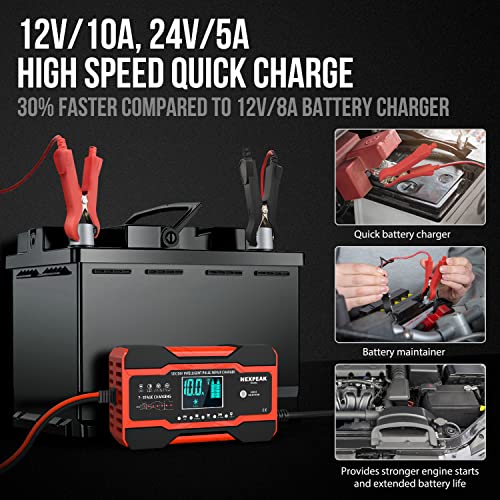
10A 7-Stage Smart Car Battery Charger

This 10-amp smart charger stands out for drivers who want more than a basic battery tender. It supports both 12-volt and 24-volt systems, so it can suit a wider range of cars, trucks, and equipment. The seven-stage charging design aims to control the charge as the battery fills. Its large display should also make it easier to check the charging stage and battery status.
The product listing focuses on lead-acid batteries and includes pulse repair and several protection features. I would use it for a car that sits for long periods, a work truck, or a battery that needs regular care. The 10-amp output can charge faster than a small 1- or 2-amp maintainer, but it still needs the correct mode and connection. Do not use it on lithium batteries unless the maker clearly approves that chemistry.
Pros:
- Supports both 12V and 24V systems
- Seven-stage charging offers useful control
- Large display improves status checks
- 10A output suits many full-size batteries
- Includes listed repair and protection functions
Cons:
- Lead-acid use limits battery chemistry choice
- More features may take time to learn
- 10A output may be more than needed for small batteries
What Amazon Buyers Are Saying
Review themes for chargers in this class often center on the clear display, strong output, and useful automatic modes. Buyers also tend to value a charger that works on both 12V and 24V equipment. Complaints usually relate to unclear instructions, mode selection, or clamp fit. Check current buyer feedback and the latest manual before purchase, since ratings and owner experiences can change.
My Recommendation
I recommend this model for owners who want one charger for several lead-acid battery jobs. It offers a strong mix of voltage choice, display feedback, and charging stages. It is not my first choice for lithium use. Overall, it is a capable value pick for a garage or home workshop.
10A Temperature-Compensated Battery Charger
This 12V, 10A smart charger targets common lead-acid batteries in cars, trucks, motorcycles, lawn mowers, and boats. Its automatic design helps reduce the need to watch the charger during a normal charging cycle. The listing also highlights temperature compensation and an LCD display. Those features can help the user understand what the charger is doing in changing conditions.
The eight-layer protection claim adds appeal for people who want safeguards against common connection and charging problems. I still advise checking polarity, battery condition, and ventilation before use. This is a charger and maintainer for 12V systems, not a universal solution for every battery type. Its broad vehicle list makes it useful for a home garage with several lead-acid vehicles.
Pros:
- Useful 10A output for many 12V batteries
- Temperature compensation is helpful in varied weather
- LCD display gives quick charging information
- Designed for cars, boats, motorcycles, and lawn equipment
- Automatic operation reduces hands-on work
Cons:
- Only listed for 12V systems
- Battery chemistry support should be checked before use
- Display and protection claims do not replace safe setup
What Amazon Buyers Are Saying
Buyers who choose similar smart chargers often praise the display and the simple automatic process. Many also like having one unit for several types of lead-acid vehicles. Common concerns in this category include cord length, clamp quality, and instructions that need closer reading. I suggest checking the newest customer reviews for comments about your specific vehicle and battery size.
My Recommendation
This is a practical choice for a 12V lead-acid battery owner who wants automatic charging and visible status information. It makes the most sense for mixed home use rather than a single small motorcycle battery. I would buy it after confirming the battery chemistry and the charger’s current operating instructions.
TowerTop 25A Smart Battery Charger
The TowerTop gives users three output choices: 2A, 10A, and 25A. That range makes it more flexible than a simple maintenance charger. The product listing also includes engine start, auto desulfation, battery repair, and a winter mode. It supports AGM, standard, gel, and deep-cycle batteries, which gives it a useful place in a larger garage.
I see this as a heavy-duty charger that can also perform maintenance work. The 2A setting may suit slow charging, while higher settings can help with larger batteries when used as directed. Engine-start functions are not a substitute for a healthy battery or a proper jump starter. Read the manual closely, select the correct battery mode, and keep the unit in a dry, ventilated area.
Pros:
- Three charging rates add flexibility
- Supports several listed lead-acid battery styles
- Includes winter mode and repair functions
- Engine-start feature adds emergency utility
- Suitable for larger vehicles and deep-cycle applications
Cons:
- Bulkier than a small battery maintainer
- Higher output requires careful mode selection
- Repair and start features cannot fix a failed battery
What Amazon Buyers Are Saying
Users who seek this type of charger usually value the adjustable output and the extra start function. Owners also tend to like having settings for different battery sizes. The most likely complaints involve the unit’s size, fan or operating noise, and learning the controls. Customer results can vary with battery age and damage, so I would not expect a repair mode to restore every battery.
My Recommendation
The TowerTop is one of the stronger picks here for a workshop, truck owner, or person who maintains several batteries. It offers more control than most basic trickle chargers. I recommend it to experienced users who will follow the manual and choose the correct mode. It is less appealing if you only need a small overnight maintainer.
10A Smart Charger with LCD Display
This 12V, 10A automatic charger shares many useful traits with the previous 10A model. It targets cars, trucks, motorcycles, lawn mowers, and boats. The LCD display can help users see charging information without guessing. The listing also mentions temperature compensation and eight protection functions.
Its main appeal comes from simple operation. Connect it to the battery, confirm the mode, and let the automatic system manage the charge. I would use it for a vehicle that sits during winter or for a second car that does not get driven often. Because the listed compatibility focuses on lead-acid batteries, check the label before using it with AGM, gel, or lithium chemistry.
Pros:
- Clear LCD status display
- Useful 10A charging output
- Automatic charging needs less supervision
- Temperature compensation may help in changing weather
- Works with several common vehicle types
Cons:
- 12V operation limits its range
- Battery type must match the charger settings
- 10A may be excessive for some small batteries
What Amazon Buyers Are Saying
Common buyer feedback for this style of product focuses on the easy-to-read screen and quick setup. Owners often appreciate automatic charging for cars that sit unused. Some buyers may report concerns about instructions, cable reach, or long-term durability. I advise checking recent reviews for details on the exact battery and vehicle you plan to maintain.
My Recommendation
This charger is a sensible choice for a 12V lead-acid car battery when you want a screen and automatic control. It does not offer the voltage range of the first pick, but its design remains practical. I would consider it a good mid-range option for normal home use.
Schumacher Electric SC1280 Charger
The Schumacher SC1280 brings useful voltage flexibility to this list. It works with 6V and 12V batteries and offers charging choices that include a 3A trickle mode and higher output. Its microprocessor-controlled design aims to adjust charging as the battery condition changes. The product is intended for power sport, automotive, and marine batteries.
This model suits owners who want a recognized automotive charger with more range than a basic maintainer. The 6V setting can help with some older or specialty applications, while the 12V setting covers most modern cars. It is still important to select the right voltage before charging. I would choose it for a garage that handles more than one battery type or vehicle class.
Pros:
- Supports both 6V and 12V batteries
- Includes a low-current trickle mode
- Microprocessor control supports automatic charging
- Useful for automotive, marine, and power sport batteries
- Higher output can reduce charging time on suitable batteries
Cons:
- More settings may confuse first-time users
- Not a lithium charger unless the manual says so
- Large output settings need careful battery matching
What Amazon Buyers Are Saying
Buyers often choose Schumacher chargers for their brand history, voltage options, and broad vehicle use. Review discussions commonly praise the automatic function and the ability to handle more than one battery type. Some complaints in this category involve control labels, clamp design, or performance with a deeply damaged battery. A charger cannot reliably recover a battery with an internal fault.
My Recommendation
The SC1280 is a strong all-purpose option for a user who needs both 6V and 12V support. It offers more flexibility than most car-only maintainers. I recommend it for a home garage, but I would choose a simpler model for someone who only wants plug-in maintenance on one 12V car.
10A Fully Automatic 12V Charger
This model takes a simple approach. It is a 12V, 10A fully automatic smart charger for routine battery charging and maintenance. The shorter product listing does not provide as much detail about battery chemistry or special modes as some other picks here. That makes the manual and product page especially important before purchase.
I would consider it for a standard 12V car battery when the main goal is automatic charging. The 10A output gives it more charging power than a small trickle-only unit. However, buyers should not assume that “smart” means universal. Confirm support for flooded, AGM, gel, or other battery types before connecting it.
Pros:
- Simple 12V design
- 10A output can charge suitable batteries efficiently
- Fully automatic operation reduces manual work
- Useful for routine car battery care
- Compact feature set may appeal to new users
Cons:
- Public listing gives fewer detailed specifications
- Battery chemistry support needs confirmation
- Does not list the broad voltage range of some rivals
What Amazon Buyers Are Saying
For basic automatic chargers, buyers usually care about simple connections, clear charging status, and whether the unit maintains a battery over time. Reviews may also mention cable length and the clarity of the manual. Because product details can change, I recommend reading the latest owner comments for this exact listing rather than relying on the short name alone.
My Recommendation
This charger can make sense when you want a basic automatic 12V unit and the current listing confirms your battery type. I would not choose it for mixed-voltage work or unusual batteries without more documentation. Its value depends heavily on the current price and the detail provided by the seller.
10A 12V/24V Smart Battery Charger
This charger offers 12V and 24V support in a relatively focused package. That makes it useful for owners who work on both cars and larger equipment. The listing describes it as a 10A smart trickle charger, but buyers should confirm how the unit selects voltage and which battery types it supports. Correct voltage selection matters more than a high output number.
I like the flexibility for a home workshop, farm vehicle, or small fleet. A 24V option can help with paired-battery systems when the charger is designed for that use. Still, I would not connect it to a 24V setup without reading the instructions first. The product’s value depends on clear mode controls, suitable cables, and a good safety design.
Pros:
- Supports listed 12V and 24V systems
- 10A output fits many charging tasks
- Smart charging reduces constant monitoring
- Useful for mixed vehicle needs
- May replace the need for separate voltage-specific chargers
Cons:
- Battery chemistry support needs careful checking
- Incorrect voltage selection can cause serious problems
- May be more charger than a single-car owner needs
What Amazon Buyers Are Saying
People who buy dual-voltage chargers often like the ability to use one unit across several vehicles. Review themes may include easy setup, display quality, and whether the voltage switch feels clear. The main concern tends to be safe use with different battery systems. I recommend checking recent reviews for instructions and real-world cable reach before ordering.
My Recommendation
This is a useful option for a buyer who truly needs both 12V and 24V charging. It offers better range than a single-voltage model, but it demands careful setup. I recommend it for informed users who will verify battery type, voltage, and charging instructions first.
Schumacher Electric SC1361 Charger
The Schumacher SC1361 is a 12V charger and maintainer with a 6A charging rate. It also lists a 10A boost and a 50A engine-start function. That combination gives it more emergency value than a simple trickle charger. The low-profile clamps can help when space around the battery is tight.
This model fits drivers who want everyday maintenance plus extra starting support. The engine-start function should only serve as a short assist and should not replace proper battery testing. I like the auto-restart feature for routine use, since power interruptions can happen in a garage. It works with power sport, automotive, and marine batteries, subject to the manual’s battery-type rules.
Pros:
- 6A charging output suits routine maintenance
- Includes 10A boost and 50A engine-start features
- Auto-restart adds convenience
- Low-profile clamps help in tight spaces
- Useful for auto, marine, and power sport batteries
Cons:
- Only supports 12V systems
- Engine-start mode needs careful use
- Heavier and more complex than a small maintainer
What Amazon Buyers Are Saying
Buyers commonly look to this kind of Schumacher unit for its boost and engine-start options. They may also value the compact clamp design and automatic restart. Common complaints can involve the unit’s size, operating sound, or difficulty starting a severely drained battery. Owner results depend on the battery’s state, cable connection, and vehicle demand.
My Recommendation
The SC1361 is a strong choice for a car owner who wants more than maintenance. It offers practical backup power features while keeping a moderate charging rate. I recommend it for a garage or roadside kit, provided you understand that an engine-start mode cannot overcome every battery failure.
12V 10A Lead-Acid and LiFePO4 Charger
This is the most chemistry-flexible pick in the group because its listing names both lead-acid and LiFePO4 lithium batteries. It provides 10A output at 12V and includes automatic repair and desulfation claims. Temperature compensation is also listed. That mix can appeal to owners with a conventional car battery and a separate lithium-powered vehicle or system.
The key issue is correct mode selection. Lead-acid and LiFePO4 batteries use different charging rules, so never assume one mode fits both. I would confirm the exact battery label, select the correct chemistry, and follow the current manual. Used correctly, this model can reduce the need to own two chargers.
Pros:
- Listed for lead-acid and LiFePO4 batteries
- 10A output suits many 12V applications
- Temperature compensation adds useful control
- Repair and desulfation functions are included in the listing
- Can serve mixed battery-chemistry households
Cons:
- Wrong chemistry mode can damage a battery
- Only supports 12V systems
- Lithium users should verify BMS and charging requirements
What Amazon Buyers Are Saying
Buyers interested in dual-chemistry chargers often praise the convenience of one unit for different batteries. Review themes may include mode clarity, screen information, and whether the unit recognizes a low battery. Some owners may find the instructions less clear when switching chemistry modes. I would read the newest reviews and manual before using it with an expensive LiFePO4 battery.
My Recommendation
This is my preferred pick for a careful buyer who needs both lead-acid and LiFePO4 support. It offers useful flexibility without requiring two separate chargers. I recommend it only when the current documentation confirms the exact battery chemistry and charging mode you need.
How to Choose the 10 Best Trickle Charger for Car Battery
Choosing among the 10 best trickle charger for car battery options starts with the battery, not the charger’s largest number. A charger must match voltage, chemistry, battery size, and the way you plan to use it. I focus on four practical points: electrical fit, charging control, safety, and long-term value.
1. Match Voltage and Battery Chemistry
Most passenger cars use a 12V battery system. Some equipment uses 6V, while larger systems may use 24V. Pick a charger that clearly supports your system. A 12V charger is not automatically safe for a 24V setup.
Next, identify the battery chemistry. Common lead-acid types include flooded, AGM, and gel. LiFePO4 batteries need a suitable lithium charging profile. Do not rely on the word “smart” alone. Read the label and manual. The charger should name your battery type or provide a clear, approved mode.
2. Choose the Right Output for Your Use
A small 1A or 2A maintainer works well for slow upkeep on a healthy battery. A 6A or 10A charger can restore charge faster and support larger car batteries. A 25A model can help with heavy-duty work, but it needs more care and better ventilation.
For long-term storage, look for automatic float or maintenance operation. The charger should reduce or stop its main charge when the battery reaches the proper level. A charger that keeps pushing full current can overheat or harm a battery. Always follow the maker’s charge-time guidance.
3. Check Safety, Controls, and Total Value
Useful safety features may include reverse-polarity protection, short-circuit protection, overcharge control, and temperature monitoring. These features help, but they do not replace correct connections. Inspect the cables and clamps before each use. Keep the battery area clean and well ventilated, since some lead-acid batteries can release gas while charging.
Also consider the display, cable length, clamp size, restart behavior, and warranty. A low price means little if the controls feel unclear or the cables cannot reach the battery. For most drivers, the best trickle charger for car battery is the one that matches the battery and remains simple to use. Extra repair or start modes add value only when you need them.
Final Verdict: Which Should You Buy?
For most garages, I would choose the Schumacher SC1280 for its 6V/12V range and flexible maintenance modes. The TowerTop is better for heavy-duty work, while the LiFePO4 model suits mixed chemistry needs.
These 10 best trickle charger for car battery picks cover simple maintenance, fast charging, dual voltage, and emergency support. Match the charger to your battery before buying.
FAQs Of 10 best trickle charger for car battery
Can I leave a trickle charger connected all winter?
Only if it has automatic maintenance or float control and the battery maker allows it. Check the charger manual, use a ventilated area, and inspect the setup often.
What amp charger is best for a car battery?
A 2A maintainer suits slow storage care. A 6A or 10A smart charger offers faster charging for many full-size car batteries. Always follow the battery maker’s guidance.
Can I use a car battery charger on a LiFePO4 battery?
Use it only when the charger lists LiFePO4 support and provides the correct lithium mode. A standard lead-acid mode may not be suitable.
What is the difference between a trickle charger and a battery maintainer?
A basic trickle charger may deliver a steady low current. A smart maintainer adjusts or pauses charging as the battery fills, which is better for long storage.
Is a 12V charger safe for a 24V battery system?
No. Use a charger that clearly supports 24V operation. Confirm the system voltage and select the correct mode before connecting it.