
Charging an electric car at home comes down to one simple trade-off: speed versus convenience. A standard wall outlet delivers Level 1 charging, adding only a few miles of range per hour. A dedicated ev home charger running on a 240-volt circuit delivers Level 2 charging, which can add 20 to 45 miles of range per hour depending on the vehicle and the charger’s amperage.
Most home chargers fall into two installation types. Hardwired units connect directly to a home’s electrical panel through a dedicated circuit, usually installed by a licensed electrician. Plug-in units connect to an existing high-voltage outlet, such as a NEMA 14-50, the same type used for RVs and electric ranges. Plug-in chargers are easier to install or move, while hardwired models often support higher amperage and skip the outlet as a potential failure point.
The right charger depends on the vehicle’s connector type (J1772 for most EVs, NACS for Tesla and newer models), the electrical capacity already available in the home, and how much charging speed the driving routine actually requires. A commuter driving 30 miles a day doesn’t need the same amperage as someone who drives 100 miles and needs a full overnight recharge. Matching amperage, circuit size, and connector type to actual needs makes more sense than chasing the highest number on the box.
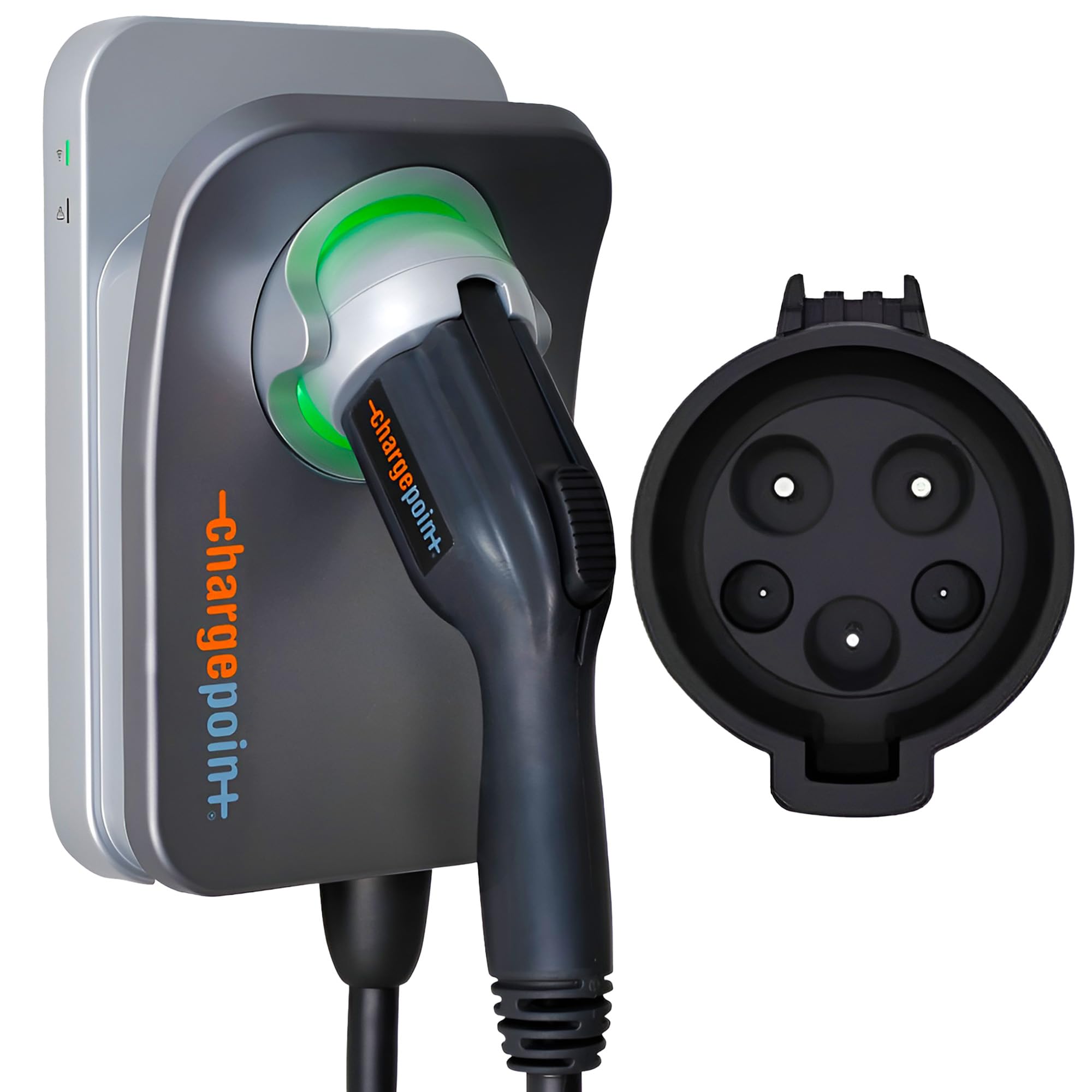
Best for maximum flexibility: ChargePoint HomeFlex J1772
Best plug-in for easy installation: EVIQO J1772 40A
Best for dual outlet/hardwire setup: EMPORIA Level 2 Charger
Best for quick plug-in setup: Autel 40A NEMA 14-50
Best for Tesla owners wanting hardwired reliability: ChargePoint HomeFlex NACS
Best for Tesla owners wanting faster hardwired charging: EVIQO NACS 48A
Best budget-friendly plug-in option: AIMILER 32A Charger
Best for renters and Level 1 backup charging: EVDANCE Portable Charger
Best for travel and apartment charging: bokman Portable Charger
Best for high-amperage hardwired setups: Autel 50A Hardwired Charger
ChargePoint HomeFlex Level 2 EV Fast Charger (J1772, Hardwired, 50A)

This charger suits drivers who want adjustable amperage and a long track record from a major charging network brand.
Pros
- Adjustable from 16A to 50A to match different circuit sizes
- 23-foot cable reaches most driveway and garage setups
- Backed by ChargePoint’s large public charging network and app
Cons
- Requires professional hardwired installation
- WiFi connectivity issues reported by some owners
- J1772 connector needs an adapter for Tesla vehicles
The HomeFlex stands out for its adjustable amperage setting, letting one charger work on a 20A up to an 80A circuit. That flexibility makes it a good match for homes where the electrical panel may not support the highest output right away. EV Home Charger
Indoor or outdoor installation works well thanks to its weather-resistant housing and cold-rated cable. The mobile app adds scheduling and monitoring features, though a stable 2.4GHz WiFi connection is needed for full functionality.
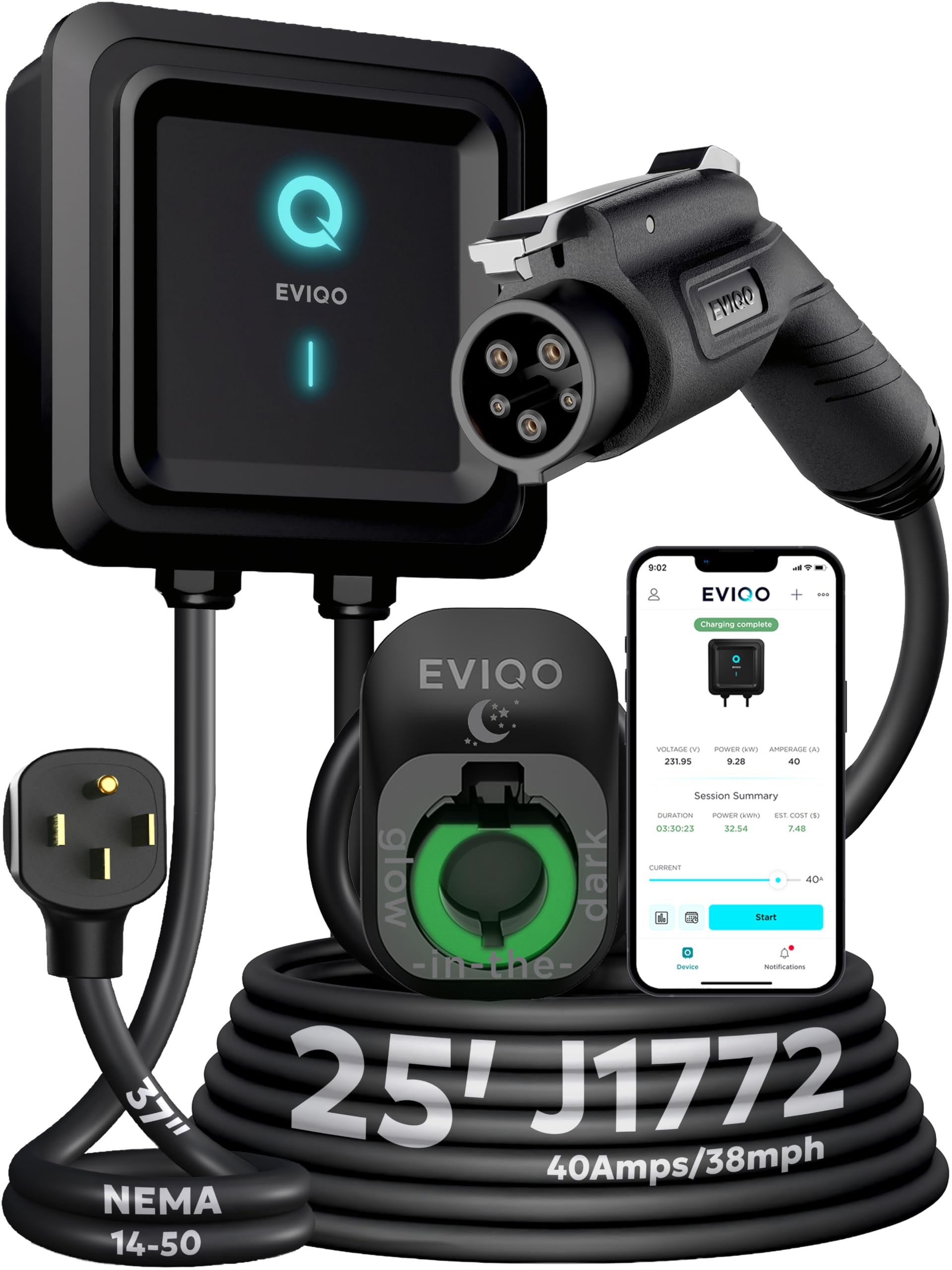
EVIQO Level 2 EV Charger (J1772, 40A, NEMA 14-50)
This plug-in charger works well for anyone who already has a NEMA 14-50 outlet installed and wants a straightforward setup without an electrician visit.
Pros
- Plugs directly into a 240V NEMA 14-50 outlet, no hardwiring needed
- 25-foot cable offers generous reach
- IP66-rated housing withstands rain, snow, and dust
Cons
- Requires a dedicated 50A circuit for full 40A output
- Needs 2.4GHz WiFi specifically, won’t connect to 5GHz networks
- Not compatible with dryer-style 14-30 outlets
The plug-in design means this charger can move with the owner to a new home, provided the right outlet is available there too. A glow-in-the-dark holster helps with nighttime plug-ins.
The app supports scheduling for off-peak charging, and a side reset button avoids breaker trips for troubleshooting. Drivers should confirm outlet type before buying, since the 14-50 differs from the 14-30 dryer outlet.
EMPORIA Level 2 EV Charger (J1772, 48A, NEMA 14-50)
This charger fits drivers who want the option to start with a plug-in setup and later convert to hardwired for higher output.
Pros
- Convertible between NEMA 14-50 plug-in and hardwired configurations
- Supports up to 48A when hardwired, 40A on the NEMA plug
- UL listed and Energy Star certified
Cons
- Hardwiring for full 48A requires professional installation
- Compact design may need extra mounting hardware for some garages
- WiFi setup requires 2.4GHz network only
The dual installation option gives this charger unusual flexibility. A renter or new homeowner can start with the plug-in version, then have an electrician convert it to hardwired later for higher amperage.
Real-world charging speed depends on the vehicle’s onboard charger accepting the full 48A, so drivers with lower-capacity onboard chargers won’t see the maximum rate. The app tracks energy use and supports scheduled charging for lower utility rates.
Autel 40A Level 2 EV Charger (NEMA 14-50, WiFi)
This charger suits owners who want a five-minute plug-in setup with RFID security for shared or public-facing driveways.
Pros
- Installs in minutes with a standard NEMA 14-50 outlet
- Adjustable from 16A to 40A through the app
- RFID access adds a layer of charging security
Cons
- Maximum 40A output, lower than some hardwired competitors
- NEMA 4X rating protects against weather but not submersion
- Smaller cable length compared to some 25-foot competitors
Autel built this unit for owners who want to skip the electrician visit entirely. Plugging into an existing 14-50 outlet gets it running fast, which matters for anyone renting or planning to move soon.
The RFID start/stop feature is a standout for shared driveways or multi-unit housing, preventing unauthorized use. Adjustable amperage through the app lets owners match output to their circuit without touching the unit itself.
ChargePoint HomeFlex NACS (Hardwired, Tesla Compatible)
This charger is built specifically for Tesla owners who want a native NACS connector without needing a J1772 adapter.
Pros
- Native NACS connector plugs directly into Tesla vehicles
- Hardwired design skips outlet failure points
- Owners report straightforward electrician installation
Cons
- Some users report WiFi connectivity drops on mesh networks
- Bluetooth stays on at all times, which some owners dislike
- Non-Tesla EVs with NACS ports still need to confirm compatibility
Owner reviews mention successful installs alongside Toyota bZ and other NACS-equipped vehicles, with charging times of roughly two hours for a 50-to-80 percent top-up on some models. That suggests real-world performance lines up with expectations for a 50A hardwired unit.
A few reviewers noted WiFi drops on mesh network setups, though most found the app easy to use for scheduling and monitoring once connected.
EVIQO Level 2 EV Charger NACS 48A (Hardwired, Tesla)
This hardwired charger gives Tesla owners higher amperage than most plug-in NACS alternatives, with a built-in button to release the charge port.
Pros
- Delivers up to 48A, with an optional 50A setting via DIP switch
- Built-in button pops open the Tesla charge port automatically
- Non-Tesla EVs can use it with a NACS-to-J1772 adapter
Cons
- Requires a dedicated 60A circuit for full 48A output, or 70A for 50A mode
- Hardwired install means no moving it to a new home easily
- DIP switch adjustment for higher amperage adds setup complexity
The 48A rating on a dedicated 60A circuit puts this charger ahead of most plug-in competitors for raw charging speed. Owners who want more can enable 50A mode, though that requires a 70A circuit and adjusting internal DIP switches.
The built-in port-release button is a small but useful touch for Tesla owners used to that convenience from Tesla’s own wall connector. Non-Tesla EV owners can adapt it with a separate NACS-to-J1772 adapter, though that adds a cost not included in the box.
AIMILER Level 2 EV Charger (32A, NEMA 14-50)
This charger works well for budget-focused buyers who want adjustable amperage without paying for premium brand features.
Pros
- Adjustable output from 16A to 32A to match different breaker sizes
- Built-in leakage protection skips the need for a separate GFCI breaker
- Includes a portable bag for taking it on trips
Cons
- Maximum 32A is lower than several hardwired competitors
- App setup requires a specific 2.4GHz WiFi connection
- Physical button adjustments can be confusing without checking instructions first
The adjustable current range means one charger works across 20A, 30A, or 40A circuits, which is convenient for renters or those unsure about future upgrades. The built-in anti-leakage protection also saves the added cost of a separate GFCI breaker for NEMA 14-50 setups.
The touchscreen and button interface takes some learning, based on the instructions required for factory resets and amperage changes. Once configured, it plugs in and works reliably for daily Level 2 charging.
EVDANCE Level 1&2 Portable EV Charger (12A/16A)
This charger suits drivers who need a backup or travel charger rather than a primary overnight solution.
Pros
- Works with both standard 120V outlets and 240V NEMA 6-20 outlets
- 25-foot cable and carrying bag make it travel-friendly
- Reviewers report reliable overnight charging for plug-in hybrids
Cons
- Maximum 16A output charges slowly compared to true Level 2 units
- Not compatible with NEMA 14-50 or 14-30 outlets without an adapter
- Only a 1-year warranty, shorter than most competitors
Owners describe this as a dependable backup rather than a full replacement for a dedicated Level 2 charger. One reviewer reported nearly three years of regular use as a primary Level 1 charger with few issues.
Charging speed tops out at 10 to 12 miles per hour on the 240V setting, slower than dedicated Level 2 hardwired units. That trade-off makes sense for plug-in hybrids or drivers with low daily mileage.
bokman Portable Level 1&2 EV Charger (16A, 20ft)
This charger fits drivers who want simple button controls without relying on an app or WiFi connection at all.
Pros
- Physical buttons and LED screen work without WiFi or an app
- Delay timer allows off-peak charging without a smartphone
- IP65-rated housing holds up in rain and cold temperatures
Cons
- 16A maximum output limits charging speed on 240V circuits
- Shorter 20-foot cable than several 25-foot competitors
- Some owners report the connector needs reseating during a charge
Skipping the app entirely appeals to owners who want a no-fuss charger that works the same way every time. The tactile buttons stay responsive even in cold weather or with gloves on, based on owner feedback.
A built-in delay timer offers a basic version of off-peak scheduling without needing a smartphone. Reviewers using it across 120V and 240V setups report solid results, though the connector occasionally needs adjusting mid-charge.
Autel Level 2 EV Charger (50A, Hardwired, Bluetooth)
This hardwired charger fits owners who want the highest available amperage along with both WiFi and Bluetooth connectivity.
Pros
- Delivers up to 50A for faster charging on compatible vehicles
- NEMA Type 4 housing withstands snow, rain, and hail
- Bluetooth and Ethernet options add connectivity beyond WiFi alone
Cons
- Requires professional hardwired installation
- 50A output only helps if the vehicle’s onboard charger supports it
- No adjustable plug-in option like some Autel siblings
This model targets buyers who want the top end of home charging speed, up to 37 miles of range per hour depending on the vehicle. The NEMA Type 4 rating means confident outdoor mounting in most climates.
Bluetooth and Ethernet support give this charger more connection paths than WiFi-only competitors, useful in homes with a garage that gets weak wireless signal. As with any 50A charger, the vehicle’s onboard charger and the home’s circuit capacity determine whether that full speed is reachable.
Buying Guide
Connector Type: J1772 vs. NACS
The connector type determines which vehicles a charger works with, and this decision comes first. J1772 is the standard connector for nearly all non-Tesla EVs sold in North America. NACS (North American Charging Standard) is Tesla’s connector, now being adopted by other automakers.
Tesla owners can use a J1772 charger with an adapter, which typically comes with the vehicle. Non-Tesla EV owners need a separate adapter to use a NACS charger, sold separately in most cases. Buyers should check their vehicle’s charging port before choosing a connector type.
Level 1 vs. Level 2 Charging
| Feature | Level 1 | Level 2 |
|---|---|---|
| Voltage | 120V | 240V |
| Typical speed | 2-5 miles/hour | 10-45 miles/hour |
| Outlet type | Standard household | NEMA 14-50, 6-20, or hardwired |
| Best for | Plug-in hybrids, low mileage | Daily EV commuters |
| Install cost | None | Outlet or hardwiring needed |
Level 1 charging works from any standard outlet without special wiring. Level 2 charging requires a 240V circuit, either through a compatible outlet or a hardwired connection installed by an electrician.
Hardwired vs. Plug-In Installation
Hardwired chargers connect directly to the home’s electrical panel through a dedicated circuit. This setup often supports higher amperage and removes the outlet as a possible point of failure, but it requires professional installation and can’t be easily moved.
Plug-in chargers connect to an existing high-voltage outlet, most commonly a NEMA 14-50. These are easier to install and can move to a new home, provided the same outlet type is available there.
Amperage and Circuit Capacity
Amperage determines charging speed, but only up to what the vehicle’s onboard charger and home circuit can support. A 48A charger on a 60A circuit charges faster than a 32A charger on a 40A circuit, assuming the vehicle can accept that rate.
Buyers should confirm their electrical panel’s available capacity before choosing a high-amperage charger. An electrician can determine whether the home supports a 40A, 50A, or 60A circuit without a costly panel upgrade.
Cable Length and Weatherproofing
A 25-foot cable covers most garage and driveway layouts, while 20-foot cables may fall short for larger vehicles or awkward parking setups. Outdoor installations need a charger rated for rain, snow, and temperature swings, commonly marked as IP66 or NEMA Type 4.
Smart Features and App Connectivity
Most modern chargers include an app for scheduling charging during off-peak utility hours, tracking energy use, and receiving software updates. These apps typically require a 2.4GHz WiFi connection, not the 5GHz band many routers default to.
Scheduling features help lower electricity costs in regions with time-of-use utility rates. Buyers in areas with weak garage WiFi signal should consider a charger with Bluetooth or Ethernet as a backup connection method.