
The 10 best smart car battery chargers offer safe, automatic charging for daily drivers, stored vehicles, and marine batteries.
A dead battery can ruin a morning, cancel a trip, or leave a stored car unable to start. A smart car battery charger helps prevent that problem by checking battery voltage, adjusting charging power, and switching to maintenance mode when the battery is full. I compared the supplied models by charging control, battery support, safety features, display design, and everyday value. This guide covers the strongest options for cars, trucks, motorcycles, boats, lawn equipment, and other 12-volt systems.
See the differences between my top picks at a glance.
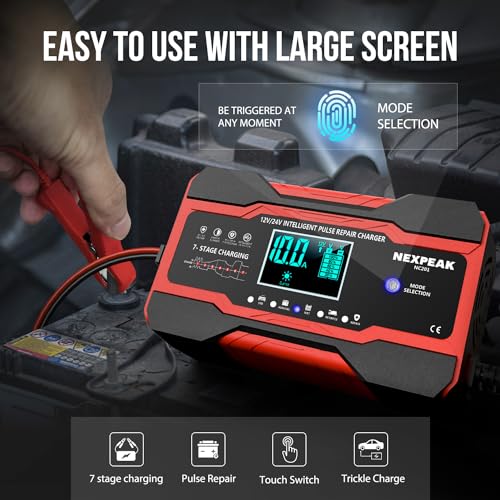
10A 7-Stage Smart Battery Charger

This 10-amp smart charger suits drivers who want more than a basic trickle charger. Its listed 12V and 24V support gives it wider use than a single-voltage model. The seven-stage charging design aims to move from diagnosis to bulk charging, absorption, and maintenance in a controlled way. A large screen also makes it easier to check the charging state from a short distance.
The pulse repair feature may help with some lightly sulfated lead-acid batteries, though it cannot restore a battery with a damaged cell. Built-in protection matters here because a 10-amp charger can deliver useful power to a weak battery. I would use this unit for a stored car, truck, or compatible lead-acid battery that needs regular care. Always confirm the battery type before selecting a charging mode.
Pros:
- Useful 10-amp output for many automotive batteries
- 12V and 24V support adds flexibility
- Seven charging stages help control the charging process
- Large display improves day-to-day monitoring
- Pulse repair mode may help with mild sulfation
- Multiple safety protections support unattended maintenance
Cons:
- Listed battery support focuses on lead-acid types
- Pulse repair cannot fix severe internal battery damage
- A 10-amp output may be more than small motorcycle batteries need
What Amazon Buyers Are Saying
Buyer feedback for this type of charger commonly focuses on the clear display, automatic charging cycle, and useful output for cars and trucks. Some users may value the repair and maintenance modes when caring for an older battery. As with most smart chargers, results can vary when a battery has a very low voltage or a failed cell. Check current Amazon reviews for the latest comments on cable length, display clarity, and long-term durability.
My Recommendation
I recommend this model for lead-acid battery owners who want a strong screen and several charging stages. It is a practical pick for seasonal vehicles and home garages. I would not choose it for a lithium battery unless the maker clearly confirms compatibility.
| Category | Rating |
|---|---|
| Charging control | 4.5/5 |
| Display and controls | 4.5/5 |
| Battery support | 4/5 |
| Safety features | 4.5/5 |
| Overall Rating | 4.4/5 |
TowerTop 25A Smart Charger with Engine Start
The TowerTop stands out because it offers selectable 2A, 10A, and 25A charging levels. That range lets you use a gentler setting for smaller batteries and a stronger setting for larger automotive batteries. The listing also includes engine-start assistance, battery repair, auto desulfation, and winter mode. It supports standard, AGM, gel, and deep-cycle batteries.
This is the most feature-rich choice for a garage that handles more than one vehicle. The 25-amp setting can reduce charging time, but the correct setting still depends on battery size and condition. Engine-start assistance should not replace a proper jump starter or a healthy battery. I like the adjustable output because it gives the user more control than a fixed-output maintainer.
Pros:
- Adjustable 2A, 10A, and 25A charging levels
- Supports several common lead-acid battery types
- Engine-start function adds emergency usefulness
- Winter mode suits cold-weather charging needs
- Auto desulfation and repair functions expand its role
- Useful for cars, trucks, and deep-cycle applications
Cons:
- Larger and more complex than a simple maintainer
- Users must select settings with care
- Engine-start output does not replace a dedicated jump pack
What Amazon Buyers Are Saying
Feedback for multi-mode chargers often highlights the adjustable current, broad battery support, and engine-start feature. Buyers may also like having one unit for maintenance and occasional recovery work. The most common concern with this class of product is the learning curve created by several modes and controls. Read current buyer comments to confirm how users rate the display, clamps, instructions, and performance with your battery size.
My Recommendation
This is my strongest choice for users who need one charger for several battery sizes. It offers more control than most basic models. It is worth considering for a home garage, but casual users may prefer a simpler 10-amp charger.
| Category | Rating |
|---|---|
| Charging flexibility | 4.7/5 |
| Battery compatibility | 4.6/5 |
| Emergency features | 4.5/5 |
| Ease of use | 4.1/5 |
| Overall Rating | 4.5/5 |
10A LCD Charger with Temperature Control
This 12-volt, 10-amp charger targets drivers who want simple automatic charging with a visible LCD. The listing describes temperature compensation, which can help the charger adjust its behavior as conditions change. It also lists eight layers of protection for issues such as overcharging, short circuits, and reversed connections. The design suits cars, trucks, motorcycles, lawn mowers, and boats.
The LCD is useful when you want to check progress without guessing from a small indicator light. Automatic operation reduces the need to watch the charger during a normal cycle. I would use it as a general-purpose charger for a compatible 12-volt battery. Before connecting it to a motorcycle or lawn tractor battery, check the recommended charging current in that battery’s manual.
Pros:
- Clear LCD gives useful charging information
- 10-amp output fits many full-size vehicle batteries
- Temperature compensation adds useful control
- Eight listed protection functions improve peace of mind
- Works across several common vehicle applications
- Automatic operation is friendly for new users
Cons:
- It is designed for 12-volt systems
- Not the best choice for a 24-volt truck battery
- Small batteries may need a lower charging rate
What Amazon Buyers Are Saying
Common buyer themes for LCD automatic chargers include easy setup, readable status information, and useful charging for cars that sit unused. Some users may prefer the visual feedback over a charger with only lights. Complaints in this product category often relate to display visibility, cable reach, or slow recovery of a deeply discharged battery. Review the latest Amazon feedback before buying if those points matter to you.
My Recommendation
I recommend this charger for owners who want a straightforward 12-volt unit with a screen. It balances useful safety features and simple controls. It earns a strong rating for routine car and truck maintenance.
| Category | Rating |
|---|---|
| LCD visibility | 4.4/5 |
| Charging performance | 4.3/5 |
| Protection | 4.4/5 |
| Versatility | 4.2/5 |
| Overall Rating | 4.3/5 |
10A Automatic Charger with 8-in-1 Protection
This model shares the practical 12-volt, 10-amp format that works well for many home garages. Its listing highlights automatic smart charging, trickle maintenance, temperature compensation, and an LCD display. The eight-in-one protection claim suggests a strong focus on safe everyday operation. It is listed for cars, trucks, motorcycles, lawn mowers, and boats.
The main appeal is balance. You get useful monitoring and protection without moving to the more complex controls found on a high-output charger. Temperature compensation is helpful because batteries charge differently in very hot or cold conditions. I would place this model on a stored vehicle and let its maintenance cycle support the battery over time, while still checking the battery and charger during the first use.
Pros:
- Good all-round 12-volt design
- 10-amp output supports many automotive batteries
- LCD display helps track charging status
- Temperature compensation supports changing conditions
- Eight protection functions are useful for home charging
- Suitable for several vehicle and equipment types
Cons:
- No listed 24-volt charging support
- May be too strong for some small batteries
- Users should verify battery chemistry before connection
What Amazon Buyers Are Saying
Buyers who choose similar automatic maintainers often praise their simple connection process and ability to keep a vehicle battery ready during storage. The display and protection features are also common reasons for interest. Some feedback may point to limits with very weak batteries or short leads, which are normal concerns to check in current reviews. I suggest comparing recent comments with your exact vehicle type.
My Recommendation
This is a sensible choice for everyday 12-volt maintenance. It suits buyers who want a screen and safety features but do not need engine-start power. I consider it a good value option for a home garage.
| Category | Rating |
|---|---|
| Everyday charging | 4.3/5 |
| Protection | 4.4/5 |
| Ease of use | 4.4/5 |
| Vehicle range | 4.2/5 |
| Overall Rating | 4.3/5 |
Haibro 12V/24V Smart Battery Charger
Haibro gives this charger both 12-volt and 24-volt capability with a listed 10-amp output. That makes it more useful for owners of mixed equipment, including some trucks, boats, and larger battery systems. The listing includes desulfation, temperature compensation, trickle charging, and automatic maintenance. It also names AGM, gel, deep-cycle, and LiFePO4 batteries.
The broad chemistry list is the key reason to look closely at this model. Lithium batteries need a charger profile that matches the battery maker’s requirements, so I would confirm the exact LiFePO4 instructions before use. Dual-voltage support also requires careful voltage selection. For a user who owns several types of equipment, this flexibility may justify choosing Haibro over a simple 12-volt maintainer.
Pros:
- Supports both 12-volt and 24-volt systems
- Listed support for lead-acid and LiFePO4 batteries
- 10-amp output offers useful charging power
- Temperature compensation adds charging control
- Desulfation and maintenance modes add value
- Fits mixed vehicle and marine battery needs
Cons:
- Dual-voltage operation requires careful setup
- Battery chemistry compatibility must be confirmed
- Not ideal for buyers who only need a small 12-volt maintainer
What Amazon Buyers Are Saying
Feedback on dual-voltage chargers often centers on flexibility and the ability to serve more than one vehicle type. Buyers may like having one unit for a car and a larger battery system. The main concerns usually involve mode selection and instructions, especially when lithium batteries are involved. Check current Amazon reviews for comments about controls, cable quality, and actual use with your battery chemistry.
My Recommendation
I recommend Haibro for experienced users with both 12-volt and 24-volt needs. It is less appealing for a single car owner who wants the simplest possible charger. Verify the charging profile before using it with LiFePO4 batteries.
| Category | Rating |
|---|---|
| Voltage flexibility | 4.7/5 |
| Battery support | 4.5/5 |
| Maintenance features | 4.3/5 |
| Ease of setup | 4.0/5 |
| Overall Rating | 4.4/5 |
10A Fully Automatic Smart Trickle Charger
This charger takes a simple approach to 12-volt battery care. Its listed 10-amp output can charge many car batteries, while the automatic trickle function helps maintain a full battery after the main cycle. It may appeal to owners who do not need a repair mode, dual-voltage support, or engine-start function. The compact feature set can also make setup less confusing.
I see this as a practical basic charger for a commuter car, spare vehicle, or seasonal equipment. It should not be treated as a universal solution for every battery chemistry. Check the product instructions and battery label before use, then watch the first cycle for correct operation. Buyers who value simplicity may prefer this type of charger over a screen-heavy model.
Pros:
- Simple automatic charging design
- 10-amp output suits many 12-volt batteries
- Trickle maintenance helps support stored vehicles
- Less complex than chargers with many manual modes
- Useful for routine home garage charging
- Good fit for buyers with basic needs
Cons:
- Limited information is listed about advanced battery modes
- No stated 24-volt support
- May not suit users who need a detailed LCD or repair cycle
What Amazon Buyers Are Saying
Buyers of basic automatic chargers often value easy connection and dependable maintenance more than extra features. Some may appreciate a simple unit that does not require frequent adjustments. Common points to check in current reviews include clamp quality, cord reach, and performance with deeply discharged batteries. I would read recent feedback closely because simple models can differ in build quality.
My Recommendation
This is worth considering when you want a straightforward 12-volt maintainer. It is not my first choice for mixed battery types or advanced repair work. For basic seasonal care, its simple design may be exactly what you need.
| Category | Rating |
|---|---|
| Ease of use | 4.5/5 |
| Routine charging | 4.2/5 |
| Feature range | 3.8/5 |
| Value | 4.2/5 |
| Overall Rating | 4.2/5 |
E-FAST 25A Dual-Voltage Smart Charger
The E-FAST is built for users who want high output and flexible voltage selection. It lists 25-amp charging, 12V and 24V operation, adjustable trickle charging, desulfation, and a 200-second booster mode. Support includes lead-acid, AGM, gel, and LiFePO4 batteries. This feature set makes it one of the more capable options in the group.
High output can be useful when charging a large automotive or deep-cycle battery, but it also demands careful setup. Select the correct voltage and charging mode before connecting the clamps. The booster mode may help in a limited start-support situation, yet it should not replace safe jump-start equipment. I would choose E-FAST for a workshop or owner who understands battery size and charging needs.
Pros:
- Strong 25-amp output for larger batteries
- 12V and 24V operation adds broad use
- 200-second booster mode offers extra support
- Adjustable trickle charging improves flexibility
- Supports several common battery chemistries
- Desulfation mode may help some older batteries
Cons:
- High output is excessive for many small batteries
- More settings increase the chance of user error
- LiFePO4 use requires careful confirmation of the correct profile
What Amazon Buyers Are Saying
Feedback on high-output chargers often praises faster charging and the ability to handle more than one voltage system. Buyers may also like the booster function when a vehicle battery is low. The most important concerns to check include heat, fan noise, clamp strength, and mode clarity. Since user results depend on battery condition, current reviews should guide your final decision.
My Recommendation
E-FAST is a strong choice for a knowledgeable user with large or mixed battery systems. It offers more power than most home maintainers. I would not buy it solely for a small motorcycle or a basic commuter car.
| Category | Rating |
|---|---|
| Output power | 4.7/5 |
| Voltage flexibility | 4.6/5 |
| Battery range | 4.5/5 |
| Ease of use | 4.0/5 |
| Overall Rating | 4.5/5 |
12V 10A Pulse Repair Smart Charger
This 12-volt charger combines a 10-amp output with smart maintenance, pulse repair, an LCD, and temperature compensation. The listed battery range is broad and includes AGM, gel, SLA, LiFePO4, flooded, and deep-cycle batteries. That makes it attractive to owners with cars, motorcycles, boats, and other equipment. The display should help users watch the charge without relying on sound or guesswork.
Pulse repair can be useful for some batteries affected by mild sulfation, but it cannot reverse normal wear or internal damage. The wide chemistry support is helpful, yet every battery still needs the correct mode. I would use this charger for routine care and occasional recovery, not as a promise that an old battery will return to new condition. Its feature mix gives it strong value for a multi-vehicle household.
Pros:
- Broad listed battery compatibility
- 10-amp output works for many vehicle batteries
- LCD display supports easy monitoring
- Temperature compensation improves charging control
- Pulse repair adds a useful maintenance option
- Suitable for automotive, marine, and power sport use
Cons:
- Users must confirm the correct battery mode
- Pulse repair cannot fix a failed or damaged battery
- 12-volt-only design limits use with 24-volt systems
What Amazon Buyers Are Saying
Buyers looking at this type of product often focus on the LCD, broad battery list, and repair function. Some may report good results on batteries that still hold a charge but need maintenance. Others may find that a severely discharged battery remains unusable. Check current Amazon reviews for real-world comments about recovery results, display accuracy, and long-term use.
My Recommendation
This is one of the better choices for a user who needs several maintenance modes in a 12-volt unit. It offers more flexibility than a basic trickle charger. I recommend it when your batteries match the listed chemistry support.
| Category | Rating |
|---|---|
| Battery compatibility | 4.6/5 |
| Repair features | 4.4/5 |
| Display | 4.3/5 |
| Maintenance value | 4.4/5 |
| Overall Rating | 4.4/5 |
Schumacher SC1280 6V/12V Charger
The Schumacher SC1280 brings a familiar brand name and microprocessor-controlled charging to this list. It supports 6-volt and 12-volt batteries, with charging output listed up to 15 amps and a 3-amp trickle mode. The charger is designed for automotive, marine, and power-sport batteries. Its voltage range is useful for owners who maintain both modern vehicles and some older equipment.
The 6-volt setting is the feature that separates it from most 12-volt-only models here. Automatic control can help manage the charging cycle, while the lower trickle setting suits long-term maintenance. I would choose it for a garage that values brand familiarity and voltage flexibility. As always, confirm the battery type and follow the safety instructions before leaving any charger connected.
Pros:
- Supports both 6-volt and 12-volt batteries
- Up to 15 amps offers useful charging power
- 3-amp trickle mode suits maintenance
- Microprocessor control helps manage charging automatically
- Works with auto, marine, and power-sport batteries
- Good fit for a mixed home garage
Cons:
- May cost more than less established basic chargers
- It does not offer the 24-volt support of some competitors
- Users still need to choose the correct voltage setting
What Amazon Buyers Are Saying
Buyers of Schumacher chargers often look for a recognizable name, simple automatic operation, and support for both 6-volt and 12-volt systems. The trickle mode may appeal to owners who store vehicles for part of the year. Common review points to examine include charging speed, clamp design, and performance with weak batteries. Current Amazon feedback is the best place to check recent owner experiences.
My Recommendation
The SC1280 is my preferred option for users who need 6-volt support or want an established garage charger. It is a dependable, flexible choice for common automotive work. It may be unnecessary if you only maintain one 12-volt car.
| Category | Rating |
|---|---|
| Voltage flexibility | 4.7/5 |
| Charging control | 4.5/5 |
| Maintenance mode | 4.4/5 |
| Garage usefulness | 4.6/5 |
| Overall Rating | 4.5/5 |
How to Choose the 10 Best Smart Car Battery Charger
Choosing among the 10 best smart car battery charger options starts with your battery, not the charger’s biggest number. A high amp rating is not always better. The right model should match voltage, chemistry, battery size, and your main task. Use these three checks before you buy.
1. Match Voltage and Battery Chemistry
First, check if you need 6V, 12V, or 24V charging. Most cars use 12-volt batteries, but some equipment uses 6V or 24V systems. Connecting the wrong voltage can damage the battery and charger.
Next, check chemistry. Flooded lead-acid, AGM, gel, SLA, and LiFePO4 batteries can need different charging profiles. Do not assume that a charger listed for lead-acid batteries also suits lithium batteries. Look for clear support in the product listing and manual.
2. Choose Output for the Battery Size
A 2-amp mode works well for small batteries and slow maintenance. A 10-amp smart charger gives a useful balance for many cars, trucks, boats, and lawn machines. A 25-amp model can charge larger batteries faster, but it needs more careful setup.
Adjustable output gives you more control. It lets you use a lower setting for a motorcycle battery and a higher setting for a large automotive battery. If you only own one car, a simple 10-amp model may offer better value than a large workshop charger.
3. Check Safety, Modes, and Long-Term Value
Useful safety features include reverse-polarity protection, short-circuit protection, overcharge control, overheat control, and automatic shutoff. Temperature compensation can help the charger respond to hot and cold conditions. A clear LCD also helps you spot a wrong connection or charging problem.
For storage, choose a charger with a true maintenance mode. For old lead-acid batteries, a repair or desulfation mode may be useful, but it cannot save every failed battery. For emergency work, engine-start or booster modes add value, but they do not replace a dedicated jump starter.
Final Verdict: Which Should You Buy?
Among these 10 best smart car battery charger choices, I favor the TowerTop for adjustable output and broad garage use. The Schumacher SC1280 is best for 6V and 12V support, while E-FAST suits high-output 12V/24V charging.
For simple storage, choose a 10A automatic maintainer. Always match voltage and chemistry before charging. The right smart car battery charger can protect battery life and reduce surprise starts.
FAQs Of 10 best smart car battery charger
What is the best smart car battery charger for most vehicles?
A 10-amp automatic 12-volt charger is a strong general choice for many cars and trucks. Choose a model with maintenance mode, safety protection, and confirmed battery compatibility.
Can I leave a smart battery charger connected overnight?
Many smart maintainers are designed for long-term connection, but you should follow the product manual. Check the clamps, battery condition, ventilation, and charging mode before leaving it connected.
Is a 25-amp car battery charger better than a 10-amp model?
Not always. A 25-amp charger can charge large batteries faster, while a 10-amp model may offer safer, simpler use for many passenger cars and stored vehicles.
Can a smart charger repair a dead battery?
A repair or desulfation mode may help a lightly sulfated battery. It cannot repair a battery with a failed cell, physical damage, or severe internal wear.
Can I use a car battery charger on an AGM or LiFePO4 battery?
Only use it when the charger listing and manual clearly support that battery chemistry. Select the correct mode and follow the battery maker’s charging instructions.