
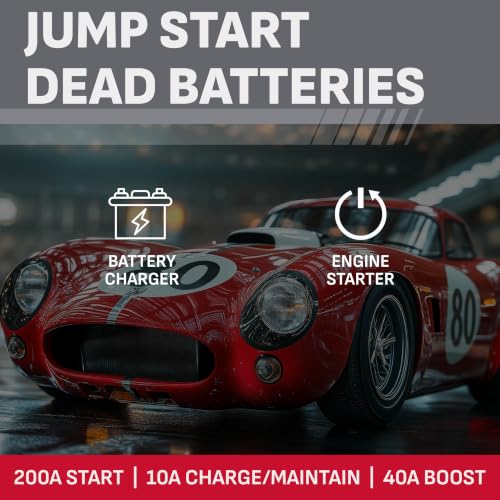
The best car battery chargers with engine start combine safe charging, strong cranking power, and useful battery care features.
A dead battery often happens at the worst time. You may need to leave for work, move a boat, or start a car after a cold night. A charger with engine start can restore power and help turn the engine over without waiting hours for a full charge. I reviewed ten popular options for cars, trucks, motorcycles, boats, and recreational vehicles. I focused on starting output, voltage settings, charging control, battery support, ease of use, and overall value. Always check the manual before using an engine-start mode, and never use it as a replacement for proper battery charging.
See the differences between my top picks at a glance.
| Model | Voltage | Engine Start | Best For | Control | Buy |
|---|---|---|---|---|---|
| Schumacher SC1446 | 6V/12V | 200A | Home garage use | Manual timer | View on Amazon |
| TowerTop 25A | 12V | Listed start mode | Smart maintenance | Automatic | View on Amazon |
| 12V Smart Starter | 12V | 50A | Small vehicles | Smart modes | View on Amazon |
| NOONE 20A | 12V/24V | 50A | Mixed battery types | Automatic | View on Amazon |
| CRAFTSMAN CMXCESM233 | 6V/12V | 250A | Large starting power | Manual timer | View on Amazon |
| AZZUNOX 50A | 12V/24V | 250A | Fast charging | Automatic modes | View on Amazon |
| Schumacher SC1633 | Check manual | Not emphasized | Maintenance | 10A charger | View on Amazon |
| NOONE 15A | 6V/12V | 50A | Flexible charging | Automatic | View on Amazon |
| 10A Smart 7-Stage | 12V/24V | Not clearly listed | Lead-acid care | 7-stage | View on Amazon |
| Schumacher DSR123 | 12V/24V | 250A | Heavy-duty service | Automatic | View on Amazon |
Schumacher SC1446 200A Battery Charger

The Schumacher Electric SC1446 is a practical choice for drivers who want a traditional charger with strong starting help. It supports 6-volt and 12-volt batteries, so it can serve more than one type of vehicle. Its 10-amp charge setting suits regular battery recovery and maintenance. The unit also offers 20-amp and 40-amp boost settings for faster help when a battery is weak.
The 200-amp engine-start rating gives this model a useful edge in a home garage. A manual timer lets me control the charge period instead of relying only on an automatic program. That control can help when I need to follow a set charging plan. Still, I would read the manual closely because engine-start mode needs a short duty cycle and proper cable connection.
Pros:
- Strong 200A engine-start rating
- Works with both 6V and 12V batteries
- 20A and 40A boost choices
- Manual timer gives direct control
- Suitable for power sport, auto, and marine batteries
Cons:
- Manual controls need more attention
- Not as simple as a fully automatic charger
- Engine-start use may require cool-down time
What Amazon Buyers Are Saying
Buyer feedback for traditional Schumacher chargers often centers on solid output, useful wheels, and the value of having several charge settings in one tool. Some buyers like the direct controls because they can choose the boost level they need. Common concerns with this style include the learning curve, weight, and the need to monitor a manual timer. Check current reviews for the latest comments about the exact SC1446 package.
My Recommendation
I recommend the SC1446 for a garage owner who wants high starting power and hands-on control. It is less suited to someone who wants a set-and-forget maintainer. Based on its listed features, it offers strong value for cars, trucks, marine batteries, and equipment.
| Category | Rating |
|---|---|
| Starting Power | 4.5/5 |
| Charging Flexibility | 4.5/5 |
| Ease of Use | 4/5 |
| Value | 4.5/5 |
| Overall Rating | 4.4/5 |
TowerTop 25A Smart Battery Charger
The TowerTop 25A charger targets drivers who want more than a simple trickle charger. It offers 2A, 10A, and 25A charging levels for different battery conditions. Its listing also highlights automatic maintenance, an engine-start function, auto desulfation, battery repair, and a winter mode. Those features make it appealing for a car that sits for long periods.
This model supports AGM, standard flooded, gel, and deep-cycle batteries according to its product details. The automatic design should reduce the need for constant adjustment during normal charging. Winter mode may help when low temperatures slow the charging process. I would still confirm battery chemistry and the exact start-output instructions before connecting it to a vehicle.
Pros:
- Multiple 2A, 10A, and 25A charge settings
- Automatic charging and maintenance
- Includes desulfation and repair functions
- Winter mode helps with cold-weather charging
- Supports several common battery types
Cons:
- 12V focus limits use with 6V batteries
- Feature-rich controls may take time to learn
- Buyers should verify the engine-start procedure
What Amazon Buyers Are Saying
Reviews for smart chargers in this class commonly praise the clear display, automatic operation, and ability to maintain a parked vehicle battery. Buyers also tend to value repair and winter modes when a battery loses charge over time. The main concerns often involve confusing mode labels or unclear expectations about how quickly a deeply discharged battery will recover. Read recent product reviews to confirm performance with your battery type.
My Recommendation
The TowerTop is worth considering if battery maintenance matters as much as engine starting. I like its broad set of charge and care modes. It is a better fit for a vehicle owner who will read the instructions and use the correct mode rather than someone who wants a basic manual charger.
| Category | Rating |
|---|---|
| Charging Modes | 4.5/5 |
| Battery Support | 4.5/5 |
| Automatic Operation | 4.3/5 |
| Value | 4.2/5 |
| Overall Rating | 4.4/5 |
12V Smart Battery Charger and Starter
This 12V smart battery charger and engine starter is designed for users who want a compact set of useful power levels. It charges at 2A and 6A, offers a 10A boost, and lists a 50A engine-start mode. That range gives me a slow option for maintenance and a stronger option for a low battery. It supports AGM, gel, and standard batteries.
The 50A start setting is more modest than the 200A and 250A units in this guide. Even so, it may suit small cars, motorcycles, and other 12V applications when the battery still has some reserve power. Smart charging should help reduce overcharging during normal use. This is not the model I would choose for repeated heavy-duty starting or large commercial vehicles.
Pros:
- Simple 12V design
- 2A and 6A charging options
- 10A boost setting
- 50A engine-start mode
- Supports AGM, gel, and standard batteries
Cons:
- Not designed for 6V batteries
- Lower starting output than heavy-duty models
- May not suit large truck or fleet use
What Amazon Buyers Are Saying
Buyers of compact smart chargers often like the balance between a low maintenance setting and a start-assist mode. The smaller size can also make storage easier in a home garage. Some users may expect a 50A start rating to act like a portable jump pack, but a plug-in charger needs proper wall power and battery connection. Check current feedback for details about cable reach, display use, and starting results.
My Recommendation
I recommend this model for basic 12V car and small vehicle service. It offers a sensible feature set without the bulk of a high-output shop charger. It is worth buying when your main need is routine charging with occasional start assistance.
| Category | Rating |
|---|---|
| 12V Charging | 4.2/5 |
| Start Assistance | 4/5 |
| Ease of Use | 4.2/5 |
| Value | 4.2/5 |
| Overall Rating | 4.1/5 |
NOONE 20A 12V/24V Smart Charger
The NOONE 10A/20A charger stands out because it supports both 12V and 24V systems. That makes it more flexible than many home chargers built only for passenger cars. Its listing includes a 50A engine-start function, winter mode, automatic repair, and desulfation. It also targets AGM, gel, deep-cycle, and LiFePO4 batteries.
The 10A and 20A charge choices give me a way to match the charger to the battery size and charging speed I need. The 24V setting may help owners of selected commercial or equipment batteries, but I would never guess the voltage. A wrong setting can damage a battery or vehicle system. The LiFePO4 claim also makes it important to follow the battery maker’s charging instructions.
Pros:
- Supports 12V and 24V systems
- 10A and 20A charging options
- 50A engine-start mode
- Winter and repair modes
- Works with several listed battery chemistries
Cons:
- 24V operation requires careful setup
- 50A start output is not the highest here
- LiFePO4 users should confirm full compatibility
What Amazon Buyers Are Saying
Feedback on dual-voltage smart chargers often highlights flexibility for cars, equipment, and deep-cycle applications. Buyers may also appreciate the display and automatic stop features. The most important point to check in current reviews is whether users find the 12V and 24V selection clear. Reviewers may also mention whether the repair mode improves a weak battery or simply helps with routine battery care.
My Recommendation
This is a strong choice for a user with more than one type of vehicle or battery system. I like the dual-voltage design and the broad battery support. I recommend it only for buyers who will verify voltage and chemistry before use.
| Category | Rating |
|---|---|
| Voltage Flexibility | 4.7/5 |
| Battery Compatibility | 4.4/5 |
| Start Assistance | 4.1/5 |
| Value | 4.3/5 |
| Overall Rating | 4.4/5 |
CRAFTSMAN CMXCESM233 250A Charger
The CRAFTSMAN CMXCESM233 is built for buyers who put engine-start power first. It offers a listed 250A start rating, along with 25A and 50A boost settings. The charger works with 6V and 12V batteries, which adds useful range for power sport, auto, and marine applications. Its 10A charge setting handles slower battery charging.
This model uses a manual timer rather than a fully automatic control system. That design can suit experienced users who want to choose the charge period themselves. It also means I must stay aware of the setting and avoid leaving a battery connected without a plan. The high start rating does not make it a jump starter, so the charger still needs a suitable AC power source.
Pros:
- Very strong 250A engine-start rating
- 6V and 12V support
- 25A and 50A boost modes
- 10A charging mode for regular use
- Useful for auto, marine, and power sport batteries
Cons:
- Manual timer needs close attention
- Likely larger than a compact maintainer
- Requires household power during use
What Amazon Buyers Are Saying
Buyers looking at CRAFTSMAN high-output chargers often focus on starting strength, sturdy handling, and the useful boost range. Manual controls appeal to users who understand charge times and battery size. The usual concern is that a powerful shop-style charger takes more space and requires more care than a small automatic unit. Check current reviews for comments about mobility, cable length, and control labels.
My Recommendation
I recommend the CMXCESM233 for a garage, workshop, or boat owner who wants serious starting output. It is one of the better choices in this list for users who understand manual chargers. It is not my first pick for beginners who want fully automatic operation.
| Category | Rating |
|---|---|
| Starting Power | 4.8/5 |
| Voltage Range | 4.5/5 |
| Control | 4/5 |
| Build and Value | 4.5/5 |
| Overall Rating | 4.5/5 |
AZZUNOX 50A Dual-Voltage Charger
The AZZUNOX charger aims at users who want fast charging and high starting power in one unit. Its listing gives it a maximum 50A charging rate and a 250A cranking engine-start rating. It supports 12V and 24V systems, which can help owners of cars, trucks, and selected equipment. Desulfation, repair, and winter modes add more battery-care options.
A high charge rate can save time, but it also makes correct setup more important. I would match the voltage, battery type, and charge rate before starting the process. The 250A start mode looks attractive for a weak vehicle battery, but it still depends on battery condition, cable contact, and available AC power. This model makes the most sense for a user who wants a powerful garage charger rather than a small emergency tool.
Pros:
- Up to 50A listed charging output
- 250A cranking engine-start mode
- 12V and 24V operation
- Includes repair and desulfation functions
- Winter mode supports cold-weather use
Cons:
- High output requires careful battery setup
- May be more charger than a small car owner needs
- AC power is required for starting assistance
What Amazon Buyers Are Saying
Buyers interested in high-output chargers usually praise fast charging, strong start assistance, and dual-voltage flexibility. Some also like having repair and winter settings in one device. Common questions focus on whether the displayed output matches real use and whether the controls are easy to understand. I suggest checking the newest reviews for comments about heat, fan noise, clamps, and actual vehicle size.
My Recommendation
The AZZUNOX is a good fit for a workshop or vehicle owner who needs fast charging and high cranking support. Its wide voltage range adds value, but it also raises the need for careful use. I would buy it for power and flexibility, not for simple plug-in maintenance.
| Category | Rating |
|---|---|
| Charging Speed | 4.7/5 |
| Starting Power | 4.8/5 |
| Voltage Flexibility | 4.6/5 |
| Ease of Use | 4/5 |
| Overall Rating | 4.5/5 |
Schumacher SC1633 Wheeled Charger
The Schumacher SC1633 is a wheeled 10A charger and maintainer for users who value mobility. Its cart-style design can make it easier to move around a garage or driveway than a small box charger. The 10A output suits regular charging and maintenance for many common batteries. The product title emphasizes charging and maintenance more than a high engine-start rating.
That distinction matters when shopping for the best car battery charger with engine start. I would not select the SC1633 solely for emergency starting unless the current manual and product listing clearly confirm that function. Instead, I see it as a practical maintenance unit for vehicles that sit unused. Its wheeled format may also appeal to boat owners and people who service more than one vehicle.
Pros:
- Wheeled design improves movement
- 10A charging output
- Useful for ongoing battery maintenance
- Known Schumacher charger format
- Practical for garage and marine settings
Cons:
- Engine-start output is not clearly emphasized
- Less portable than a compact charger
- Buyers should confirm voltage and battery support
What Amazon Buyers Are Saying
Feedback on wheeled Schumacher chargers often centers on mobility, simple operation, and the usefulness of a larger charger for garage work. Buyers may like rolling the unit close to a vehicle instead of carrying it. The main concern is usually size or weight when compared with a small maintainer. Since product packages can change, check recent buyer comments to confirm the exact features included with this model.
My Recommendation
I recommend the SC1633 for maintenance, not as the first choice for strong engine starting. It can be a sensible garage tool if mobility matters and 10A charging meets your needs. Choose another model in this guide if a clearly listed 200A or 250A start mode is your top priority.
| Category | Rating |
|---|---|
| Maintenance | 4.4/5 |
| Mobility | 4.5/5 |
| Engine-Start Suitability | 3.4/5 |
| Value | 4/5 |
| Overall Rating | 4/5 |
NOONE 15A 6V/12V Smart Charger
This NOONE charger offers a useful middle ground between a small maintainer and a heavy shop unit. It supports 6V and 12V batteries and lists 10A and 15A charge settings. The product details also include a 50A engine-start mode, automatic repair, desulfation, and overheat protection. It supports lead-acid, AGM, and LiFePO4 batteries as listed.
The two-voltage design makes it useful for cars, motorcycles, lawn equipment, and some older battery systems. Automatic operation should make everyday charging easier than a manual timer model. Overheat protection is a helpful safety feature, but it does not remove the need for correct polarity and ventilation. I would treat the 50A start mode as light start assistance, not as a substitute for a full jump pack.
Pros:
- Supports 6V and 12V batteries
- 10A and 15A charge settings
- 50A engine-start mode
- Automatic repair and desulfation
- Listed overheat protection
Cons:
- 50A starting power is below heavy-duty models
- Users must confirm LiFePO4 charging rules
- Multiple modes may confuse first-time users
What Amazon Buyers Are Saying
Smart charger buyers often value automatic control, safety protection, and support for both 6V and 12V batteries. The repair and desulfation modes can also attract owners of older batteries. Common complaints in this product category involve unclear icons, slow recovery from a deeply dead battery, or expectations that the engine-start mode will work without enough battery voltage. Current reviews can help confirm how easy the display is to use.
My Recommendation
This NOONE model is worth considering when you need flexible voltage support and routine battery care. It offers more range than a basic 12V maintainer. I recommend it for home users who want moderate starting help and automatic charging in one device.
| Category | Rating |
|---|---|
| Voltage Support | 4.6/5 |
| Safety Features | 4.3/5 |
| Start Assistance | 4/5 |
| Value | 4.3/5 |
| Overall Rating | 4.3/5 |
10A Smart 7-Stage Battery Charger
This 10A smart charger focuses on controlled battery care. It supports 12V and 24V batteries and uses a listed seven-stage charging process. The product details mention a large screen, pulse repair, quick charging, and several protection systems. It is made for lead-acid batteries, so buyers should not assume that it suits every modern battery chemistry.
The seven-stage design can help the charger move from testing to charging, conditioning, and maintenance in a measured way. That makes it appealing for cars, motorcycles, seasonal vehicles, and equipment that sits for weeks. However, the provided product information does not clearly highlight a dedicated engine-start output. I would choose it for charging and maintenance, then select a different model if emergency cranking power is essential.
Pros:
- Seven-stage charging process
- 12V and 24V support
- Large display for status checks
- Pulse repair feature
- Multiple listed protection systems
Cons:
- Engine-start capability is not clearly listed
- Designed mainly for lead-acid batteries
- 10A output may be slow for very large batteries
What Amazon Buyers Are Saying
Buyers who choose multi-stage chargers often like the screen, automatic process, and battery maintenance features. A large display can make it easier to see charging progress from across a garage. The main issue to check is whether the actual battery type matches the charger’s supported chemistry. Buyers should also look for recent comments about the display, clamp quality, and repair mode results.
My Recommendation
This model is a reasonable maintenance charger, but it is not my top engine-start pick. I recommend it for lead-acid battery owners who want staged charging and clear status information. If you need a verified high-current start mode, choose the CRAFTSMAN, AZZUNOX, or Schumacher DSR123 instead.
| Category | Rating |
|---|---|
| Charging Control | 4.5/5 |
| Display | 4.4/5 |
| Battery Care | 4.3/5 |
| Engine-Start Suitability | 3.2/5 |
| Overall Rating | 4/5 |
Schumacher DSR123 250A Pro Charger
The Schumacher DSR123 is the most workshop-focused model in this group. It offers automatic operation, 12V and 24V support, and a listed 250A engine-start rating. Its boost range runs from 10A to 50A, which gives users more control over charging speed. The wheeled design helps move this pro-grade unit around a service area.
This charger makes sense for larger batteries, marine use, equipment, and busy garages. Automatic operation can simplify the charge cycle, while the high start rating adds useful emergency support. The unit is likely more space-consuming than a small home maintainer. I would also plan for a grounded outlet, enough working room, and careful cable placement before use.
Pros:
- 250A engine-start rating
- 12V and 24V support
- Automatic operation
- 10A to 50A boost range
- Wheeled pro-grade design
Cons:
- Large and less convenient to store
- May cost more than a basic home charger
- Requires a suitable AC outlet and workspace
What Amazon Buyers Are Saying
Users who buy pro-grade Schumacher chargers commonly look for strong starting power, large clamps, wheels, and dependable use across several vehicles. The wheeled frame can be a major benefit when the unit is heavy. Typical concerns include size, noise, and the need to understand automatic modes and boost settings. Check current Amazon reviews for the latest comments on durability, wheel assembly, and cable length.
My Recommendation
The DSR123 is my best heavy-duty choice. I recommend it for a shop, fleet owner, boat owner, or serious home garage. It may be excessive for one small car, but its 250A start output and dual-voltage design justify the size for demanding work.
| Category | Rating |
|---|---|
| Starting Power | 4.9/5 |
| Commercial Use | 4.8/5 |
| Voltage Flexibility | 4.7/5 |
| Portability | 4.1/5 |
| Overall Rating | 4.7/5 |
How to Choose the Best Car Battery Charger With Engine Start
Choosing among the 10 best car battery charger with engine start options takes more than comparing the largest amp number. I first match the charger to the battery voltage, then check its start rating, charging control, battery chemistry support, and safety features. The right model should fit the vehicle and the way you plan to use it.
1. Match Voltage and Battery Chemistry
Most passenger cars use a 12V battery. Some equipment and commercial systems use 24V, while older motorcycles and specialty equipment may use 6V. A dual-voltage charger can offer more flexibility, but only if the controls clearly show the selected setting.
Check whether the charger supports flooded lead-acid, AGM, gel, deep-cycle, or LiFePO4 batteries. These batteries can need different charging profiles. Never select a LiFePO4 mode just because it appears on the display. Confirm that the battery maker allows that charger and charging method.
2. Compare Engine-Start Output With Your Vehicle
Engine-start ratings vary widely. A 50A start mode may help a small 12V vehicle with a weak battery. A 200A or 250A rating gives more starting support for larger engines, marine batteries, and workshop use. The rating does not guarantee a start every time.
A charger needs AC power. It also needs clean terminal contact and a battery that has not failed internally. A completely damaged battery may not accept charge or start assistance. For repeated roadside emergencies, a separate portable jump starter may be a better tool.
3. Check Charge Control, Safety, and Long-Term Value
Automatic chargers are easier for routine use. They can adjust the charge cycle and switch to maintenance when the battery reaches the proper level. Manual chargers can offer more direct control, but they need closer attention and a correctly set timer.
Look for reverse-polarity protection, overheat protection, short-circuit protection, and clear status readings. A long cable, strong clamps, wheels, and a stable case can matter as much as extra charging modes. Finally, compare the price with your actual needs. A heavy 250A charger may be a smart buy for a workshop but poor value for one small commuter car.
Final Verdict: Which Should You Buy?
For most serious users, the Schumacher DSR123 is the best overall heavy-duty pick, while the CRAFTSMAN CMXCESM233 offers excellent 250A starting power. The Schumacher SC1446 is a strong value for home garages.
These 10 best car battery charger with engine start options cover smart maintenance, dual-voltage work, and high-current starting. Match voltage and battery type before buying.
FAQs Of 10 best car battery charger with engine start
Can a car battery charger with engine start replace a jump starter?
No. A charger with engine start needs AC power and a proper battery connection. A portable jump starter stores power and can work away from an outlet.
What engine-start rating should I choose for a car?
A 50A mode may suit smaller vehicles, while 200A to 250A models offer more help for larger engines and workshop use. Always follow the charger manual.
Can I use a 12V charger on a 24V battery?
No. Use a charger that clearly supports 24V operation and select the correct setting. The wrong voltage can damage the battery or vehicle system.
Is automatic charging safer than a manual charger?
Automatic charging can reduce overcharging risk during normal use. A manual charger can work well, but you must set the timer and monitor the battery.
Can these chargers repair a dead battery?
Repair or desulfation modes may help some weak lead-acid batteries. They cannot fix every battery, especially one with an internal short or physical damage.