
The best car battery chargers for a dead battery offer safe charging, smart controls, and dependable engine-start support.
A dead battery can ruin a morning, stop a road trip, or leave a stored vehicle stuck in the driveway. The right charger can do more than add power. It can slowly restore a weak battery, maintain charge during storage, and help prevent repeat failures. I reviewed ten popular 12-volt and 6/12-volt models for cars, trucks, motorcycles, boats, lawn equipment, and other vehicles. My focus was charging control, battery type support, safety features, boost power, ease of use, and value.
See the differences between my top picks at a glance.
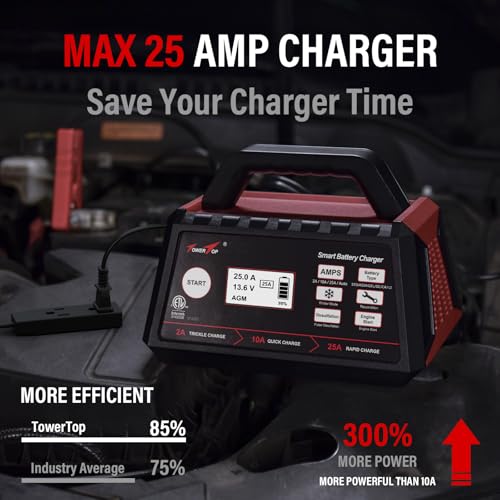
TowerTop 25A Smart Car Battery Charger

The TowerTop charger is a strong choice for drivers who want one tool for charging, maintenance, and emergency starting. Its listed 2/10/25-amp settings give you more control than a small trickle charger. The unit is designed for 12-volt batteries and supports AGM, standard, gel, and deep-cycle types.
I also like its repair, desulfation, winter, and engine-start functions. The automatic design can reduce the need to watch the battery during a normal charge. Still, a repair mode cannot bring every worn-out battery back to life. Use the correct setting, check the battery maker’s guidance, and keep the charger in a well-ventilated area.
Pros:
- Several charge-rate options
- Engine-start function for emergency use
- Supports AGM, standard, gel, and deep-cycle batteries
- Includes repair and desulfation modes
- Winter mode suits cold-weather charging
- Useful for home garages and stored vehicles
Cons:
- More features may take time to learn
- It is larger than a basic maintainer
- Engine-start mode still needs a suitable battery
What Amazon Buyers Are Saying
Buyer feedback for this type of TowerTop charger tends to focus on its broad feature set and clear control options. Owners often value having charging, maintenance, and starting functions in one unit. Some buyers note that the instructions and mode choices require careful reading. Results also vary when the battery has an internal fault or severe damage, so buyers should not expect the repair function to replace a new battery.
My Recommendation
I recommend the TowerTop for a garage that serves several vehicles. It is especially useful when you want more power than a small maintainer can provide.
Schumacher SC1280 Automatic Charger
The Schumacher SC1280 gives you a flexible charger for both 6-volt and 12-volt batteries. Its 15-amp charge output can help restore a low battery faster than a low-current maintainer. It also offers a 3-amp trickle charge for long-term care.
Microprocessor control and automatic operation make this model appealing to owners who do not want to manage every charging step. The product listing also names power sport, automotive, and marine batteries. I would choose it for a household with cars, motorcycles, or other compatible battery-powered equipment.
Pros:
- Works with 6V and 12V systems
- Combines faster charging with trickle charging
- Automatic control helps limit overcharging risk
- Useful for automotive, marine, and power sport batteries
- Known Schumacher brand support
- Good fit for mixed vehicle households
Cons:
- It does not provide the highest engine-start output in this group
- Users must select the correct voltage
- Not a substitute for a lithium-specific charger unless compatibility is confirmed
What Amazon Buyers Are Saying
Amazon review themes for the SC1280 commonly center on its automatic operation and dual-voltage design. Buyers who maintain more than one type of vehicle often like its flexibility. Some owners mention that clamp placement and cable reach affect ease of use. As with any charger, reviews also remind buyers to confirm battery condition before blaming the charger for a battery that will not hold power.
My Recommendation
This is one of the safest all-around picks for a mixed garage. The 6V/12V choice adds useful flexibility, and the 3-amp maintenance mode is practical for storage.
E-FAST 25A 12V/24V Smart Charger
The E-FAST 25A charger stands out because it supports both 12-volt and 24-volt systems. That makes it more suitable for larger vehicles and equipment than a standard 12-volt home charger. Its listed support includes lead-acid, AGM, gel, and LiFePO4 batteries.
The adjustable current and 200-second booster mode add useful control for demanding jobs. However, the wider battery support makes it even more important to read the manual before connecting it. I would view this as a high-output tool for experienced users, not just a simple plug-in maintainer.
Pros:
- Supports 12V and 24V systems
- Up to 25 amps for larger charging tasks
- Listed support for LiFePO4 batteries
- Includes booster mode
- Adjustable charging current
- Useful for cars, trucks, and larger equipment
Cons:
- More complex than a basic 12V charger
- Incorrect voltage selection can cause serious problems
- High output may be excessive for small batteries
What Amazon Buyers Are Saying
Review discussions around high-output E-FAST chargers often praise the 12V/24V range and the ability to work with several battery chemistries. Buyers who need one charger for different equipment find that flexibility useful. The main concern with this class of product is setup: users need to check voltage, battery chemistry, and charge mode before starting. That careful approach matters more than raw amp output.
My Recommendation
I recommend the E-FAST for owners of trucks, equipment, or more than one battery system. It is not my first choice for someone who only needs to maintain one family car.
10A 7-Stage Smart Battery Charger
This 10-amp smart charger uses a seven-stage charging design for 12-volt and 24-volt lead-acid batteries. Multiple stages can help manage the process from low charge to maintenance. Its large screen may also make it easier to see charging status and selected settings.
The product listing mentions pulse repair, safety protection, and a design intended to extend battery cycle life. Those features can help with routine care, but they cannot fix a battery with a failed cell. I like this model for buyers who want more information than a basic light-only charger provides.
Pros:
- Seven charging stages
- 12V and 24V support
- Large display for status checks
- Pulse repair feature
- Multiple protection functions
- Useful for lead-acid battery care
Cons:
- Listed mainly for lead-acid batteries
- The display adds another part to protect from moisture
- Users must confirm the correct voltage before charging
What Amazon Buyers Are Saying
Buyers who choose this style of charger often like the screen and the visible charging stages. They also value the compact size and the ability to use it with 12V or 24V lead-acid systems. Some feedback for smart chargers notes that the many modes can seem less direct at first. Reading the display and manual helps avoid confusion.
My Recommendation
This charger is a good match for someone who wants a readable display and a staged charging process. It offers strong value if your batteries are lead-acid and you need both 12V and 24V support.
12V 10A LCD Smart Battery Charger
This fully automatic 12-volt charger provides up to 10 amps for cars, trucks, motorcycles, lawn mowers, and boats. The LCD display gives a quick view of charging information. Temperature compensation is a helpful feature because charging behavior can change in very cold or hot conditions.
The listed eight-layer protection system adds confidence for routine home use. I would still place the charger on a stable, dry surface and inspect the cables before each use. This model is a practical pick when you want a straightforward 12V charger without 24V or heavy engine-start functions.
Pros:
- Fully automatic operation
- LCD display
- Temperature compensation
- Listed eight-layer protection
- Works with several common vehicle types
- Good fit for home charging
Cons:
- 12V only
- It does not replace a dedicated jump starter
- Compatibility with special battery types should be confirmed
What Amazon Buyers Are Saying
Common buyer interest centers on the LCD screen, automatic operation, and broad use across cars and small equipment. Users who want a simple status check tend to prefer a display over a single indicator light. As with similar compact chargers, some buyers may find the cable length or clamp size less convenient for large vehicles. Check the product measurements before buying.
My Recommendation
I recommend this charger for a normal 12V vehicle owner who wants automatic charging and a readable screen. It is simple, focused, and not overloaded with features.
Schumacher SC1446 200A Engine Start Charger
The Schumacher SC1446 is built for drivers who place high value on engine-start power. It provides a listed 200-amp engine start, plus 20/40-amp boost settings and a 10-amp charge rate. It also supports both 6-volt and 12-volt batteries.
This model uses manual timer control, so it asks more from the user than a fully automatic charger. The 135-minute timer can help manage charging time, but you must set it correctly and monitor the process. Wheels can make the heavier design easier to move around a garage.
Pros:
- 200-amp engine-start rating
- 6V and 12V operation
- 20/40-amp boost settings
- 10-amp charging mode
- 135-minute timer
- Wheels improve mobility
Cons:
- Manual controls need close attention
- Bulkier than a compact smart charger
- Not the best choice for unattended maintenance
What Amazon Buyers Are Saying
Buyer interest in the SC1446 usually comes from its strong starting and boost ratings. People who work on older cars, marine batteries, or several vehicles may value that extra output. Reviews of manual chargers often point out that users must stay involved and select the right setting. That is a limitation, not a fault, if you want direct control.
My Recommendation
Choose the SC1446 if emergency engine starting matters more than small size or full automation. For a simple overnight maintainer, another model here will be easier.
PLXX 15A 12V/24V Smart Charger
The PLXX charger offers a 0-to-15-amp range for 12V and 24V batteries. Its automatic design includes auto shutoff, repair, and winter modes. The listing also identifies automotive, truck, motorcycle, lawn mower, boat, marine, and AGM applications.
This range makes the PLXX useful for owners who want one charger for daily vehicles and seasonal equipment. The 24V function can help with compatible systems, but it also makes careful setup essential. I would treat the repair mode as a support feature, not proof that it can restore a battery with physical damage.
Pros:
- 12V and 24V support
- Adjustable output up to 15 amps
- Automatic shutoff
- Repair and winter modes
- Broad vehicle use
- AGM support is listed
Cons:
- Mode selection may confuse first-time users
- It may be more charger than a single car needs
- Battery chemistry and voltage still require verification
What Amazon Buyers Are Saying
Buyers looking at PLXX-style smart chargers tend to appreciate the combination of voltage choices, adjustable current, and seasonal modes. The broad application list is useful for people with boats, motorcycles, and lawn equipment. Some users may prefer a simpler interface for one 12V car. Clear instructions and correct mode selection remain key themes for safe use.
My Recommendation
The PLXX is worth considering when you need 12V and 24V support but do not need the very high starting output of a shop-style charger. It is a flexible middle-ground option.
Schumacher SC1361 6A 12V Charger
The Schumacher SC1361 is a simpler 12V charger and maintainer. Its 6-amp charge rate suits routine charging for many vehicle batteries, while the 10-amp boost offers extra help when a battery needs more support. The product also lists a 50-amp engine-start function.
Low-profile clamps may help when space around the battery is tight. Auto restart adds convenience after a power interruption or charging cycle. This charger makes sense for drivers who want Schumacher features without moving to a large 6V/12V shop unit.
Pros:
- Compact 12V design
- 6-amp charging for routine use
- 10-amp boost function
- 50-amp engine-start rating
- Low-profile clamps
- Auto restart feature
Cons:
- 12V only
- Lower charge output than 15A and 25A models
- It may take longer to charge a large battery
What Amazon Buyers Are Saying
Common buyer interest in the SC1361 comes from its smaller size, brand familiarity, and mix of charging and starting functions. Owners of cars, motorcycles, and marine equipment often value a charger that does not take much storage space. Some users may expect the engine-start feature to act like a jump starter, but it still depends on proper connection and battery condition.
My Recommendation
I recommend the SC1361 for ordinary 12V vehicles and smaller garages. It is a balanced option when you want more than maintenance but do not need 24V charging.
Schumacher SC1281 Charger and Tester
The SC1281 combines a 6-amp charger with several useful support modes. It works with 6V and 12V batteries, offers 12-to-30-amp boost settings, and lists a 100-amp engine-start function. A built-in battery and alternator tester gives it more diagnostic value than a basic charger.
This can help you decide whether a no-start problem comes from a weak battery or a charging-system concern. The tester does not replace professional electrical testing, but it provides a useful first check. I see this model as a strong choice for drivers who want charging and basic diagnosis in one device.
Pros:
- 6V and 12V operation
- Battery and alternator tester
- 100-amp engine-start rating
- 12-to-30-amp boost range
- 6-amp charging mode
- Useful for basic troubleshooting
Cons:
- More expensive than a simple maintainer may be
- Testing results require proper connection and interpretation
- It is not a replacement for a professional load test
What Amazon Buyers Are Saying
Buyers often focus on the tester and the combination of 6V/12V charging. That mix appeals to people who want to check an alternator after replacing or charging a battery. Some feedback points to the need to understand the controls before use. The strongest results come when owners follow the connection steps and treat the tester as a useful guide rather than a final diagnosis.
My Recommendation
This is my preferred Schumacher pick for basic battery and alternator checks. Buy it if diagnosis matters as much as charging.
Basic 12V 10A Automatic Charger
This fully automatic 12V 10-amp charger is aimed at buyers who want a simple way to charge a common vehicle battery. It has enough listed output for routine charging while remaining less complex than a large shop charger. The automatic smart design can reduce the need for constant manual adjustment.
It may suit a car, pickup, motorcycle, or lawn machine when the battery matches the charger’s requirements. I would confirm the battery type and read the latest product instructions before use. Buyers who need 24V charging, high engine-start power, or advanced testing should consider another model in this guide.
Pros:
- Simple 12V operation
- 10-amp charging output
- Fully automatic design
- Good option for routine vehicle charging
- Less complex than multi-voltage units
- Budget-friendly feature set
Cons:
- 12V only
- Limited diagnostic functions
- Not designed as a high-output engine starter
What Amazon Buyers Are Saying
Buyers seeking an affordable 12V charger often like automatic operation and a 10-amp rating. The simple design may appeal to people who do not need a screen full of settings. As expected with basic chargers, reviews and product details should be checked for exact battery compatibility and cable reach. This model is best viewed as a practical charger, not a complete electrical test station.
My Recommendation
This is a reasonable value pick for a single 12V vehicle. I would choose it when low cost and simple charging matter most.
How to Choose the 10 Best Car Battery Charger for Dead Battery
Choosing among the 10 best car battery charger for dead battery options starts with the battery, not the charger. A dead battery may only need a slow recharge. It may also have a failed cell, a damaged case, or a separate alternator problem. A charger can restore usable power, but it cannot repair every fault. Use these three checks before you buy.
1. Match Voltage, Battery Type, and Charge Rate
Most cars use a 12V battery, but some equipment uses 6V or 24V systems. Never guess. Select a charger that matches the system voltage. A 6V/12V model adds flexibility, while a 12V-only model may be easier for a single car.
Next, check chemistry. Common options include standard flooded lead-acid, AGM, gel, deep-cycle, and lithium iron phosphate. The charger must offer a mode made for your battery. Also consider current. A 2A or 3A maintainer suits storage. A 6A to 15A charger can handle many regular charging jobs. High-current units suit larger batteries but need more care.
2. Decide if You Need Engine Start or Battery Testing
Do not confuse a battery charger with a portable jump starter. Some large chargers offer engine-start support, but the car must still connect to household power. This feature helps when you have a garage outlet and need extra starting assistance.
A tester can add value if you often troubleshoot no-start problems. The Schumacher SC1281, for example, lists battery and alternator testing. That can help point you toward the battery or charging system. It does not replace a professional test, especially when a battery repeatedly loses charge.
3. Compare Safety, Controls, and Long-Term Value
Look for automatic shutoff, reverse-polarity protection, short-circuit protection, temperature control, and clear status signals. These features reduce mistakes, but they do not make unsafe placement acceptable. Charge in a dry, ventilated area. Keep sparks and flames away from a battery.
Finally, think about how often you will use the charger. A basic 12V 10A model may offer the best value for one car. A 6V/12V model fits a mixed garage. A 12V/24V charger suits trucks or equipment. For storage, a smart maintainer may matter more than a large boost number.
Final Verdict: Which Should You Buy?
For most garages, I recommend the Schumacher SC1280 because it supports 6V and 12V batteries and combines automatic charging with maintenance. The TowerTop is my pick for more modes and stronger output.
These 10 best car battery charger for dead battery choices cover basic charging, storage, testing, and engine-start support. Match voltage and battery type before connecting.
FAQs Of 10 best car battery charger for dead battery
Can a car battery charger bring a fully dead battery back to life?
It may restore a deeply discharged battery if the battery still works internally. A failed cell, damaged case, or badly sulfated battery may need replacement.
How many amps should a charger use for a dead car battery?
A 6A to 10A charger suits many passenger cars. Higher output can charge faster, but use the battery maker’s guidance and the correct charger mode.
Is a battery charger better than a jump starter?
A charger restores and maintains battery power over time. A jump starter gives short-term starting power. Many drivers keep both because they solve different problems.
Can I leave a smart charger connected overnight?
Many automatic smart chargers support maintenance use, but read the manual first. Place the charger in a dry, ventilated area and inspect the cables.
What charger is best for an AGM car battery?
Choose a charger with a clearly labeled AGM mode. The TowerTop, E-FAST, and PLXX listings identify AGM support, but always confirm the current product instructions.