
Setting up electric charging points at home comes down to matching a charger to the electrical circuit already in the garage, the vehicle’s connector type, and how fast the driver actually needs to refuel overnight. Level 1 chargers plug into a standard 120V household outlet and add roughly 3 to 5 miles of range per hour, which works for plug-in hybrids or short commutes. Level 2 chargers run on 240V circuits, the kind used for dryers and ranges, and can add 20 to 45 miles of range per hour depending on amperage and the vehicle’s onboard charger.
The two biggest decisions are plug-in versus hardwired installation and how much amperage the home’s electrical panel can support. Plug-in units that use a NEMA 14-50 outlet are easier to install or relocate, while hardwired chargers usually deliver higher amperage and skip the outlet as a potential point of failure. Homeowners without a spare 240V circuit have options too, including outlet kits and load-sharing switches that avoid a full panel upgrade.
Weatherproofing, cable length, smart app controls, and connector compatibility (J1772 versus Tesla’s NACS) round out the practical checklist. The right charger depends less on brand and more on matching amperage, circuit type, and connector to the specific vehicle and garage setup. The comparisons below cover hardwired and plug-in Level 2 stations, portable Level 1 chargers, and the supporting hardware that makes installation cheaper or simpler.
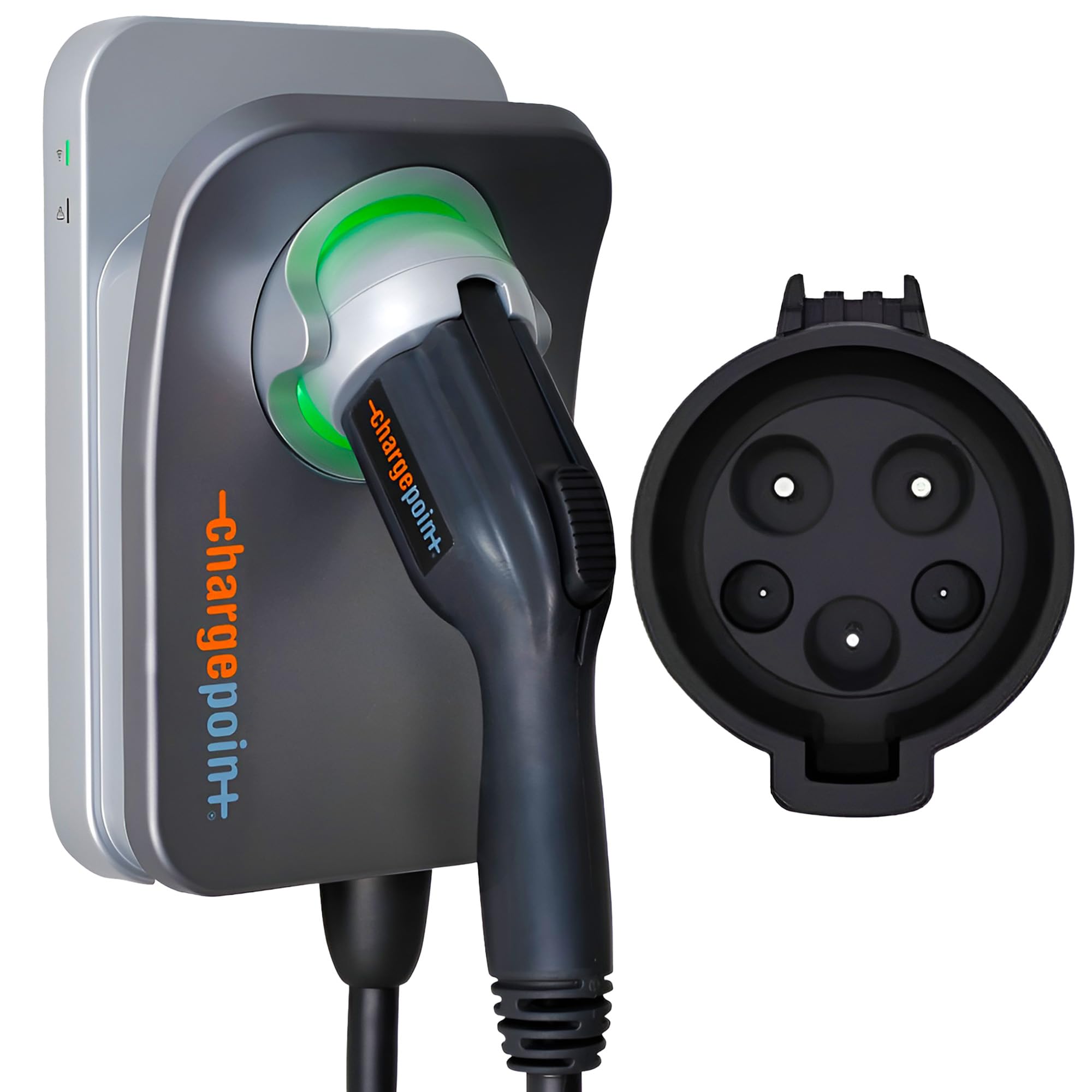
Best hardwired Level 2 charger: ChargePoint HomeFlex
Best value plug-in Level 2 charger: EVIQO Level 2 EV Charger
Best for solar-powered homes: Wallbox Pulsar Plus
Best for Tesla and non-Tesla households: ApexCharger MACH 1
Best for smart home integration: Leviton EV40P
Best for adjustable amperage control: EVDANCE Level 2 Charger
Best budget Level 1 charger: Lectron Level 1 EV Charger
Best for flexible Level 1/2 charging: VEVOR Level 1&2 Charger
Best for avoiding an electrical panel upgrade: Splitvolt 24 Amp Splitter Switch
Best for adding a dedicated 240V outlet: NOVINSEN NEMA 14-50 Outlet Kit
ChargePoint HomeFlex Level 2 EV Charger

Homeowners who want maximum charging speed and a permanent installation should consider this hardwired charger.
Pros
- Adjustable 16-50A output fits multiple circuit sizes
- 23-foot cold-resistant cable rated for outdoor use
- Backed by ChargePoint’s large public charging network
Cons
- Requires professional hardwiring, no plug-in option
- Some users report app connectivity hiccups
- Non-Tesla drivers need an adapter for NACS vehicles
This charger delivers up to 37 miles of range per hour on a properly sized circuit, making it one of the faster options for daily commuters or multi-EV households. It needs a dedicated 20A to 80A circuit installed by a licensed electrician, which adds upfront cost but removes the outlet as a wear point. The ChargePoint app adds scheduling and smart home connections, though Wi-Fi setup can be finicky in detached garages. For drivers who charge nightly and want a station that lasts for years, this is a proven, widely reviewed choice.
EVIQO Level 2 EV Charger
Buyers who already have a NEMA 14-50 outlet and want strong performance at a competitive price should look here first.
Pros
- Plug-in design skips hardwiring labor costs
- Sealed IP66/NEMA 4 housing handles rain and snow
- Side reset button simplifies troubleshooting
Cons
- 40A output is slightly lower than some hardwired rivals
- Requires a dedicated 50A circuit for full speed
- Cable near the plug end is shorter than the overall length suggests
The EVIQO charger plugs into a NEMA 14-50 outlet, so it skips the electrician labor of hardwiring as long as that outlet already exists. It charges most EVs overnight at up to 40A and holds a stronger Wi-Fi antenna than many plug-in competitors, useful for basements and detached garages. The glow-in-the-dark connector holster is a small but practical touch for nighttime plugging. Reviewers highlight responsive customer support when issues come up.
Wallbox Pulsar Plus
This compact charger suits homeowners who want solar compatibility and a refined app experience.
Pros
- Compact, attractive design fits tight garage spaces
- Bluetooth and Wi-Fi connectivity for remote scheduling
- Solar energy compatible for optimized charging
Cons
- 40A output trails some 48A competitors
- Priced higher than similar-speed alternatives
- A few buyers found the app geared more toward business use
The Pulsar Plus adds 25 to 35 miles of range per hour, a moderate Level 2 speed that fits daily commuters without maxing out a home’s electrical capacity. Installation takes just minutes for the NEMA 14-50 plug-in version if a compatible outlet already exists. Its smart app supports charge scheduling to take advantage of off-peak electricity rates, and solar compatibility appeals to homes with panel systems. It costs more than similarly rated chargers, which may not suit strict budget buyers.
ApexCharger MACH 1
Households with both a Tesla and a non-Tesla EV should consider this dual-connector charger.
Pros
- Includes a NACS adapter for Tesla vehicles
- Supports both hardwire and NEMA 14-50 installation
- Long 5-year manufacturer warranty
Cons
- Newer to market with a smaller review history
- 48A speed requires a 60A breaker for full output
- LED display adds complexity some users may not need
The MACH 1 bundles a J1772 connector and a Tesla NACS adapter, so one station can charge two different EVs without buying separate equipment. It supports either hardwiring for full 48A speed or a NEMA 14-50 plug for simpler setup. The 30-foot cable reaches across most garages and driveways comfortably. Its 5-year warranty stands out among charging stations in this roundup, most of which offer three years.
Leviton EV40P
Homeowners already using Leviton smart home products will appreciate this charger’s integration with the My Leviton app.
Pros
- Ties into Leviton’s smart load center and lighting ecosystem
- Freeze-resistant cable rated for outdoor installation
- Pre-attached input cable speeds up installation
Cons
- Some users report reduced performance in extreme cold below -15°C
- App lacks detailed energy data compared to competitors
- Amperage adjustment has drawn mixed feedback in reviews
The EV40P plugs into a NEMA 14-50 outlet and delivers a 9.6kW output, translating to solid overnight charging for most EVs. Its biggest advantage is compatibility with Leviton’s broader smart home lineup, letting one app manage the charger, a load center, and lighting. A NEMA Type 3R rating covers outdoor installation, though several reviewers in colder climates noted reduced reliability once temperatures drop well below freezing.
EVDANCE Level 2 EV Charger
Drivers who want precise control over charging speed will benefit from this charger’s six adjustable amperage settings.
Pros
- Six selectable amperage levels from 10A to 40A
- Built-in delay-start timer for off-peak charging
- Large 2.4-inch display shows real-time charging data
Cons
- Portable design means less permanent mounting hardware
- No published smart app for remote scheduling
- Newer product with a limited long-term track record
The EVDANCE charger plugs into a NEMA 14-50 outlet and lets drivers dial in exact amperage from 10A up to 40A using a touch button, useful for homes sharing circuit capacity with other appliances. Its delay-start feature shifts charging to cheaper overnight utility rates without needing a smartphone app. The onboard display tracks voltage, power, and charging time directly on the unit, a helpful feature for renters who cannot install permanent smart home systems.
Lectron Level 1 EV Charger
Renters and plug-in hybrid owners who lack a dedicated 240V circuit will find this the simplest and most affordable charging solution.
Pros
- Works with any standard 120V household outlet
- Low price compared to every Level 2 option here
- Includes a carrying case for travel
Cons
- Adds only 40 to 50 miles of range overnight
- Not suitable for daily long-distance commuters
- Charging speed is far slower than Level 2 stations
This Level 1 charger plugs straight into a regular wall outlet, delivering 1.65 kW of power without any electrician visit or panel upgrade. It suits plug-in hybrids or drivers with short daily commutes who can charge overnight without urgency. It draws under 12 amps in practice according to several reviewers, keeping it safe on standard household circuits. It will not satisfy high-mileage EV owners who need a full charge in a few hours.
VEVOR Level 1&2 EV Charger
Buyers who want one charger that works on both a 120V outlet and a 240V circuit will get flexibility from this dual-level unit.
Pros
- Works on both NEMA 6-20 and NEMA 5-15 outlets with included adapter
- Long 25-foot cable for larger garages or driveways
- IP66 waterproof rating for outdoor use
Cons
- 16A maximum output limits Level 2 charging speed
- Fewer verified long-term reviews than established brands
- LED indicators offer less detail than app-based competitors
The VEVOR charger switches between Level 1 and Level 2 charging depending on which outlet it’s plugged into, using the included NEMA 5-15 adapter for standard household outlets or a NEMA 6-20 outlet for faster charging. Its 16A ceiling keeps Level 2 speeds modest compared to 40A and 48A chargers in this roundup, but the flexibility suits renters or households without a dedicated EV circuit. The carrying bag and weatherproof housing add practical value for portable use.
Splitvolt 24 Amp Splitter Switch
Homeowners without a spare 240V circuit can add EV charging by sharing an existing dryer outlet instead of paying for new wiring.
Pros
- Avoids the cost of running a new electrical circuit
- Plug-and-play setup with no electrician required
- Real-time display shows voltage, current, and kWh usage
Cons
- Requires setting the EV charger to a 24A maximum
- Charger and dryer cannot run at the same time
- One long-term reviewer reported overheating after 17 months of use
This device plugs into an existing NEMA 10-30 dryer outlet and automatically switches power between the dryer and an EV charger, so only one appliance draws power at a time. It’s a genuine money-saver for homeowners who don’t want to pay for a new dedicated circuit, since it works with the wiring already in place. The EV charger must be set to a 24A limit to stay within the shared circuit’s rating. Most reviewers report smooth results, though at least one flagged a failure after over a year of regular use, worth noting for anyone relying on this as a permanent solution.
NOVINSEN NEMA 14-50 Outlet Kit
Homeowners installing a plug-in Level 2 charger for the first time will need an outlet like this one to complete the setup.
Pros
- Includes outlet, surface mount box, and cover plate in one kit
- Heavy-duty brass contacts and galvanized steel mounting plate
- ETL listed for safety compliance
Cons
- Requires professional installation for wiring to the panel
- Surface-mount design may not suit every wall type
- Rated for 50A but should be paired with an appropriately sized breaker
This kit provides the NEMA 14-50 outlet many plug-in Level 2 chargers require, along with the junction box and cover plate for a clean surface-mounted install. It’s built with a U-shaped brass clamp for a secure wire connection and a flame-retardant nylon housing rated for repeated plugging and unplugging. Licensed electricians in the reviews describe it as a straightforward part to install, though the actual wiring to a home’s electrical panel still requires a qualified professional and a permit in most areas.
Electric Charging Points at Home Buying Guide
Match the Charger to the Circuit, Not Just the Vehicle
The fastest charger available won’t work faster than the circuit feeding it allows. A 240V circuit rated for 50A supports a 40A charger under continuous-load rules, while a 30A circuit limits output to 24A. Check the home’s electrical panel capacity and existing circuits before selecting an amperage.
Plug-In vs. Hardwired Installation
| Factor | Plug-In (NEMA 14-50) | Hardwired |
|---|---|---|
| Installation cost | Lower, if outlet exists | Higher, requires electrician |
| Portability | Can be unplugged and moved | Permanent |
| Max amperage | Often capped around 40-50A | Can support up to 80A |
| Repair/replacement | Easier, swap at the outlet | Requires an electrician |
Renters and apartment dwellers usually do better with plug-in units since they can take the charger along when they move. Homeowners planning to stay long-term and wanting maximum speed often choose hardwired stations instead.
Connector Type and Vehicle Compatibility
Most non-Tesla EVs sold in the US use a J1772 connector. Tesla vehicles use the NACS connector but can charge on J1772 stations with an adapter, which some chargers include and others don’t. Confirm the vehicle’s charging port type and whether an adapter ships with the charger before buying.
Charging Speed Expectations
| Level | Voltage | Typical Range Added Per Hour |
|---|---|---|
| Level 1 | 120V | 3-5 miles |
| Level 2 (24-32A) | 240V | 15-25 miles |
| Level 2 (40-48A) | 240V | 25-45 miles |
Actual speed depends on the vehicle’s onboard charger, which caps how much power it accepts regardless of what the station can deliver.
Weather Protection and Cable Length
Garages exposed to rain, snow, or extreme heat need a station rated IP65 or higher, or NEMA 3R/4 for outdoor mounting. Cable length matters just as much: measure the distance from the planned mounting spot to the vehicle’s charging port, accounting for parking variation, before choosing a station with a 20-foot or 25-foot cable.
When to Call an Electrician
Any hardwired installation, new circuit, or outlet installation requires a licensed electrician and often a local permit. Even plug-in chargers benefit from a professional inspection of the outlet and breaker before first use, since undersized wiring is a common cause of overheating.