
A single 12V outlet was never built for how many devices ride in a car today. Phones, tablets, dash cams, GPS units, and coolers all compete for the same socket, and most factory outlets only handle one gadget at a time. A dedicated vehicle charging station solves that bottleneck by splitting one power source into several, often adding fast-charging protocols like USB-C PD and QC3.0 that a stock outlet can’t deliver.
Not every charging station solves the same problem. Some are compact multi-port hubs built for the front seat, others are retractable docks meant for backseat passengers or rideshare customers, and a few are full DC-to-AC inverters that let a car run laptop chargers or small appliances. Picking the right one comes down to matching the connector types, wattage, and cable reach to how people actually sit and charge in the Vehicle Charging Stations.
Weight and mounting matter as much as raw power. A bulky inverter with fans and AC outlets works well bolted near a cargo area, but it’s the wrong pick for a driver who just needs to top off a phone at a stoplight. Cable length, number of independent switches, and voltage displays also separate the basic options from the ones built for heavy daily use.
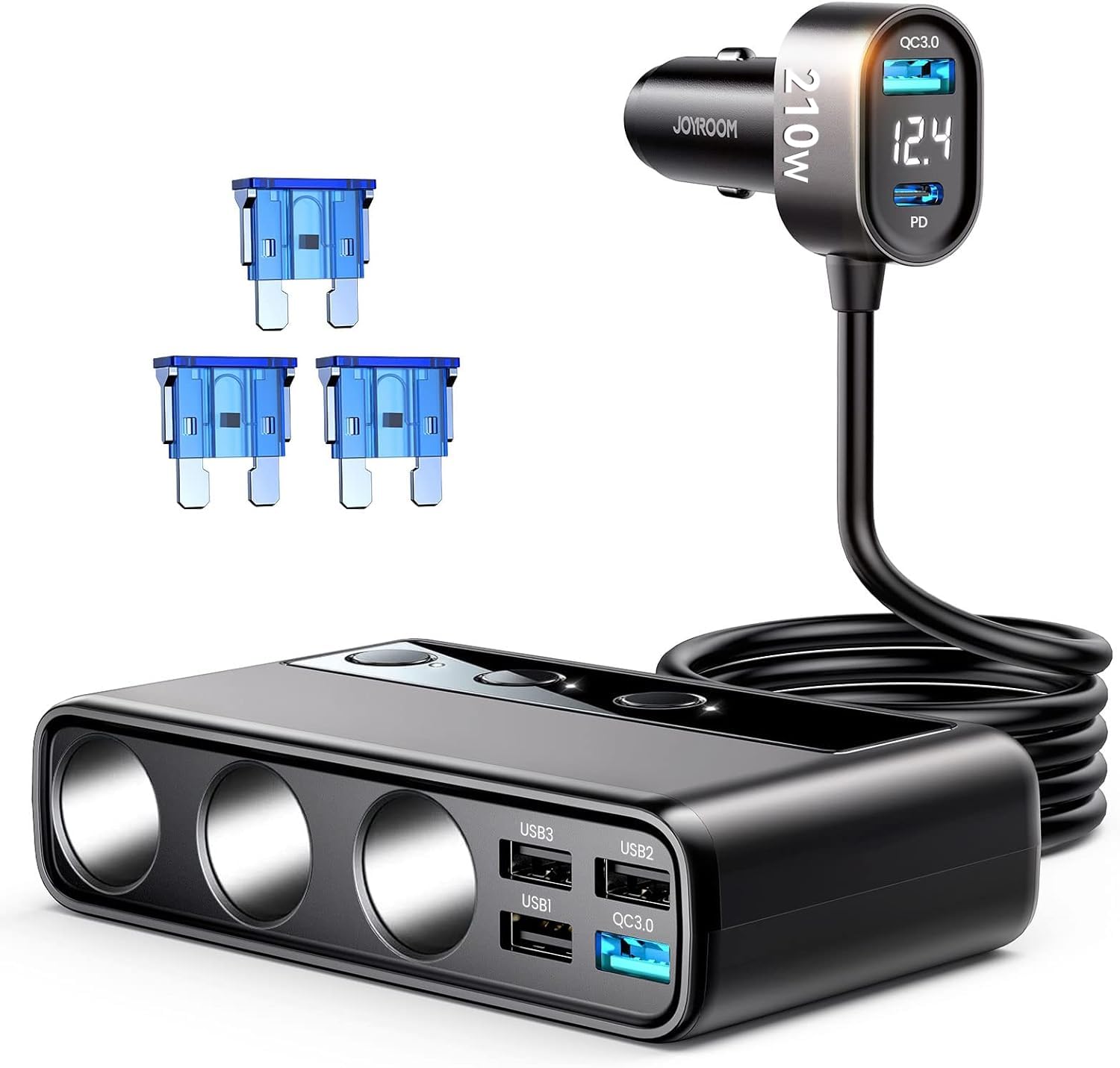
Best for maximum device count: JOYROOM 210W 9-in-1 Cigarette Lighter Adapter
Best for everyday single-device speed: Anker 323 52.5W USB C Car Charger
Best compact 4-port option: JUNVANG 90W 4-Port USB C Car Charger
Best budget power inverter: PiSFAU 200W Car Power Inverter
Best for rideshare and backseat passengers: OHLPRO 3-in-1 Headrest Charging Station
Best for families with kids in the back: AINOPE 108W 6-Port Car Charger
Best higher-wattage inverter for laptops: Vansoet 400W Car Power Inverter
Best for large households sharing one outlet: BESTEK 125W 6-Port Car Charger
Best ultra-compact retractable design: SUPERONE 105W 6-Port Retractable Charger
Best-selling retractable cable charger: LISEN 84W Retractable Car Charger
JOYROOM 210W 9-in-1 Cigarette Lighter Adapter

Drivers who need to power a whole dashboard’s worth of gear, from dash cams to a car fridge, will get the most out of this 9-port splitter.
Pros
- Nine total outputs across three cigarette lighter sockets and six USB ports
- Independent power switches reduce wear from constant plugging
- LED voltage display flags battery issues in real time
Cons
- Single socket output caps at 120W, so heavy devices share the total 210W pool
- Bulkier than simple single-port chargers
- Best suited for parked or slow-driving use given its size
This adapter works less like a phone charger and more like a power strip for the car. Three cigarette lighter sockets handle equipment like vacuum cleaners or heated seat accessories, while the QC3.0 and PD ports cover phones and tablets. The voltage display is a genuinely useful safety touch, warning drivers before a weak battery becomes a dead one. Total output tops at 210W, so running several high-draw devices at once will divide power rather than deliver full speed to each.
Anker 323 52.5W USB C Car Charger
This is the right pick for a driver who wants one fast, dependable charger for a phone and one passenger’s device without extra bulk.
Pros
- USB-C port delivers up to 30W with PowerIQ 3.0 for quick top-ups
- Small, low-profile housing that doesn’t crowd the outlet
- Combined USB-A and USB-C output supports two devices at once
Cons
- Only two ports total, limiting it for multi-device households
- No cigarette lighter passthrough for other accessories
- No voltage display or extra safety readouts
- Vehicle Charging Stations
At 52.5W combined output, this charger suits daily commuters more than families outfitting a whole vehicle. The USB-C PD port charges modern phones quickly, and ActiveShield 2.0 monitors temperature to protect connected devices. Its simplicity is the appeal: a snug fit in the socket, a clear charging indicator, and none of the extra sockets or switches that bigger stations carry. Anyone needing more than two ports should look further down this list.
JUNVANG 90W 4-Port USB C Car Charger
A compact middle ground between a two-port charger and a full six-port hub, this 90W unit fits drivers who carry two USB-C devices and two USB-A accessories regularly.
Pros
- Two USB-C and two USB-A ports cover mixed device types
- 90W combined output with PD and QC support for faster charging
- Metal housing helps dissipate heat during extended use
Cons
- Shared 45W max per port means full speed isn’t guaranteed on all four at once
- No cigarette lighter passthrough socket
- No LED display for voltage or diagnostics
This charger targets a family of four rather than a full vehicle’s electronics. The metal shell is a practical touch for heat management during long charging sessions, and the port mix means older USB-A cables and newer USB-C cables both get a home. Output is split dynamically, so plugging in four devices at once will slow individual charging speeds compared to using just one or two ports.
PiSFAU 200W Car Power Inverter
Anyone who needs an actual AC outlet in the car, not just USB power, should consider this compact inverter first.
Pros
- Converts 12V DC to 110V AC through two standard outlets
- Compact, phone-sized housing despite the inverter function
- Four USB ports supplement the AC outlets for smaller devices
Cons
- 200W ceiling limits it to smaller laptops and low-draw electronics
- Uses a modified sine wave, which isn’t ideal for all sensitive electronics
- Some buyers note the plug housing feels less durable than the rest of the unit
This inverter earns its place for anyone plugging in laptop chargers, small lights, or holiday string lights that need a real wall-style plug. Its small footprint is notable given that most inverters this capable are bulkier. The 200W limit is the tradeoff: it handles phones, tablets, and light laptop use, but larger appliances need a higher-wattage inverter like the option below.
OHLPRO 3-in-1 Headrest Charging Station
Rideshare drivers and anyone regularly hosting backseat passengers will find this headrest-mounted station solves a problem front-seat chargers can’t.
Pros
- Mounts directly to the headrest, putting charging within easy reach of back-seat riders
- Retractable cables in USB-C, Micro USB, and Lightning-style connectors cover most phones
- 360-degree rotation lets each cable angle toward its user
Cons
- Charging speeds are modest, topping out around 10W for tablets
- Requires running a cable from the front outlet to the headrest unit
- Not intended for fast-charging modern flagship phones at top speed
This is a specialty pick built for a specific use case: taxis, rideshare vehicles, and family cars where passengers charge from the back seat. The retractable cables keep things tidy compared to loose cords stuffed in a console, and the non-slip mount keeps it from sliding around. Charging speed is the compromise here. It’s built for convenience and reach, not for topping off a phone in ten minutes.
AINOPE 108W 6-Port Car Charger
Families on road trips with kids in the back seat will appreciate this six-port charger’s long cable and even device distribution.
Pros
- Six ports total, enough for a full SUV of passengers
- PD 36W and QC3.0 ports handle phones and tablets quickly
- Extended cable reaches from the front outlet to back-row seats
Cons
- 108W is shared across all six ports, so simultaneous full-speed charging isn’t realistic
- Bulkier housing due to the six-port design
- Best suited to vehicles with a front outlet near the center console
This charger is built around the reality of family road trips: multiple kids, multiple tablets, and constant arguing over who gets to charge next. The long cable is the standout feature, letting the unit reach back-seat riders instead of forcing everyone to lean forward. Total output is capped at 108W, so treating this as a way to fast-charge six devices simultaneously will disappoint. It’s built for steady, shared charging instead.
Vansoet 400W Car Power Inverter
Drivers who need more inverter capacity than a basic 200W unit, without stepping up to a full portable power station, will get more headroom from this 400W model.
Pros
- 400W continuous output, double the PiSFAU inverter above
- Independent AC switch lets USB charging continue without the AC side running
- Temperature-controlled cooling fan activates only when needed
Cons
- Larger and heavier than basic USB-only car chargers
- Modified sine wave output isn’t suited for all sensitive electronics
- Fan noise may be noticeable during heavier loads
This inverter is built for anyone running small appliances, mini fridges, or drones off a car battery for extended stretches. The dedicated AC switch is a smart inclusion, letting a driver kill the inverter side to save battery while still using the USB ports. Compared to the PiSFAU inverter, this one trades compactness for real headroom, useful for laptops and small kitchen gadgets that draw more than 200W.
BESTEK 125W 6-Port Car Charger
Large households or shared vehicles that need six charging ports without an inverter’s bulk will find this a straightforward, no-frills option.
Pros
- Three USB-C PD ports plus QC3.0 and standard USB cover most device types
- 125W combined output is competitive among multi-port chargers
- Smart chip auto-detects connected devices for appropriate charging speed
Cons
- No cigarette lighter passthrough for non-USB accessories
- Housing color scheme (white and blue) may not match every car’s interior
- No voltage display or diagnostic feedback
This charger is a solid fit for anyone who just wants six working ports without paying for an inverter or a retractable cable system. The smart chip does the heavy lifting of matching charge speed to each device automatically, so passengers don’t need to worry about plugging into the “right” port. It skips extras like AC outlets or voltage readouts, keeping the focus on straightforward USB charging.
SUPERONE 105W 6-Port Retractable Charger
Drivers with tight cigarette lighter sockets or older vehicles will appreciate how small this retractable charger is compared to typical multi-port hubs.
Pros
- Compact housing built for tight sockets in trucks and older cars
- Dual retractable USB-C cables reduce loose cords in the cabin
- Six total ports including USB-A for older accessories
Cons
- Not compatible with CarPlay or similar phone-mirroring features
- Combined 105W output is shared, limiting simultaneous full-speed charging
- Retractable cables only cover USB-C, not Lightning-style connectors
This charger solves a problem specific to older or smaller vehicles: bulky multi-port chargers that stick out too far from the socket. Shrinking the housing by a claimed 60% makes it easier to use in trucks and tight console setups. The dual retractable cables cut down on cord clutter, though buyers with older Lightning-cable phones will need a separate adapter since this unit is built around USB-C only.
LISEN 84W Retractable Car Charger
This widely used retractable charger balances cable convenience with dependable output, making it a safe default pick for most drivers.
Pros
- Two retractable cables, including USB-C and an older-style connector, extend up to 31.5 inches
- 84W combined output across four total ports
- 180-degree adjustable plug fits various socket angles
Cons
- Doesn’t support CarPlay, Bluetooth, or data transfer
- Not compatible with Micro-USB devices
- Some retraction requires a specific pull-and-release motion to reset
The extending cables are the reason this charger stands out. At just under three feet, they reach a passenger seat or center console without strain, and they retract cleanly when not in use. Output splits across a 45W PD USB-C port and additional connections, covering most phones without a hunt for the right cable. It’s a dependable, general-purpose pick for anyone who doesn’t need an inverter’s power or a six-port hub’s device count.
Buying Guide
Match Charging Output To What’s Actually Plugged In
Total wattage only tells part of the story. A charger rated 100W or higher usually splits that power across all its ports, so plugging in several devices at once means each gets a smaller share.
Check the per-port wattage, not just the headline number, especially for anyone charging tablets or laptops that need more power than a phone.
| Device Type | Typical Power Need |
|---|---|
| Smartphone (fast charge) | 18W-30W |
| Tablet | 20W-45W |
| Laptop | 45W-100W |
| Dash cam or GPS | 5W-12W |
Understand Connector Types Before Buying
USB-C PD (Power Delivery) charges newer phones and tablets faster than standard USB-A. QC3.0 (Quick Charge) is a similar fast-charging standard used mostly on Android devices. A charger with both covers the widest range of gear. Anyone with an older Lightning-cable iPhone should confirm the charger includes that connector or plans to use their own cable.
Decide Between A Multi-Port Hub And A Power Inverter
A multi-port USB charger works for phones, tablets, and small electronics. A power inverter converts the car’s DC power into AC, the kind of power a wall outlet provides, which is necessary for laptop chargers, small kitchen gadgets, or anything with a standard plug.
- Choose a multi-port hub for charging phones and tablets only.
- Choose an inverter for laptops, mini fridges, or anything with a three-prong plug.
- Check the inverter’s wattage rating against the device’s power draw before buying; a 200W inverter won’t run a device that needs 400W.
Consider Cable Reach And Mounting
Front-seat chargers plug directly into the console outlet, which limits reach for backseat passengers. Retractable cable models and headrest-mounted stations extend power to the back seat without loose cords across the cabin. Rideshare drivers and parents with kids in car seats benefit most from this style.
Look For Safety Features That Match Daily Use
Independent power switches reduce wear on multi-socket splitters by avoiding repeated plugging and unplugging. Voltage displays warn of a weak car battery before it causes starting problems. Built-in fuses and overcurrent protection guard against short circuits, which matters more in high-port-count chargers running multiple devices at once.
Check Vehicle Compatibility
Most car chargers work with standard 12V outlets found in cars and small SUVs. Trucks, RVs, and some commercial vehicles use 24V systems, and not every charger supports both. Confirm the voltage range listed for a charger before use in a 24V vehicle to avoid damage to the unit or connected devices.