
Best EV Chargers an electric vehicle at home comes down to one main choice: how fast do you need to charge, and what electrical setup can your home support? A standard wall outlet delivers Level 1 charging, adding only a few miles of range per hour. A Level 2 charger, which runs on a 240-volt circuit, can add 20 to 45 miles per hour depending on amperage and the vehicle’s onboard charger.
Home EV chargers fall into two main installation types. Plug-in models connect to an existing outlet, usually a NEMA 14-50, the same type used for RVs and electric ranges. Hardwired units connect directly to your electrical panel through a dedicated circuit, which usually requires an electrician but can support higher amperage. Connector type matters too: J1772 works with nearly every EV sold in North America except Tesla, which uses its own NACS plug (though Tesla owners can use a J1772 adapter, and non-Tesla drivers increasingly have NACS options as automakers adopt the standard).
The right charger depends on your circuit’s amperage, your vehicle’s charging capacity, and whether you want a permanent hardwired install or the flexibility of a plug-in unit. Weather resistance matters for garage or driveway installs, and Wi-Fi features add scheduling and monitoring but aren’t essential for basic charging. The models below cover a range of amperages, connector types, and installation styles to match different homes and driving habits.
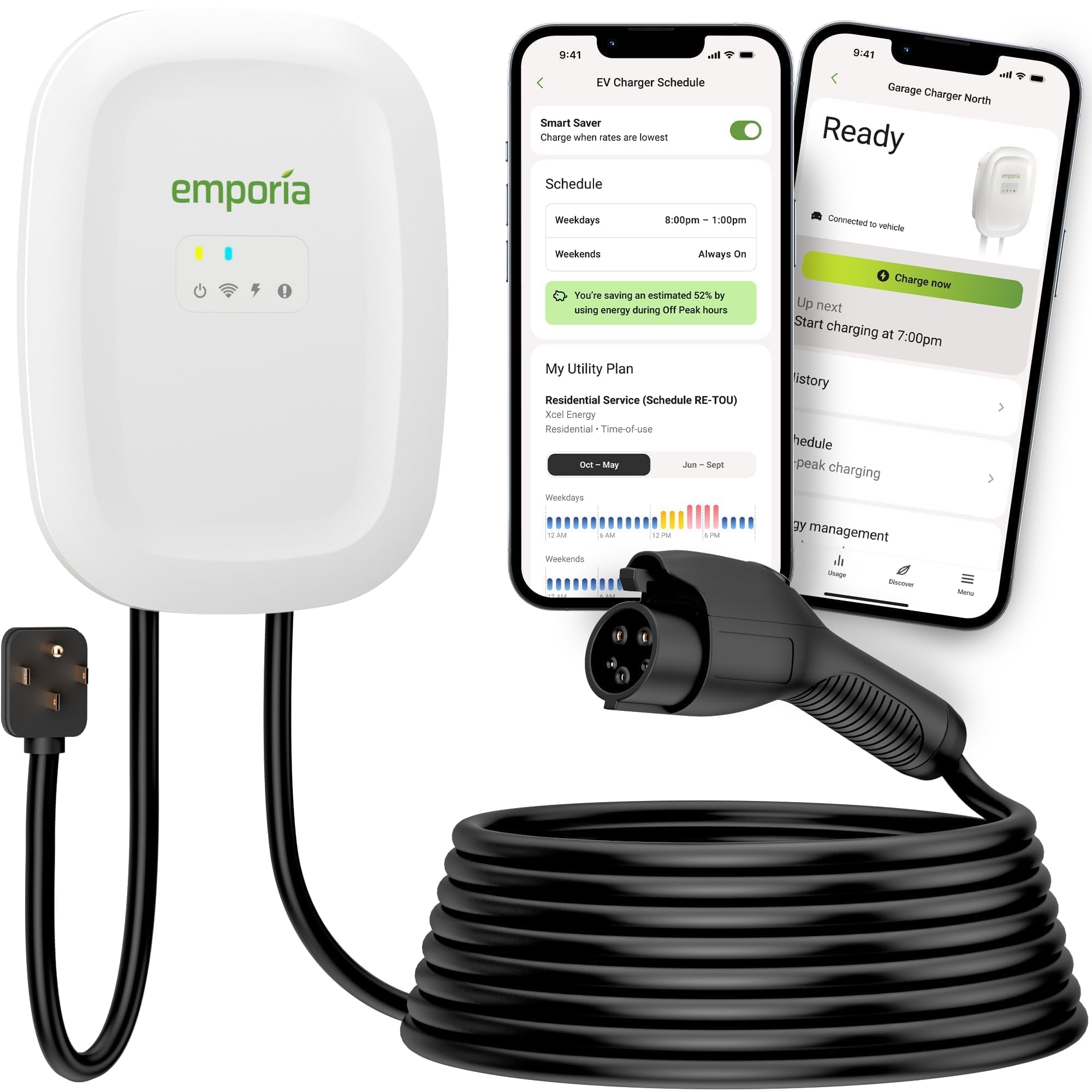
Best overall value: EMPORIA Level 2 EV Charger, 48 Amp, NEMA 14-50
Best budget-friendly plug-in: Grizzl-E Classic, 40A NEMA 14-50
Best for weatherproof outdoor installs: EVIQO Level 2 EV Charger, 40A NEMA 14-50
Best for a large charging network: ChargePoint HomeFlex, Hardwired 50A
Best for Tesla owners: EMPORIA Level 2 EV Charger w/NACS, Hardwired
Best premium hardwired option: Autel Home Smart EV Charger, 50Amp
Best for adjustable amperage control: EVDANCE Level 2 EV Charger, 40Amp Portable
Best for standard home outlets: EVDANCE Level 1&2 EV Charger, 16A
Best for touchscreen control: AIMILER Level 2 EV Charger, 32A
Best for travel and portability: DEWALT Level 1 & 2 Portable EV Charger, 16 Amps
EMPORIA Level 2 EV Charger, 48 Amp, NEMA 14-50

This charger suits shoppers who want flexibility between plug-in and hardwired setups without sacrificing top-tier amperage.
Read more: Best EV Chargers
Pros
- Works as a NEMA 14-50 plug-in (40A) or hardwired unit (48A)
- Long 25-foot cable reaches most garages and driveways
- Wi-Fi app supports scheduling and real-time energy tracking
Cons
- Hardwiring requires professional installation for full 48A output
- App relies on 2.4GHz Wi-Fi only, no Bluetooth backup
- Outdoor durability details are less documented than some competitors
The dual installation option is the standout feature here. Owners can start with the NEMA 14-50 plug on a 40-amp circuit, then convert to hardwired later for the full 48-amp rate if their panel supports it. That flexibility makes it a practical pick for anyone unsure which setup fits their home. J1772 compatibility covers nearly every non-Tesla EV, and UL listing plus Energy Star certification confirm it meets recognized safety standards. The 3-year warranty adds confidence for a long-term home installation.
Grizzl-E Classic, 40A NEMA 14-50
This charger fits shoppers who want a rugged, no-frills unit without a smartphone app.
Pros
- Adjustable amperage (16A, 24A, 32A, 40A) matches different circuit breakers
- Metal case and IP67 rating suit outdoor and cold-weather use
- Built-in GFCI and multiple protections for electrical safety
Cons
- No Wi-Fi or app control for scheduling or monitoring
- 24-foot cable is shorter than several competitors
- Amperage adjustment requires manual settings, not remote control
The Grizzl-E Classic focuses on durability over smart features. Its metal enclosure and IP67 water resistance make it a solid choice for a detached garage or an outdoor wall mount exposed to weather. The adjustable amperage settings let one charger work across different circuit breaker sizes, from 20A to 50A, which is useful if a home’s electrical setup changes down the line. Skipping the app keeps things simple for owners who just want reliable charging without extra software to manage.
EVIQO Level 2 EV Charger, 40A NEMA 14-50
This charger works well for households that need a weatherproof plug-in unit with strong Wi-Fi range.
Pros
- IP66/NEMA 4 sealed housing withstands rain, snow, and dust
- Stronger antenna design helps maintain Wi-Fi connection in garages
- Adjustable charging speed from 6A to 40A through the app
Cons
- Plug-in only design; no hardwired option listed
- Requires a dedicated 50A circuit for full 40A output
- Newer product with a shorter track record than established brands
EVIQO built this charger around outdoor reliability and connectivity. The sealed IP66 housing and internal steel shielding target homes where the charger sits outside or in an unheated garage. A stronger built-in antenna addresses a common complaint with smart chargers: losing Wi-Fi signal in a metal-heavy garage environment. The NEMA 14-50 plug requires a 50-amp dedicated circuit, and the glow-in-the-dark connector holster is a small but practical touch for nighttime plugging.
ChargePoint HomeFlex, Hardwired 50A
This charger appeals to drivers who want a well-known charging network name alongside home installation.
Pros
- Adjustable output from 16A to 50A fits multiple circuit sizes
- Backed by a large public charging network for app familiarity
- UL-certified with a cold-resistant cable for outdoor use
Cons
- Requires hardwiring by a licensed electrician
- Some owners report app connectivity issues after firmware updates
- Rated slightly lower on average than several competitors here
ChargePoint’s home unit pairs a hardwired 50-amp charger with the same app used across its public charging network. That familiarity can be useful for drivers who already use ChargePoint stations while traveling. The adjustable amperage setting (16A to 50A) means one unit can match different home circuits, from a 20A breaker up to an 80A one. Hardwiring is required, so factor in electrician costs when budgeting for this option.
EMPORIA Level 2 EV Charger w/NACS, Hardwired
This charger is built specifically for Tesla owners who want a NACS connector without an adapter.
Pros
- Native NACS connector works directly with Tesla vehicles
- Can remotely open a Tesla’s charging port door from the app
- 48-amp hardwired output matches Emporia’s top-tier J1772 model
Cons
- Hardwired installation only, no plug-in option
- Not compatible with J1772 vehicles without a separate adapter
- Smaller number of buyer reviews compared to the J1772 version
Tesla owners who want to skip the J1772-to-NACS adapter dance will find this charger convenient. It replicates the Tesla wall connector experience, including automatic charge port door opening, while carrying UL listing and Energy Star certification. The 24-foot cable is slightly shorter than Emporia’s J1772 model, and the hardwired-only design means installation costs should factor into the decision. For single-Tesla households, it simplifies daily charging.
Autel Home Smart EV Charger, 50Amp
This charger suits shoppers who want a NEMA 4X-rated enclosure with both Wi-Fi and Bluetooth connectivity.
Pros
- NEMA 4X rating adds strong protection against dust, ice, and rain
- Cold-rated cable stays flexible down to -40 degrees
- Supports Wi-Fi, Bluetooth, and Ethernet for connection flexibility
Cons
- Hardwired installation required, adding setup cost
- Larger and heavier than several plug-in alternatives
- Rated slightly lower on average than some higher-rated picks
Autel’s charger targets colder climates and harsher outdoor conditions. The NEMA 4X enclosure rating goes a step beyond standard weatherproofing, and the cable stays pliable in extreme cold, a detail that matters for anyone in a northern climate charging outside through winter. Triple connectivity options (Wi-Fi, Bluetooth, Ethernet) give installers more ways to keep the unit online. The 12kW output supports up to 50A, useful for larger battery EVs that can accept faster charging.
EVDANCE Level 2 EV Charger, 40Amp Portable
This charger works for drivers who want manual control over charging speed without relying on an app.
Pros
- Adjustable current from 10A to 40A via physical button
- Built-in TFT display shows live charging stats
- Delay-start timer helps shift charging to off-peak hours
Cons
- No Wi-Fi connectivity for remote control or monitoring
- Some owners report the unit defaulting below the max 40A setting
- Newer brand with a smaller review history
The EVDANCE 40-amp charger puts charging control on the unit itself rather than in an app. A 2.4-inch screen displays voltage, current, and charging time directly, which some owners prefer over phone-based monitoring. Adjustable amperage settings (10A to 40A) let it match different circuit sizes, and the delay-start feature shifts charging to cheaper overnight electricity rates. It requires a NEMA 14-50 outlet and works with any J1772 vehicle, with Tesla owners needing a separate adapter.
EVDANCE Level 1&2 EV Charger, 16A
This charger fits renters or owners without access to a dedicated high-amperage circuit.
Pros
- Works with both standard 120V and 240V NEMA 6-20 outlets
- Compact and portable with an included carry bag
- Lower cost entry point into Level 2 charging speeds
Cons
- Maximum 16A output is slower than most other Level 2 chargers here
- Not compatible with NEMA 14-50, 14-30, or 6-50 outlets directly
- Only a 1-year warranty, shorter than several competitors
This EVDANCE model bridges Level 1 and Level 2 charging without requiring a dedicated high-amperage circuit. Plugged into a standard 120V outlet, it charges slowly like a typical wall outlet. Switched to a 240V NEMA 6-20 outlet, it reaches 16A, faster than Level 1 but well below the 40A or 48A chargers on this list. It suits drivers with modest daily mileage or those in apartments with limited electrical access.
AIMILER Level 2 EV Charger, 32A
This charger suits drivers who want touchscreen control plus app scheduling in one plug-in unit.
Pros
- Touch-button LED display shows amperage, speed, and delay settings
- Built-in leakage protection removes the need for an extra GFCI breaker
- App and manual controls both work, offering backup flexibility
Cons
- Maximum 32A output is lower than several 40A and 48A competitors
- Setup requires specific button sequences that can confuse new users
- NEMA 4 rating is good but below the 4X rating of some rivals
AIMILER’s charger stands out for offering two ways to start a charge: plug in and go, or use the app for scheduling and monitoring. The touchscreen display shows live charging data, and adjustable amperage (16A to 32A) matches different circuit sizes. Built-in leakage protection means the NEMA 14-50 outlet doesn’t need a separate GFCI breaker, simplifying installation. The 32A ceiling is lower than several other picks, worth noting for owners who want the fastest possible home charging.
DEWALT Level 1 & 2 Portable EV Charger, 16 Amps
This charger fits drivers who want a trusted tool brand name and simple portable charging without installation.
Pros
- No hardwiring or tools needed; plugs directly into compatible outlets
- IP66 waterproof rating supports indoor and outdoor use
- Travel bag and rugged cage design suit on-the-go charging
Cons
- Maximum 16A output is the slowest Level 2 speed in this roundup
- Lower average customer rating than most competitors listed
- Included adapter only covers NEMA 5-15, not 14-50 or 14-30
DEWALT’s entry brings brand recognition to the portable charger space. It plugs into a NEMA 6-20 outlet for 16A charging or steps down to a standard 120V outlet with the included adapter. The protective cage and anti-slip handle reflect the brand’s tool-industry design background. Charging speed tops out lower than most dedicated Level 2 units here, making it better suited for backup or travel use than as a primary home charger for daily long-distance driving.
Buying Guide
Understand Amperage and Circuit Capacity
A charger’s amperage rating determines how fast it delivers electricity, but the home’s electrical circuit sets the real limit. A 48-amp charger plugged into a 40-amp circuit only delivers 40 amps. Check the electrical panel’s available capacity, or have an electrician confirm it, before assuming a higher-amp charger will perform at its advertised speed.
| Amperage | Approx. Range Added Per Hour | Common Circuit Size |
|---|---|---|
| 16A | 10-12 miles | 20A |
| 24A | 15-18 miles | 30A |
| 32A | 22-25 miles | 40A |
| 40A | 28-30 miles | 50A |
| 48A | Up to 46 miles | 60A |
Plug-In vs. Hardwired Installation
Plug-in chargers connect to an existing outlet, most often a NEMA 14-50, and can be moved or replaced without an electrician. Hardwired chargers connect directly to the breaker panel, which usually needs professional installation but often supports higher amperage and a cleaner look. Renters and anyone wanting flexibility tend to prefer plug-in models; owners planning a permanent setup lean toward hardwired units.
Connector Type: J1772 vs. NACS
J1772 is the standard connector for nearly all non-Tesla EVs sold in North America. NACS is Tesla’s connector, now being adopted by other automakers. Tesla owners can use a J1772 charger with the adapter included with their vehicle, while non-Tesla drivers need a NACS-specific charger or adapter if they want to skip that step.
Weatherproofing and Enclosure Ratings
Chargers installed outdoors need a rating like IP66, NEMA 4, or NEMA 4X to resist rain, snow, and dust. Indoor garage installations have more flexibility, but temperature swings still affect cable flexibility in cold climates. Check the enclosure rating against the planned mounting location before buying.
Smart Features and Wi-Fi
App connectivity allows scheduling charging during off-peak electricity hours and tracking energy use over time. These features add convenience but aren’t required for basic charging function. A charger without Wi-Fi still charges a vehicle reliably; the app simply adds monitoring and scheduling on top.
Cable Length and Cord Management
Cable lengths in this category commonly range from 24 to 25 feet. Measure the distance from the planned mounting spot to where the vehicle parks, accounting for the charging port location on the car, before assuming a longer cable is automatically better for a given garage layout.